
Advanced Certificate in Building Predictive Models with Python
Master Python for building predictive models, enhancing data analysis skills and boosting career prospects in data science.
Advanced Certificate in Building Predictive Models with Python
Programme Overview
The 'Advanced Certificate in Building Predictive Models with Python' is a comprehensive programme designed for professionals and aspiring data scientists seeking to enhance their predictive analytics capabilities using Python. This programme covers the latest methodologies in machine learning and statistical modeling, including regression, classification, clustering, and time-series analysis, all implemented through Python's robust libraries such as NumPy, Pandas, Scikit-learn, and TensorFlow. It is ideal for data analysts, IT professionals, and business intelligence experts looking to transition into advanced predictive analytics roles or those aiming to bolster their existing data science toolkit.
Participants will develop a deep understanding of the theoretical underpinnings of predictive modeling and gain practical expertise in Python programming for data manipulation, model development, and evaluation. Key skills include feature engineering, model selection, hyperparameter tuning, and the deployment of predictive models in real-world scenarios. Additionally, learners will master the use of Python for data visualization, which is crucial for communicating insights effectively to stakeholders.
This programme significantly impacts career growth by equipping learners with the skills necessary to tackle complex predictive modeling challenges across various industries, including finance, healthcare, marketing, and technology. Graduates will be well-prepared to lead predictive analytics projects, develop predictive models to drive strategic decision-making, and advance to higher-level data science roles.
What You'll Learn
Embark on a transformative journey with our 'Advanced Certificate in Building Predictive Models with Python,' designed to equip you with the skills needed to excel in the realm of data science and machine learning. This comprehensive program delves into the core aspects of predictive modeling, including data preprocessing, feature engineering, and the application of advanced algorithms like decision trees, random forests, and neural networks. You will master the use of Python, a language renowned for its versatility and power in data analysis and machine learning.
Through hands-on projects and real-world case studies, you will apply your knowledge to build robust predictive models, enhancing decision-making processes in various industries. Whether you are a data analyst seeking to advance your career or a professional looking to integrate predictive analytics into your work, this certificate will provide you with the practical skills needed to succeed. Graduates can expect to secure roles such as data scientist, predictive modeler, or machine learning engineer, contributing to innovative solutions that drive business growth and operational efficiency.
Join us and become a part of a community of professionals who are at the forefront of predictive analytics, ready to leverage data to unlock new opportunities and insights.
Programme Highlights
Industry-Aligned Curriculum
Developed with industry leaders for job-ready skills valued by employers worldwide.
Globally Recognised Certificate
Recognised by employers across 180+ countries as a mark of professional excellence.
Flexible Online Learning
Study at your own pace with lifetime access to all course materials and updates.
Instant Access
Start learning immediately — no application process or waiting period required.
Constantly Updated Content
Stay ahead with the latest industry trends, best practices, and emerging insights.
Career Advancement
87% of graduates report measurable career progression within 6 months of completion.
Topics Covered
- 1. Introduction to Predictive Modeling: Learners will understand the basics of predictive modeling, including types of models, model evaluation, and common algorithms. They will gain the foundational knowledge necessary to build simple predictive models.
- 2. Data Preprocessing and Feature Engineering: This module covers techniques for cleaning and transforming data to improve model performance. Learners will learn how to handle missing values, outliers, and categorical data, and they will practice feature scaling and selection.
- 3. Regression Models: Learners will explore linear and non-linear regression models, including multiple linear regression, polynomial regression, and ridge regression. Practical skills include model fitting, evaluation, and interpretation of results.
- 4. Classification Models: This module focuses on classification techniques, including logistic regression, decision trees, and random forests. Learners will learn how to build, evaluate, and optimize classification models for various applications.
- 5. Ensemble Methods: Learners will study ensemble methods such as bagging, boosting, and stacking. They will understand how these methods can improve model performance and apply them to real-world datasets.
- 6. Model Evaluation and Validation: This module covers various techniques for evaluating and validating predictive models, including cross-validation, confusion matrices, and ROC curves. Practical skills include diagnosing model errors and improving model accuracy.
- 7. Time Series Forecasting: Learners will learn about time series analysis and forecasting techniques, including ARIMA, seasonal decomposition, and state-space models. They will apply these techniques to analyze and predict future trends in time series data.
- 8. Advanced Techniques in Python: This module delves into advanced Python libraries and tools for predictive modeling, such as scikit-learn, TensorFlow, and XGBoost. Learners will gain hands-on experience with these tools to build and deploy complex models.
- 9. Model Deployment and Integration: Learners will learn how to deploy predictive models in production environments, including using cloud services and containerization. They will also explore methods for integrating models into existing systems and workflows.
- 10. Case Studies and Project Work: In this final module, learners will work on comprehensive case studies and a capstone project, applying the knowledge and skills acquired throughout the program to real-world problems. They will refine their ability to design, implement, and evaluate predictive models in diverse scenarios.
What You Get When You Enroll
Secure checkout • Instant access • Certificate included
Key Facts
Audience: Data science enthusiasts, IT professionals
Prerequisites: Basic Python, statistics knowledge
Outcomes: Build predictive models, use machine learning libraries
Ready to get started?
Join thousands of professionals who already took the next step. Enroll now and get instant access.
Enroll Now — $149Why This Course
Enhanced Skill Set: Acquiring the 'Advanced Certificate in Building Predictive Models with Python' significantly expands your skill set. Python, being a versatile programming language, is widely used in data analysis and machine learning. The certificate equips you with advanced knowledge in building, optimizing, and validating predictive models, making you a valuable asset in the data science field.
Career Advancement: With this certification, professionals can pursue specialized roles such as data scientists, machine learning engineers, or predictive modelers. The demand for professionals skilled in predictive modeling is high, and this certificate can help you stand out in the job market. According to Glassdoor, data scientists with Python skills earn an average of $,per year, reflecting the premium placed on these skills.
Practical Application: The program includes hands-on projects that simulate real-world scenarios. Participants learn to apply predictive modeling techniques to solve complex problems, which are directly transferable to the workplace. This practical experience is crucial for professionals looking to implement predictive models in their current or future roles, thereby enhancing their problem-solving capabilities and decision-making processes.
Continuous Learning: The field of data science and machine learning is rapidly evolving. This certificate not only covers current methodologies but also encourages continuous learning through access to the latest resources and updates. This ongoing education keeps professionals like data analysts and statisticians at the forefront of industry trends, ensuring they remain relevant and competitive in the job market.
Your Path to Certification
Trusted by Professionals Worldwide
Course Brochure
Download our comprehensive course brochure with all details
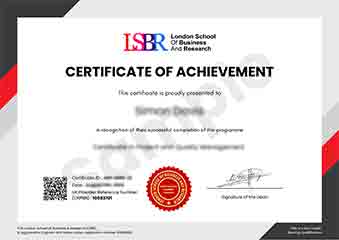
Sample Certificate
Preview the certificate you'll receive upon successful completion of this program.
Get Free Course Info
Enter your details and we'll send you a comprehensive course information pack straight to your inbox.
Employer Sponsored Training
Let your employer invest in your professional development. Request a corporate invoice and get your training funded.
Request Corporate InvoiceWhat People Say About Us
Hear from our students about their experience with the Advanced Certificate in Building Predictive Models with Python at LSBRX - Executive Education.
Oliver Davies
United Kingdom"The course content is incredibly thorough and well-structured, providing a solid foundation in building predictive models with Python. I've gained practical skills that have directly enhanced my ability to analyze data and make informed predictions, which is incredibly beneficial for my career in data science."
Arjun Patel
India"The Advanced Certificate in Building Predictive Models with Python has been a game-changer for my career. Not only did it deepen my understanding of predictive analytics, but it also provided me with practical tools and techniques that I immediately applied to real-world projects, enhancing my value in the job market."
Sophie Brown
United Kingdom"The course's structured progression from foundational concepts to advanced techniques in predictive modeling provided a solid base for applying Python in real-world scenarios, significantly enhancing my professional skills."