
Advanced Certificate in Data Normalization and Standardization Methods
Elevate data management skills with this certificate, mastering normalization and standardization techniques for enhanced data quality and analysis.
Advanced Certificate in Data Normalization and Standardization Methods
Programme Overview
The Advanced Certificate in Data Normalization and Standardization Methods is an intensive, month programme designed for professionals and students aiming to master the techniques necessary for transforming and aligning data to enhance its utility and analytical capabilities. This programme is ideal for data scientists, data engineers, business analysts, and anyone involved in data management and analysis who seeks to improve the quality and consistency of their data.
Participants will develop a comprehensive understanding of various data normalization and standardization methods, including normalization techniques such as min-max scaling, Z-score normalization, and log normalization, and standardization methods like one-hot encoding, standard scaling, and normalization based on distribution. They will learn to apply these techniques effectively to real-world datasets, ensuring data is cleaned, consistent, and ready for advanced analytics. The programme also covers the importance of data quality, the role of data normalization in machine learning, and the ethical considerations in data handling.
Upon completion, learners will be well-equipped to pursue advanced roles in data science and analytics, such as data architect, chief data officer, or data scientist, where they can leverage their skills to drive data-driven decision-making in their organizations. The programme’s focus on practical application and industry-relevant projects will prepare graduates to tackle complex data challenges and contribute to the development of robust data strategies.
What You'll Learn
The Advanced Certificate in Data Normalization and Standardization Methods offers a comprehensive and cutting-edge curriculum designed to equip professionals with the skills necessary to transform raw data into actionable insights. This program is particularly valuable for individuals seeking to enhance their data analytics capabilities, particularly in industries like finance, healthcare, and technology, where accurate data management is crucial.
Key topics include the principles of data normalization, standardization techniques, and advanced statistical methods. Students will delve into practical applications such as data cleaning, feature scaling, and the use of machine learning algorithms to optimize data sets. The program also covers the latest tools and software, including Python and R, ensuring graduates are proficient in the latest industry standards.
Upon completion, participants will be able to apply these skills to real-world scenarios, improving data quality and enabling more accurate predictive analytics. Graduates can pursue careers as data analysts, data scientists, or data engineers, where they can leverage their expertise to drive strategic decision-making.
This certificate program is ideal for professionals looking to advance their career in data science or those already in roles that require a deeper understanding of data normalization and standardization. By the end of the program, learners will have a robust skill set that not only enhances their professional capabilities but also prepares them for the evolving demands of the data-driven world.
Programme Highlights
Industry-Aligned Curriculum
Developed with industry leaders for job-ready skills valued by employers worldwide.
Globally Recognised Certificate
Recognised by employers across 180+ countries as a mark of professional excellence.
Flexible Online Learning
Study at your own pace with lifetime access to all course materials and updates.
Instant Access
Start learning immediately — no application process or waiting period required.
Constantly Updated Content
Stay ahead with the latest industry trends, best practices, and emerging insights.
Career Advancement
87% of graduates report measurable career progression within 6 months of completion.
Topics Covered
- 1. Introduction to Data Normalization and Standardization: Learners will understand the basics of data normalization and standardization, including the importance of these techniques in data preprocessing. They will gain foundational skills in recognizing and identifying data issues that require normalization and standardization.
- 2. Mathematical Foundations of Data Normalization: This module covers the mathematical concepts and techniques underlying data normalization, such as min-max scaling, z-score normalization, and decimal scaling. Learners will develop the ability to apply these techniques to real-world data sets.
- 3. Data Standardization Techniques: Learners will explore various standardization methods, including z-score, robust scaling, and vector normalization. They will learn how to choose the most appropriate standardization method for different types of data and scenarios.
- 4. Advanced Data Normalization Methods: This module delves into advanced normalization techniques such as log transformation, square root transformation, and Box-Cox transformation. Learners will understand the rationale behind these methods and how to implement them effectively.
- 5. Handling Categorical Data: Learners will study methods for normalizing and standardizing categorical data, including one-hot encoding and label encoding. They will gain practical skills in preprocessing categorical variables for analysis.
- 6. Data Normalization in Machine Learning: This module focuses on the role of normalization in machine learning models, including its impact on model performance and the importance of preprocessing data. Learners will apply normalization techniques to machine learning tasks.
- 7. Standardization for Big Data: Learners will learn how to apply standardization techniques to large datasets efficiently, including distributed computing frameworks and big data tools. They will understand the challenges and best practices for standardizing big data.
- 8. Evaluation Metrics for Normalized Data: This module covers the evaluation of data normalization and standardization methods. Learners will learn how to assess the effectiveness of normalization techniques and choose the most suitable methods for specific data sets.
- 9. Real-World Case Studies in Data Normalization: Through case studies, learners will apply their knowledge to real-world scenarios, gaining experience in tackling complex data normalization challenges. They will work on projects that involve large, diverse data sets.
- 10. Advanced Topics in Data Standardization: This module explores cutting-edge topics in data standardization, such as deep learning-based normalization and adaptive standardization techniques. Learners will stay updated with the latest advancements in the field.
What You Get When You Enroll
Secure checkout • Instant access • Certificate included
Key Facts
Audience: Data analysts, engineers
Prerequisites: Basic statistics knowledge
Outcomes: Master normalization techniques, standardize data effectively
Ready to get started?
Join thousands of professionals who already took the next step. Enroll now and get instant access.
Enroll Now — $149Why This Course
Enhances Data Quality: The Advanced Certificate in Data Normalization and Standardization Methods equips professionals with the skills to ensure data quality. This is crucial as poor data quality can lead to inaccurate insights and decisions. By learning normalization and standardization techniques, professionals can clean and organize data, ensuring it is consistent and reliable for analysis.
Improves Data Analysis Capabilities: Understanding and applying data normalization and standardization methods improves the efficiency and accuracy of data analysis. This is particularly beneficial in fields like data science, where clean, well-structured data is essential for robust predictive models and insightful analytics.
Boosts Job Competitiveness: Gaining this certification can significantly boost a professional’s job prospects. Many organizations seek individuals who can handle large datasets effectively and ensure data integrity. The certificate demonstrates a commitment to mastering advanced data management skills, making candidates more attractive to employers.
Facilitates Interoperability: In a world where data is increasingly shared across different platforms and systems, the ability to normalize and standardize data is crucial. This skill set ensures that data from various sources can be seamlessly integrated and analyzed, enhancing collaboration and operational efficiency within and between organizations.
Your Path to Certification
Trusted by Professionals Worldwide
Course Brochure
Download our comprehensive course brochure with all details
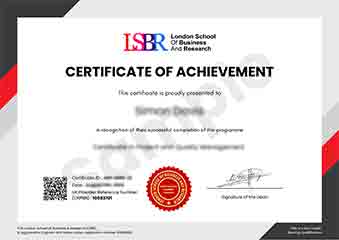
Sample Certificate
Preview the certificate you'll receive upon successful completion of this program.
Get Free Course Info
Enter your details and we'll send you a comprehensive course information pack straight to your inbox.
Employer Sponsored Training
Let your employer invest in your professional development. Request a corporate invoice and get your training funded.
Request Corporate InvoiceWhat People Say About Us
Hear from our students about their experience with the Advanced Certificate in Data Normalization and Standardization Methods at LSBRX - Executive Education.
Charlotte Williams
United Kingdom"The course content is incredibly thorough, covering advanced normalization and standardization techniques that have significantly enhanced my ability to handle complex data sets. Gaining these skills has opened up new opportunities in my field, making me more competitive and capable in data analysis tasks."
Ruby McKenzie
Australia"This course has been incredibly valuable, equipping me with advanced techniques in data normalization and standardization that are directly applicable in my field. It has not only enhanced my analytical skills but also opened up new opportunities for career advancement in data management roles."
Siti Abdullah
Malaysia"The course structure is well-organized, providing a clear progression from basic concepts to advanced techniques in data normalization and standardization, which has significantly enhanced my ability to handle complex data sets in real-world scenarios."