
Advanced Certificate in Latent Variable Analysis Techniques
Elevate skills in analyzing complex data with latent variable techniques, enhancing statistical modeling and research outcomes.
Advanced Certificate in Latent Variable Analysis Techniques
Programme Overview
The Advanced Certificate in Latent Variable Analysis Techniques is designed for professionals in psychology, education, social sciences, market research, and healthcare who require a deep understanding of advanced statistical methods to analyze complex data sets. This program covers a wide range of techniques, including confirmatory factor analysis, structural equation modeling, item response theory, and latent class analysis, providing learners with the tools to uncover hidden variables and relationships in their data. Participants will gain proficiency in using specialized software such as Mplus, R, and SPSS, enhancing their ability to conduct sophisticated analyses and interpret results accurately.
Key skills and knowledge developed through this program include the ability to design rigorous research studies, apply advanced statistical models to real-world data, interpret complex outputs from statistical software, and effectively communicate findings to both technical and non-technical audiences. Learners will also enhance their understanding of model fit assessment, parameter estimation, and model specification, enabling them to make informed decisions in their field of study.
The program has a significant impact on career advancement by equipping professionals with cutting-edge analytical skills and a robust theoretical foundation in latent variable analysis. Graduates are well-prepared to lead research projects, develop innovative statistical methods, and contribute to evidence-based decision-making in their organizations. This certificate opens doors to leadership roles in research, academia, and industry, where advanced analytical skills are highly valued.
What You'll Learn
Delve into the sophisticated world of data analysis with our Advanced Certificate in Latent Variable Analysis Techniques. This program equips professionals with advanced skills in identifying and analyzing latent variables—unobserved constructs that influence observed variables. Through a comprehensive curriculum, participants will master key techniques such as Confirmatory Factor Analysis, Structural Equation Modeling, and Item Response Theory, using real-world datasets and software tools like Mplus and R.
By the end of the program, graduates will be adept at uncovering hidden patterns and relationships in complex data sets. These skills are invaluable in fields ranging from psychology and education to marketing and public health, where understanding underlying constructs is crucial. Participants will learn to design robust studies, interpret complex models, and communicate findings effectively.
Career opportunities for program graduates are diverse and promising. They can work as data analysts, psychometricians, or research scientists in academia, government agencies, or private sector organizations. The program also prepares participants for advanced roles in market research, educational assessment, and health services, where the ability to analyze and interpret latent variables is highly sought after. Join us to unlock new dimensions in your analytical capabilities and advance your professional impact.
Programme Highlights
Industry-Aligned Curriculum
Developed with industry leaders for job-ready skills valued by employers worldwide.
Globally Recognised Certificate
Recognised by employers across 180+ countries as a mark of professional excellence.
Flexible Online Learning
Study at your own pace with lifetime access to all course materials and updates.
Instant Access
Start learning immediately — no application process or waiting period required.
Constantly Updated Content
Stay ahead with the latest industry trends, best practices, and emerging insights.
Career Advancement
87% of graduates report measurable career progression within 6 months of completion.
Topics Covered
- 1. Introduction to Latent Variable Models: Learners will study the fundamental concepts of latent variable models, including their theoretical underpinnings and practical applications. This module will equip participants with the foundational knowledge necessary to understand and apply these models effectively.
- 2. Confirmatory Factor Analysis: In this module, learners will explore confirmatory factor analysis (CFA) techniques, learning how to model complex relationships between observed and latent variables. Practical skills include model specification, estimation, and validation.
- 3. Structural Equation Modeling: This module covers structural equation modeling (SEM), allowing learners to integrate measurement and structural models within a single framework. Practical skills include model specification, fitting, and interpretation of SEM results.
- 4. Latent Growth Modeling: Learners will study latent growth modeling, focusing on analyzing changes over time in latent variables. Practical skills include specifying growth models, assessing model fit, and interpreting growth trajectory patterns.
- 5. Latent Class Analysis: This module introduces latent class analysis (LCA), enabling learners to identify unobserved subgroups within a population based on categorical indicators. Practical skills include model specification, estimation, and interpretation of results.
- 6. Mixture Modeling: In this advanced module, learners will explore mixture modeling techniques, including latent class analysis and latent profile analysis. Practical skills include specifying and estimating mixture models, evaluating model fit, and interpreting results.
- 7. Factor Analysis of Mixed Data: Learners will study factor analysis techniques for mixed data types, including continuous and categorical variables. Practical skills include model specification, estimation, and interpretation of mixed data factor analysis results.
- 8. Multilevel Latent Variable Modeling: This module covers multilevel latent variable modeling, allowing learners to analyze nested data structures. Practical skills include specifying and estimating multilevel models, assessing model fit, and interpreting results.
- 9. Advanced SEM with Latent Variables: In this advanced module, learners will delve into more complex structural equation modeling techniques, including model modification, multiple group analysis, and latent variable interactions. Practical skills include advanced model specification, estimation, and interpretation.
- 10. Practical Applications and Case Studies: The final module provides learners with practical experience through case studies and real-world applications of latent variable analysis techniques. Practical skills include applying learned techniques to solve practical problems and communicating findings effectively.
What You Get When You Enroll
Secure checkout • Instant access • Certificate included
Key Facts
Audience: Data analysts, researchers, statisticians
Prerequisites: Basic statistics knowledge, linear algebra
Outcomes: Proficient in latent variable modeling, skilled in software applications
Ready to get started?
Join thousands of professionals who already took the next step. Enroll now and get instant access.
Enroll Now — $149Why This Course
Professionals seeking to enhance their analytical capabilities should opt for the Advanced Certificate in Latent Variable Analysis Techniques. This program equips individuals with advanced statistical tools, such as confirmatory factor analysis and structural equation modeling, which are essential for uncovering underlying relationships in complex data sets. These skills are particularly valuable in fields like psychology, sociology, and marketing, where understanding hidden variables can lead to more accurate predictions and deeper insights.
The certificate offers a robust framework for conducting rigorous research and data analysis, which can significantly boost career prospects. For example, professionals in market research can use these techniques to derive meaningful insights from consumer behavior data, leading to more effective marketing strategies. Similarly, in healthcare, latent variable analysis can help identify risk factors for diseases, contributing to better patient outcomes and treatment planning.
The program not only enhances technical skills but also fosters critical thinking and problem-solving abilities. By learning to dissect and interpret latent variables, professionals become more adept at tackling complex, real-world problems. This skill set makes them highly valuable in roles that require data-driven decision-making, such as data analysts, research scientists, and consultants.
Your Path to Certification
Trusted by Professionals Worldwide
Course Brochure
Download our comprehensive course brochure with all details
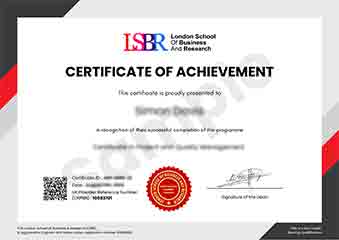
Sample Certificate
Preview the certificate you'll receive upon successful completion of this program.
Get Free Course Info
Enter your details and we'll send you a comprehensive course information pack straight to your inbox.
Employer Sponsored Training
Let your employer invest in your professional development. Request a corporate invoice and get your training funded.
Request Corporate InvoiceWhat People Say About Us
Hear from our students about their experience with the Advanced Certificate in Latent Variable Analysis Techniques at LSBRX - Executive Education.
Sophie Brown
United Kingdom"The course content is incredibly thorough and well-structured, providing a solid foundation in advanced latent variable analysis techniques that have directly enhanced my analytical skills. Gaining proficiency in these methods has significantly boosted my ability to interpret complex data sets, which is invaluable for my career in data science."
Klaus Mueller
Germany"This course has been instrumental in enhancing my ability to analyze complex data sets, which has significantly boosted my career prospects in market research. The practical applications of latent variable analysis techniques have made me more competitive in my field."
Wei Ming Tan
Singapore"The course structure is well-organized, providing a clear progression from foundational concepts to advanced techniques, which significantly enhances understanding and application of latent variable analysis. The comprehensive content, coupled with real-world examples, has greatly expanded my knowledge and prepared me for more complex data analysis tasks in my field."