
Advanced Certificate in Python Machine Learning Fundamentals
Earn an Advanced Certificate in Python Machine Learning Fundamentals to gain hands-on skills in applying Python for core machine learning tasks and models.
Advanced Certificate in Python Machine Learning Fundamentals
Programme Overview
The 'Advanced Certificate in Python Machine Learning Fundamentals' programme is designed for professionals and students seeking to advance their understanding and practical skills in machine learning using Python. This comprehensive programme covers essential topics such as data preprocessing, feature engineering, model selection, and evaluation techniques, alongside an in-depth exploration of machine learning algorithms including regression, classification, and clustering. Participants will learn to use Python libraries like NumPy, Pandas, Scikit-learn, and TensorFlow to build and deploy machine learning models.
Learners will develop key skills in Python programming, data analysis, and machine learning, enabling them to handle complex data sets, design and implement machine learning solutions, and interpret model outputs effectively. By the end of the programme, participants will be equipped with the knowledge and hands-on experience to tackle real-world machine learning challenges, and they will be prepared to apply their skills in various domains such as finance, healthcare, and technology.
This programme has a significant impact on careers in data science, AI, and technology sectors. Graduates can pursue roles such as machine learning engineer, data scientist, or AI specialist, or further their expertise by working on projects that require advanced machine learning techniques. The programme also enhances candidates' competitiveness in the job market, providing them with the foundational skills necessary to excel in roles that demand proficiency in Python and machine learning.
What You'll Learn
The Advanced Certificate in Python Machine Learning Fundamentals is a comprehensive program designed for professionals and learners seeking to master the essential skills in Python for machine learning. This program equips participants with a solid foundation in machine learning principles and practical Python programming, enabling them to develop predictive models, analyze data, and implement machine learning solutions across various industries.
Key topics include data preprocessing, feature engineering, supervised and unsupervised learning techniques, model evaluation, and deployment. Participants will gain hands-on experience with popular Python libraries such as NumPy, pandas, scikit-learn, and TensorFlow, learning to apply these tools to real-world datasets and projects.
The program is ideal for data analysts, software engineers, and researchers looking to enhance their skills or transition into machine learning roles. Graduates will be well-prepared to tackle complex data challenges, design and implement machine learning models, and contribute to data-driven decision-making processes.
Post-graduation, participants can pursue roles such as Machine Learning Engineer, Data Scientist, or AI Specialist. The program also provides a pathway to advanced studies in machine learning and data science, opening doors to leadership positions in the field. By the end of the program, learners will have built a robust portfolio of projects, demonstrating their proficiency in Python and machine learning, ready to launch successful careers in data science.
Programme Highlights
Industry-Aligned Curriculum
Developed with industry leaders for job-ready skills valued by employers worldwide.
Globally Recognised Certificate
Recognised by employers across 180+ countries as a mark of professional excellence.
Flexible Online Learning
Study at your own pace with lifetime access to all course materials and updates.
Instant Access
Start learning immediately — no application process or waiting period required.
Constantly Updated Content
Stay ahead with the latest industry trends, best practices, and emerging insights.
Career Advancement
87% of graduates report measurable career progression within 6 months of completion.
Topics Covered
- 1. Introduction to Python and Machine Learning: Learners will study the basics of Python programming and the fundamental concepts of machine learning, including data types, control structures, functions, and libraries like NumPy and pandas. They will gain practical skills in setting up a development environment and writing simple Python scripts for data manipulation.
- 2. Data Preprocessing and Exploration: Learners will learn how to preprocess and explore datasets using Python. They will study techniques such as data cleaning, transformation, normalization, and feature selection. Practical skills include using libraries such as pandas and scikit-learn for efficient data handling.
- 3. Supervised Learning Algorithms: This module covers supervised learning algorithms, including linear regression, logistic regression, decision trees, and support vector machines. Learners will understand the theory behind these algorithms and implement them using scikit-learn, gaining hands-on experience with model training and evaluation.
- 4. Unsupervised Learning Techniques: Learners will study unsupervised learning methods such as clustering (k-means, hierarchical clustering) and dimensionality reduction (PCA, t-SNE). They will learn how to apply these techniques to real-world datasets and evaluate the performance of clustering models.
- 5. Model Evaluation and Selection: This module focuses on evaluating and selecting the best machine learning models. Learners will explore various metrics for model evaluation, cross-validation techniques, and methods for hyperparameter tuning. Practical skills include using scikit-learn for model validation and optimization.
- 6. Deep Learning Fundamentals: Learners will be introduced to the basics of deep learning, including neural networks, activation functions, and loss functions. They will gain practical experience with popular deep learning frameworks such as TensorFlow or PyTorch.
- 7. Convolutional Neural Networks: This module covers convolutional neural networks (CNNs) and their applications in image classification and object detection. Learners will study the architecture of CNNs, training techniques, and practical skills in implementing and optimizing CNN models.
- 8. Recurrent Neural Networks and Natural Language Processing: Learners will learn about recurrent neural networks (RNNs) and their applications in natural language processing (NLP). They will explore RNN architectures such as LSTMs and GRUs, and gain practical skills in building NLP models for tasks like text classification and sentiment analysis.
- 9. Reinforcement Learning Basics: This module introduces learners to the fundamentals of reinforcement learning, including Markov Decision Processes, Q-learning, and policy gradients. They will study the theory behind reinforcement learning algorithms and gain practical experience with simple reinforcement learning tasks.
- 10. Project and Capstone: Learners will work on a comprehensive project that integrates the knowledge and skills acquired throughout the programme. They will choose a real-world problem, design a machine learning solution, and implement it using Python. This module will focus on developing project management skills and presenting findings in a professional manner.
What You Get When You Enroll
Secure checkout • Instant access • Certificate included
Key Facts
Audience: Beginners in Python, data enthusiasts
Prerequisites: Basic Python knowledge, interest in ML
Outcomes: Understand ML concepts, apply Python libraries
Ready to get started?
Join thousands of professionals who already took the next step. Enroll now and get instant access.
Enroll Now — $149Why This Course
Enhanced Job Prospects: Acquiring the 'Advanced Certificate in Python Machine Learning Fundamentals' can significantly boost career prospects in tech sectors. The certificate highlights proficiency in Python, a versatile language widely used in data science and machine learning. Employers value candidates who can apply Python to real-world problems, making this certification a standout asset on a resume.
Skill Mastery: The program covers essential machine learning techniques and advanced Python programming skills, enabling professionals to handle complex data analysis tasks. Mastery of these skills, such as data preprocessing, model selection, and validation, is crucial for developing robust machine learning models, thereby enhancing job performance and value.
Industry Relevance: With increasing demand for AI and machine learning capabilities, this certificate ensures that professionals stay current with industry standards and trends. It includes hands-on projects and real-world case studies that prepare individuals to tackle current and emerging challenges in their field, positioning them as valuable contributors in tech-driven organizations.
Your Path to Certification
Trusted by Professionals Worldwide
Course Brochure
Download our comprehensive course brochure with all details
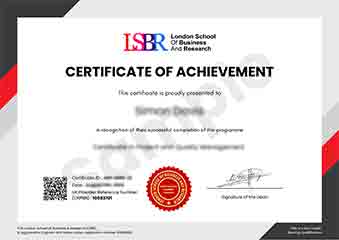
Sample Certificate
Preview the certificate you'll receive upon successful completion of this program.
Get Free Course Info
Enter your details and we'll send you a comprehensive course information pack straight to your inbox.
Employer Sponsored Training
Let your employer invest in your professional development. Request a corporate invoice and get your training funded.
Request Corporate InvoiceWhat People Say About Us
Hear from our students about their experience with the Advanced Certificate in Python Machine Learning Fundamentals at LSBRX - Executive Education.
Oliver Davies
United Kingdom"The course content is incredibly thorough and well-structured, providing a solid foundation in Python machine learning that has significantly enhanced my practical skills. I've gained valuable knowledge that is directly applicable to real-world problems, which I believe will be incredibly beneficial for my career in data science."
Ashley Rodriguez
United States"This Advanced Certificate in Python Machine Learning Fundamentals has been incredibly valuable, equipping me with the practical skills needed to apply machine learning in real-world scenarios, which has opened up new opportunities in my career."
Kai Wen Ng
Singapore"The course structure is well-organized, providing a clear path from basic concepts to advanced topics in Python machine learning, which has significantly enhanced my understanding and practical skills in the field. The comprehensive content and real-world applications have been particularly beneficial for my professional growth."