
Advanced Certificate in Reliability Testing and Validation
Elevate skills in reliability testing and validation, ensuring robust product performance and quality assurance.
Advanced Certificate in Reliability Testing and Validation
Programme Overview
The Advanced Certificate in Reliability Testing and Validation is a comprehensive programme designed for professionals in the manufacturing, automotive, aerospace, and electronics industries who seek to enhance their expertise in ensuring product reliability. The programme covers a wide range of topics including statistical methods for quality control, failure analysis techniques, predictive maintenance strategies, and the integration of reliability testing in the product lifecycle management. It is tailored for engineers, quality assurance specialists, and project managers who are committed to advancing their careers in reliability engineering and quality assurance.
Learners will develop key skills such as conducting rigorous statistical analysis to predict product failures, implementing effective testing methodologies, and leveraging advanced tools for data analysis and system simulation. They will also gain proficiency in using industry-standard software for reliability testing, and learn to create and manage detailed reliability test plans. By the end of the programme, participants will be well-equipped to design, execute, and interpret reliability tests, ensuring that products meet stringent quality and safety standards.
The programme significantly impacts career trajectories by positioning graduates as key contributors in reliability engineering, quality assurance, and product development. It enables professionals to enhance their analytical capabilities, improve product design and manufacturing processes, and reduce the risk of product failures. Graduates can pursue advanced roles in reliability engineering, lead teams in quality assurance, or contribute to research and development in reliability testing methodologies.
What You'll Learn
The Advanced Certificate in Reliability Testing and Validation is designed for professionals seeking to enhance their expertise in ensuring the reliability and quality of complex systems. This program equips participants with advanced skills in statistical analysis, failure mode and effects analysis (FMEA), and reliability modeling. Through hands-on workshops and real-world case studies, learners explore predictive maintenance strategies, reliability growth testing, and accelerated life testing techniques.
Graduates apply these skills in various industries, from aerospace and automotive to healthcare and technology, to design and validate systems that meet stringent reliability standards. They learn to develop and implement reliability testing protocols, analyze data to predict system failures, and recommend corrective actions. This program also prepares participants for certification in reliability engineering, enhancing their employability and positioning them to lead critical reliability initiatives.
Career opportunities for graduates are diverse, including roles such as reliability engineer, quality assurance specialist, and systems reliability analyst. The program's focus on practical application and industry relevance ensures that graduates are well-prepared to contribute to the success of their organizations and to advance in their careers.
Programme Highlights
Industry-Aligned Curriculum
Developed with industry leaders for job-ready skills valued by employers worldwide.
Globally Recognised Certificate
Recognised by employers across 180+ countries as a mark of professional excellence.
Flexible Online Learning
Study at your own pace with lifetime access to all course materials and updates.
Instant Access
Start learning immediately — no application process or waiting period required.
Constantly Updated Content
Stay ahead with the latest industry trends, best practices, and emerging insights.
Career Advancement
87% of graduates report measurable career progression within 6 months of completion.
Topics Covered
- 1. Basics of Reliability Testing and Validation: Learners will study the fundamental concepts of reliability testing and validation, including definitions, importance, and basic methodologies. They will gain an understanding of how to identify and define reliability requirements and the basics of test planning.
- 2. Statistical Methods in Reliability Testing: This module covers statistical techniques used in reliability testing, such as confidence intervals, hypothesis testing, and reliability growth models. Learners will develop skills in analyzing and interpreting reliability data.
- 3. Reliability Testing Strategies and Techniques: Learners will explore various testing strategies and techniques, including accelerated testing, environmental stress screening, and life testing. They will understand how to choose the most appropriate testing methods based on product characteristics.
- 4. Reliability Data Analysis and Modeling: This module focuses on advanced data analysis and modeling techniques, including failure modes and effects analysis (FMEA) and reliability prediction models. Learners will learn to apply these models to predict and improve product reliability.
- 5. Reliability Testing Tools and Software: Learners will be introduced to reliability testing tools and software, such as reliability prediction software and data analysis software. They will gain hands-on experience in using these tools to perform reliability testing and analysis.
- 6. Reliability Testing in Complex Systems: This module covers reliability testing in complex systems and multi-component assemblies. Learners will understand how to test and validate the reliability of systems composed of multiple interacting components.
- 7. Reliability Testing for Safety-Critical Systems: Learners will study reliability testing and validation for safety-critical systems, including automotive, aerospace, and medical devices. They will learn specialized testing methods and standards for ensuring high reliability in these applications.
- 8. Reliability Testing and Validation in Software Systems: This module focuses on reliability testing and validation techniques for software systems, including software failure modes and testing methodologies. Learners will gain skills in testing and validating software reliability.
- 9. Reliability Testing in High-Volume Manufacturing: Learners will explore reliability testing strategies for high-volume manufacturing environments, including production line testing and quality control. They will understand how to ensure consistent product reliability in large-scale manufacturing settings.
- 10. Continuous Improvement in Reliability Testing and Validation: This module covers continuous improvement methodologies and practices in reliability testing and validation. Learners will learn how to implement and maintain a culture of continuous improvement in reliability processes.
What You Get When You Enroll
Secure checkout • Instant access • Certificate included
Key Facts
Ideal for QA engineers, testers
No prior experience required
Understand reliability testing principles
Perform validation tests on systems
Identify and mitigate reliability risks
Ready to get started?
Join thousands of professionals who already took the next step. Enroll now and get instant access.
Enroll Now — $149Why This Course
Enhanced Expertise: The Advanced Certificate in Reliability Testing and Validation equips professionals with in-depth knowledge of statistical methods and reliability analysis techniques. This advanced understanding can significantly improve the accuracy and efficiency of testing processes, leading to more reliable products and systems.
Specialized Skills: This certification provides specialized skills in conducting rigorous testing and validation, which are crucial for ensuring product quality and safety. Professionals who hold this certificate can apply advanced reliability testing methodologies, such as accelerated life testing and reliability prediction, to enhance product reliability.
Improved Career Prospects: With an advanced certificate, professionals can expand their career opportunities in industries that require high standards of product reliability, such as aerospace, automotive, and medical devices. Employers often value candidates with specialized certifications, as they bring a higher level of competence and credibility to the role.
Competitive Edge: The certificate demonstrates a commitment to continuous professional development and a strong foundational knowledge in reliability testing and validation. This can provide a competitive edge in the job market, enabling professionals to stand out and potentially secure higher-level positions or roles with greater responsibility.
Your Path to Certification
Trusted by Professionals Worldwide
Course Brochure
Download our comprehensive course brochure with all details
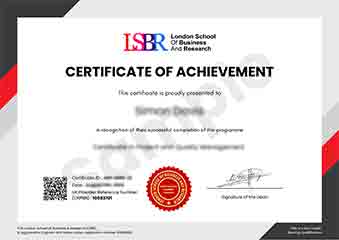
Sample Certificate
Preview the certificate you'll receive upon successful completion of this program.
Get Free Course Info
Enter your details and we'll send you a comprehensive course information pack straight to your inbox.
Employer Sponsored Training
Let your employer invest in your professional development. Request a corporate invoice and get your training funded.
Request Corporate InvoiceWhat People Say About Us
Hear from our students about their experience with the Advanced Certificate in Reliability Testing and Validation at LSBRX - Executive Education.
Oliver Davies
United Kingdom"The course content was incredibly thorough and well-structured, providing a solid foundation in reliability testing and validation that has been invaluable for my career. I've gained practical skills that I've directly applied to improve product reliability in my current role."
Tyler Johnson
United States"This course has significantly enhanced my ability to apply advanced reliability testing techniques in real-world scenarios, making me a more valuable asset in my engineering team and opening up new career opportunities in the field of quality assurance."
Greta Fischer
Germany"The course structure is well-organized, providing a comprehensive overview of reliability testing and validation that directly translates into practical skills for improving product reliability in real-world scenarios, which has significantly enhanced my professional growth."