
Advanced Certificate in Supervised Learning for Classification Models
Elevate skills in supervised learning for classification models, gaining expertise in algorithm selection, model training, and evaluation for predictive analytics.
Advanced Certificate in Supervised Learning for Classification Models
Programme Overview
The 'Advanced Certificate in Supervised Learning for Classification Models' is a comprehensive program designed for professionals in the fields of data science, machine learning, and related technical roles who seek to deepen their expertise in classification techniques. This program is ideal for data scientists, machine learning engineers, and researchers aiming to enhance their skills in applying advanced supervised learning methods to real-world datasets. It is also beneficial for individuals working in industries such as healthcare, finance, and marketing, where precision in classification outcomes is critical.
Learners will develop a robust set of skills, including advanced supervised learning methodologies, feature engineering, model selection, and validation techniques. The curriculum covers both classical and modern classification algorithms, such as logistic regression, support vector machines, decision trees, random forests, and ensemble methods, alongside deep learning approaches like neural networks. Additionally, learners will gain hands-on experience with state-of-the-art tools and frameworks, including Python, TensorFlow, and Scikit-learn, enabling them to implement and optimize classification models effectively.
The program has a significant impact on career trajectories, offering participants the opportunity to advance in their current roles or transition into higher-level positions. Graduates are well-prepared to take on leadership roles in data science teams, where they can drive innovation through the development and deployment of sophisticated classification models. Furthermore, the skills acquired can be applied to a wide range of applications, from predictive maintenance in manufacturing to fraud detection in financial services, thereby opening up a variety of career opportunities in the data-driven economy.
What You'll Learn
Embark on a transformative journey with the Advanced Certificate in Supervised Learning for Classification Models, a rigorous and practical program designed to equip you with the advanced skills needed to excel in the realm of machine learning. This program is ideal for professionals seeking to deepen their expertise in supervised learning techniques, particularly in classification models, which are fundamental in various applications such as fraud detection, predictive analytics, and natural language processing.
Key topics include advanced algorithmic techniques, such as decision trees, random forests, support vector machines, and neural networks, with a focus on optimization and model validation. You will also delve into feature engineering, a critical skill for enhancing model performance. Practical applications are at the heart of this program, with hands-on projects that simulate real-world scenarios, allowing you to apply your knowledge to solve complex problems.
Upon completion, you will be well-prepared to tackle challenges in data science roles that demand advanced machine learning skills. Graduates often secure positions as data scientists, machine learning engineers, or senior analytics professionals in sectors ranging from finance and healthcare to technology and marketing. The program's emphasis on both theoretical foundations and practical application ensures you are not just knowledgeable but also skilled in deploying supervised learning models in a professional setting. Join a community of learners who are passionate about advancing their careers in data science and machine learning.
Programme Highlights
Industry-Aligned Curriculum
Developed with industry leaders for job-ready skills valued by employers worldwide.
Globally Recognised Certificate
Recognised by employers across 180+ countries as a mark of professional excellence.
Flexible Online Learning
Study at your own pace with lifetime access to all course materials and updates.
Instant Access
Start learning immediately — no application process or waiting period required.
Constantly Updated Content
Stay ahead with the latest industry trends, best practices, and emerging insights.
Career Advancement
87% of graduates report measurable career progression within 6 months of completion.
Topics Covered
- 1. Introduction to Supervised Learning: Learners will be introduced to the fundamental concepts of supervised learning, including types of supervised learning problems and the importance of data preprocessing. They will gain skills in understanding and preparing datasets for model training.
- 2. Regression Models: This module covers linear and non-linear regression models, focusing on understanding model assumptions and evaluating model performance. Learners will gain practical skills in implementing regression models and interpreting their results.
- 3. Classification Fundamentals: Learners will study the basics of classification, including different types of classifiers and evaluation metrics. They will gain foundational skills in developing and testing simple classification models.
- 4. Decision Trees and Random Forests: This module delves into decision trees and random forests, covering their theoretical underpinnings and practical applications. Learners will learn to build and tune these models effectively.
- 5. Support Vector Machines: Learners will explore the principles and algorithms behind support vector machines (SVMs), including kernel methods. They will gain skills in applying SVMs to various classification problems.
- 6. Ensemble Methods: This module focuses on ensemble techniques, including bagging, boosting, and stacking. Learners will understand how to combine multiple models to improve overall predictive performance.
- 7. Neural Networks for Classification: Learners will study neural networks, including feedforward and convolutional neural networks, and their applications in classification tasks. They will gain skills in building and training neural networks.
- 8. Model Evaluation and Validation: This module covers various techniques for evaluating and validating classification models, including cross-validation and confusion matrices. Learners will learn to assess model performance rigorously.
- 9. Feature Engineering: Learners will learn how to select and create relevant features for classification models, improving model accuracy and efficiency. They will gain hands-on experience in feature engineering techniques.
- 10. Advanced Topics in Classification: This module explores advanced topics such as deep learning, anomaly detection, and imbalanced datasets. Learners will gain insights into cutting-edge techniques and their practical applications.
What You Get When You Enroll
Secure checkout • Instant access • Certificate included
Key Facts
Audience: Professionals, analysts, data scientists
Prerequisites: Basic statistics, programming experience
Outcomes: Proficient in classification models, model evaluation
Ready to get started?
Join thousands of professionals who already took the next step. Enroll now and get instant access.
Enroll Now — $149Why This Course
Enhanced Expertise in Supervised Learning: Professionals pursuing an Advanced Certificate in Supervised Learning for Classification Models can significantly deepen their understanding of machine learning techniques. By focusing on classification models, learners gain advanced knowledge in algorithms such as logistic regression, decision trees, and random forests, which are crucial for predictive analytics in industries ranging from finance to healthcare.
Skill Development for Practical Applications: The certificate offers hands-on experience with real-world datasets and practical projects, enabling professionals to develop skills in model selection, training, and validation. This translates to the ability to build and deploy robust classification models, enhancing their value in data-driven roles. For instance, a data scientist can effectively tackle churn prediction, fraud detection, or sentiment analysis tasks, leading to better business outcomes.
Competitive Advantage in the Job Market: With the increasing demand for skilled data professionals, obtaining this certificate can set individuals apart in the job market. Employers seek candidates who can demonstrate a high level of proficiency in supervised learning techniques. This certification not only showcases their technical expertise but also their commitment to staying updated with the latest advancements in machine learning, making them more attractive to potential employers.
Interdisciplinary Knowledge: The course content often includes interdisciplinary topics such as statistics, data preprocessing, and feature engineering. This broadens professionals' knowledge base, allowing them to approach problems from multiple angles. For example, a marketing specialist can leverage their understanding of classification models to design more effective targeted campaigns, integrating insights
Your Path to Certification
Trusted by Professionals Worldwide
Course Brochure
Download our comprehensive course brochure with all details
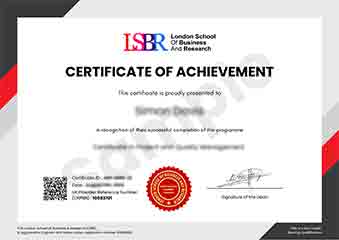
Sample Certificate
Preview the certificate you'll receive upon successful completion of this program.
Get Free Course Info
Enter your details and we'll send you a comprehensive course information pack straight to your inbox.
Employer Sponsored Training
Let your employer invest in your professional development. Request a corporate invoice and get your training funded.
Request Corporate InvoiceWhat People Say About Us
Hear from our students about their experience with the Advanced Certificate in Supervised Learning for Classification Models at LSBRX - Executive Education.
Oliver Davies
United Kingdom"The course content is deeply insightful, covering a wide range of classification models with real-world applications that significantly enhance practical skills in machine learning. Gaining this knowledge has opened up new career opportunities and deepened my understanding of how to apply supervised learning effectively in various industries."
Ryan MacLeod
Canada"This course has been incredibly valuable, equipping me with advanced techniques in supervised learning that are directly applicable in my field. It has not only enhanced my analytical skills but also opened up new career opportunities in data-driven roles."
Fatimah Ibrahim
Malaysia"The course structure is well-organized, providing a clear path from foundational concepts to advanced techniques in supervised learning, which has significantly enhanced my understanding and application of classification models in real-world scenarios."