
Certificate in Accreditation Program Evaluation Methods
This certificate equips professionals with skills in evaluating accreditation programs, enhancing quality assurance and standards compliance.
Certificate in Accreditation Program Evaluation Methods
Programme Overview
The Certificate in Accreditation Program Evaluation Methods is designed for professionals in accreditation, quality assurance, and program management, aiming to enhance their skills in evaluating and improving the effectiveness of various accreditation programs. This program encompasses a comprehensive curriculum that includes statistical analysis techniques, qualitative research methods, and standardized evaluation frameworks, providing a robust foundation for understanding and implementing rigorous evaluation practices.
Participants will develop key skills such as the ability to design and conduct evaluation studies, interpret and report evaluation findings, and apply evaluation results to enhance program quality and outcomes. Additionally, learners will gain proficiency in using data analytics tools and software relevant to program evaluation, which are essential for making informed decisions and advocating for evidence-based improvements in their organizations.
Career-wise, the certificate will significantly impact professionals by equipping them with advanced competencies that are highly valued in the field of accreditation. Graduates will be well-prepared to lead evaluations, contribute to policy development, and improve the efficiency and effectiveness of accreditation programs in various sectors, including education, healthcare, and social services. This certification can open doors to advanced roles such as program evaluator, accreditation specialist, or quality assurance manager, where the ability to assess and enhance program performance is crucial.
What You'll Learn
The Certificate in Accreditation Program Evaluation Methods is designed for professionals aiming to enhance their skills in evaluating and improving accreditation processes. This program equips you with comprehensive knowledge and practical tools to assess the effectiveness of various accreditation programs, ensuring they meet the highest standards of quality and performance.
Key topics include the theoretical foundations of program evaluation, data collection and analysis techniques, and the application of evaluation frameworks in real-world scenarios. You will learn to design, implement, and interpret evaluations, focusing on areas such as educational, healthcare, and organizational accreditation.
Participants will gain hands-on experience through case studies and projects, applying evaluation methods to improve existing accreditation programs. This practical approach ensures that graduates can immediately apply their skills to enhance the credibility and impact of their organization's accreditation processes.
Upon completion, you will be well-prepared to embark on careers in accreditation consulting, program management, research, and policy development. This program opens doors to roles such as accreditation specialist, program evaluator, and quality assurance officer, contributing to the continuous improvement of accreditation standards in diverse sectors.
Programme Highlights
Industry-Aligned Curriculum
Developed with industry leaders for job-ready skills valued by employers worldwide.
Globally Recognised Certificate
Recognised by employers across 180+ countries as a mark of professional excellence.
Flexible Online Learning
Study at your own pace with lifetime access to all course materials and updates.
Instant Access
Start learning immediately — no application process or waiting period required.
Constantly Updated Content
Stay ahead with the latest industry trends, best practices, and emerging insights.
Career Advancement
87% of graduates report measurable career progression within 6 months of completion.
Topics Covered
- 1. Introduction to Accreditation and Program Evaluation: Learners will study the fundamentals of accreditation and program evaluation, including the importance of these processes in enhancing educational and professional standards. They will gain an understanding of key concepts and terminology, setting a foundation for more advanced studies.
- 2. Data Collection Techniques: Learners will explore various methods for collecting data in program evaluations, including surveys, interviews, and observations. They will learn how to design effective data collection tools and techniques to ensure reliable and valid data.
- 3. Quantitative Data Analysis: This module focuses on statistical methods for analyzing quantitative data. Learners will gain skills in using software tools to conduct descriptive and inferential statistical analyses, enabling them to interpret data effectively.
- 4. Qualitative Data Analysis: Here, learners will study qualitative data collection and analysis techniques, such as thematic analysis and content analysis. They will learn how to code and interpret qualitative data to gain deeper insights into program performance.
- 5. Program Theory and Logic Models: Learners will delve into the development and application of program theories and logic models. They will understand how these tools can be used to map out the intended outcomes and pathways of a program.
- 6. Stakeholder Engagement in Evaluation: This module covers strategies for engaging various stakeholders in the evaluation process. Learners will learn how to build relationships, gather input, and communicate findings effectively to ensure that evaluations are relevant and responsive to the needs of all stakeholders.
- 7. Advanced Statistical Methods: Building on the foundational skills learned in Module 3, this module will cover more advanced statistical techniques, such as regression analysis and factor analysis, to enable learners to conduct more sophisticated data analysis.
- 8. Mixed Methods Research: This module introduces the integration of both quantitative and qualitative research methods in program evaluation. Learners will learn how to design and conduct mixed methods studies to gain a comprehensive understanding of program impacts.
- 9. Case Study Analysis: In this module, learners will analyze case studies of effective accreditation and evaluation practices. They will develop the ability to apply theoretical knowledge to real-world scenarios, enhancing their problem-solving skills.
- 10. Reporting and Utilizing Evaluation Findings: The final module focuses on the reporting and dissemination of evaluation findings. Learners will learn how to prepare clear and compelling reports and presentations, and how to use evaluation results to inform decision-making and improve programs.
What You Get When You Enroll
Secure checkout • Instant access • Certificate included
Key Facts
Audience: Professionals in accreditation, evaluation, and assessment
Prerequisites: Basic understanding of evaluation methods
Outcomes: Competent in applying accreditation evaluation methods
Ready to get started?
Join thousands of professionals who already took the next step. Enroll now and get instant access.
Enroll Now — $79Why This Course
Enhanced Evaluation Skills: Obtaining a Certificate in Accreditation Program Evaluation Methods equips professionals with advanced analytical and evaluation techniques necessary for assessing the effectiveness and efficiency of programs. This skill set is highly valued in industries such as education, healthcare, and non-profit sectors, where rigorous and systematic evaluations are crucial for continuous improvement.
Competitive Edge in the Job Market: Employers often seek professionals who can independently design and implement evaluation frameworks. The certificate highlights your capability to conduct thorough and unbiased assessments, making you a more attractive candidate in the job market. This certification can open doors to leadership roles or specialized positions focusing on program evaluation and accreditation.
Improved Decision-Making: The program evaluation methods covered in the certificate enhance your ability to make informed decisions based on data and evidence. This skill is pivotal in fields where stakeholders rely on robust evaluation results to allocate resources, adjust strategies, and achieve organizational goals. Professionals with this certification can contribute more effectively to strategic planning and policy development.
Your Path to Certification
Trusted by Professionals Worldwide
Course Brochure
Download our comprehensive course brochure with all details
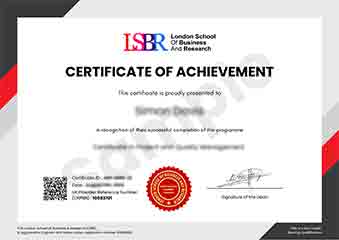
Sample Certificate
Preview the certificate you'll receive upon successful completion of this program.
Get Free Course Info
Enter your details and we'll send you a comprehensive course information pack straight to your inbox.
Employer Sponsored Training
Let your employer invest in your professional development. Request a corporate invoice and get your training funded.
Request Corporate InvoiceWhat People Say About Us
Hear from our students about their experience with the Certificate in Accreditation Program Evaluation Methods at LSBRX - Executive Education.
Charlotte Williams
United Kingdom"The course provided comprehensive and well-structured content on various evaluation methods, which significantly enhanced my ability to critically assess accreditation programs. Gaining these skills has been invaluable for my career, as I can now apply these techniques in real-world scenarios to improve the effectiveness of accreditation processes."
Jack Thompson
Australia"This certificate program has significantly enhanced my ability to evaluate accreditation processes in a practical and industry-relevant manner, making me a more competitive candidate for senior roles in quality assurance. The hands-on approach to learning has equipped me with essential skills that I can directly apply in my current position to drive positive changes in our accreditation standards."
Brandon Wilson
United States"The course structure is well-organized, providing a clear path from foundational concepts to advanced evaluation techniques, which has greatly enhanced my understanding and practical skills in accreditation program evaluation. The comprehensive content and real-world applications have been invaluable for my professional growth, offering practical insights that I can immediately apply in my work."