
Certificate in Concurrency Patterns: Designing Efficient Parallel Systems
Learn to design efficient parallel systems and master concurrency patterns for optimal performance in software development.
Certificate in Concurrency Patterns: Designing Efficient Parallel Systems
Programme Overview
This course targets software developers, architects, and engineers eager to master concurrency. First, you'll explore fundamental concurrency concepts. Next, you'll dive into essential patterns, such as producer-consumer, and map-reduce.
You'll gain hands-on experience with parallel programming tools and frameworks, including threads, locks, and semaphores. Furthermore, you'll learn to apply these skills to real-world problems. By the end, you'll design and implement efficient parallel systems.
What You'll Learn
Dive into the future of computing with our 'Certificate in Concurrency Patterns: Designing Efficient Parallel Systems.' First, you'll grasp the fundamentals of parallel programming. Next, explore advanced concurrency patterns. Meanwhile, you'll gain hands-on experience with tools like OpenMP and MPI. Finally, you'll learn to optimize performance and avoid common pitfalls. Meanwhile, you'll work on real-world projects. First, you'll tackle synchronization issues. Then, you'll design scalable architectures. Moreover, you’ll open doors to exciting careers in software development, high-performance computing, and data science. Furthermore, you’ll stand out to employers with a valuable skillset. Therefore, join us. Let's build the next generation of efficient, parallel systems together.
Programme Highlights
Industry-Aligned Curriculum
Developed with industry leaders for job-ready skills valued by employers worldwide.
Globally Recognised Certificate
Recognised by employers across 180+ countries as a mark of professional excellence.
Flexible Online Learning
Study at your own pace with lifetime access to all course materials and updates.
Instant Access
Start learning immediately — no application process or waiting period required.
Constantly Updated Content
Stay ahead with the latest industry trends, best practices, and emerging insights.
Career Advancement
87% of graduates report measurable career progression within 6 months of completion.
Topics Covered
- Introduction to Concurrency: Learn the basics of concurrency and parallelism in computing.
- Shared Memory Concurrency: Understand shared memory models and their implementation in parallel systems.
- Message Passing Concurrency: Explore message passing models and their use in distributed systems.
- Synchronization Mechanisms: Study various synchronization techniques for managing concurrent processes.
- Concurrency Patterns and Best Practices: Identify common concurrency patterns and best practices for efficient design.
- Advanced Topics in Concurrency: Dive into advanced concurrency topics, such as transactional memory and software transactional memory.
What You Get When You Enroll
Secure checkout • Instant access • Certificate included
Key Facts
Firstly, audience this program is for any individual or team eager to build robust parallel systems. Next, prerequisites basic programming knowledge is required. Consequently, after completing this certificate, participants will actively design efficient parallel systems.
Meanwhile, outcomes include:
Mastering key concurrency patterns
Applying these patterns to improve system performance
Finally, enhancing software reliability and scalability.
Ready to get started?
Join thousands of professionals who already took the next step. Enroll now and get instant access.
Enroll Now — $79Why This Course
First, this certificate equips learners with crucial skills. These skills are essential for designing efficient parallel systems. Moreover, it empowers learners to tackle real-world challenges in parallel computing. This includes building scalable, high-performance applications.
Secondly, it offers hands-on experience with concurrency patterns. These patterns are widely used in industry. Learners will actively practice these patterns. This experience is invaluable for grasping complex concepts.
Lastly, it opens doors to exciting career opportunities. Graduates can explore roles such as software developers, system architects, and more. Additionally, it provides a competitive edge in the job market.
Your Path to Certification
Trusted by Professionals Worldwide
Course Brochure
Download our comprehensive course brochure with all details
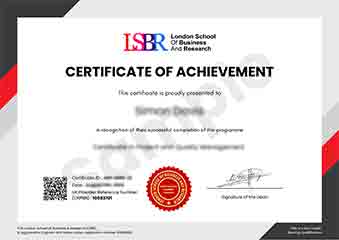
Sample Certificate
Preview the certificate you'll receive upon successful completion of this program.
Get Free Course Info
Enter your details and we'll send you a comprehensive course information pack straight to your inbox.
Employer Sponsored Training
Let your employer invest in your professional development. Request a corporate invoice and get your training funded.
Request Corporate InvoiceWhat People Say About Us
Hear from our students about their experience with the Certificate in Concurrency Patterns: Designing Efficient Parallel Systems at LSBRX - Executive Education.
James Thompson
United Kingdom"The course material was incredibly comprehensive, covering a wide range of concurrency patterns that are directly applicable to real-world scenarios. I gained practical skills in designing efficient parallel systems, which has significantly boosted my confidence in tackling complex software development challenges in my career."
Madison Davis
United States"This course has been a game-changer for my career. The focus on industry-relevant concurrency patterns has equipped me with practical skills that I can directly apply in my role as a software engineer, leading to more efficient parallel systems and significantly improving my problem-solving abilities in real-world scenarios."
James Thompson
United Kingdom"The course structure was exceptionally well-organized, with each module building logically on the previous one, making complex concurrency concepts easy to grasp. The comprehensive content not only covered theoretical foundations but also delved into real-world applications, significantly enhancing my professional growth and ability to design efficient parallel systems."