
Certificate in Implementing Machine Learning in Supernova Analysis
Gain expertise in applying machine learning to supernova analysis for predictive insights and data-driven decision-making.
Certificate in Implementing Machine Learning in Supernova Analysis
Programme Overview
The 'Certificate in Implementing Machine Learning in Supernova Analysis' is designed for astronomers, data scientists, and researchers who are eager to apply advanced machine learning techniques to the study of supernovae. This programme equips learners with the skills to analyze and interpret complex astronomical data, focusing on the identification, classification, and prediction of supernova events using cutting-edge algorithms and tools.
Key skills and knowledge developed through this programme include proficiency in Python and R for data manipulation and analysis, understanding of machine learning algorithms such as neural networks, decision trees, and support vector machines tailored for astronomical data, and expertise in handling large datasets using cloud computing platforms. Learners will also gain experience in developing and optimizing models for supernova detection and classification, as well as in validating and interpreting model results.
This programme significantly impacts career trajectories by preparing professionals to lead innovative research initiatives in astrophysics and astronomy. Graduates will be well-suited to work in academic research institutions, astronomical observatories, and space agencies, contributing to advancements in our understanding of the universe. They will also be capable of developing data-driven solutions for diverse applications, including but not limited to, the prediction of supernova events, the analysis of cosmic phenomena, and the improvement of telescope performance through data-driven methodologies.
What You'll Learn
Unlock the secrets of the cosmos with the 'Certificate in Implementing Machine Learning in Supernova Analysis.' This comprehensive program equips you with the skills to analyze and interpret vast datasets from astronomical observations, harnessing the power of machine learning to predict and classify supernovae. You'll delve into essential topics such as data preprocessing, feature extraction, and advanced machine learning algorithms tailored for astronomical data. The curriculum also includes practical workshops on Python programming, TensorFlow, and PyTorch, ensuring you are proficient in the tools used by leading researchers.
Graduates of this program will be well-prepared to contribute to cutting-edge research projects at universities and observatories, leading to insights that could reshape our understanding of stellar explosions and the universe. Career paths include positions as data scientists in astronomy, research associates in astrophysics, and machine learning engineers in space technology companies. By joining this program, you'll not only gain valuable technical skills but also foster a deep appreciation for the vastness and complexity of the cosmos.
Programme Highlights
Industry-Aligned Curriculum
Developed with industry leaders for job-ready skills valued by employers worldwide.
Globally Recognised Certificate
Recognised by employers across 180+ countries as a mark of professional excellence.
Flexible Online Learning
Study at your own pace with lifetime access to all course materials and updates.
Instant Access
Start learning immediately — no application process or waiting period required.
Constantly Updated Content
Stay ahead with the latest industry trends, best practices, and emerging insights.
Career Advancement
87% of graduates report measurable career progression within 6 months of completion.
Topics Covered
- 1. Introduction to Machine Learning for Supernova Analysis: Learners will understand fundamental concepts of machine learning and their application in analyzing supernovae. They will gain skills in data preprocessing and feature extraction relevant to astronomical data.
- 2. Data Handling and Exploration: This module covers techniques for handling large astronomical datasets and exploratory data analysis. Learners will learn to use Python libraries such as Pandas and NumPy to efficiently process and visualize supernova data.
- 3. Supervised Learning Algorithms: Learners will study supervised learning algorithms such as regression and classification. They will apply these techniques to predict supernova types and classify them based on observed characteristics.
- 4. Unsupervised Learning for Supernova Clustering: This module focuses on unsupervised learning methods like clustering for grouping similar supernovae. Learners will gain experience in identifying patterns and anomalies in supernova data.
- 5. Time Series Analysis of Supernovae: Learners will explore advanced time series analysis techniques to understand the evolution of supernovae over time. They will use tools like ARIMA and LSTM networks for forecasting supernova behavior.
- 6. Feature Engineering for Machine Learning: This module teaches learners how to create and select features that are most relevant for machine learning models in supernova analysis. Practical skills in feature engineering will be developed through hands-on exercises.
- 7. Model Evaluation and Validation: Learners will learn methods for evaluating and validating machine learning models. They will apply cross-validation techniques and understand metrics like precision, recall, and F1 score in the context of supernova data.
- 8. Deep Learning for Supernova Classification: This module introduces deep learning techniques such as Convolutional Neural Networks (CNNs) for image analysis. Learners will apply CNNs to classify supernovae from images and understand their performance compared to traditional machine learning methods.
- 9. Advanced Topics in Machine Learning for Astronomy: In this module, learners will explore cutting-edge topics in machine learning as applied to astronomy, including deep learning for spectral analysis and ensemble learning methods for improving model accuracy.
- 10. Capstone Project: Implementing a Machine Learning Solution for Supernova Analysis: Learners will complete a capstone project where they apply the skills learned throughout the course to solve a real-world problem in supernova analysis. They will develop a complete machine learning pipeline from data collection to model deployment.
What You Get When You Enroll
Secure checkout • Instant access • Certificate included
Key Facts
Audience: Data scientists, engineers
Prerequisites: Basic programming, statistics knowledge
Outcomes: Proficient in ML techniques, supernova data analysis
Ready to get started?
Join thousands of professionals who already took the next step. Enroll now and get instant access.
Enroll Now — $79Why This Course
Enhance Competency: The Certificate in Implementing Machine Learning in Supernova Analysis equips professionals with advanced skills in analyzing and interpreting data from supernovae explosions. This specialization is crucial as it bridges the gap between astrophysics and machine learning, enabling professionals to contribute to cutting-edge research and innovation in astrophysical studies.
Career Advancement: With this certification, professionals can open doors to specialized roles in data analysis, astrophysics research, and machine learning engineering. The demand for experts who can apply machine learning techniques to complex astronomical data is growing, positioning certified professionals as valuable assets in both academic and industrial settings.
Industry Relevance: The program focuses on real-world applications, preparing professionals to tackle challenges in supernova analysis with machine learning tools. This not only enhances their technical proficiency but also their ability to solve practical problems, making them more competitive in the job market.
Network Expansion: Attending this program allows professionals to connect with industry leaders and fellow enthusiasts, fostering a collaborative environment that can lead to new opportunities and collaborations in the field of astrophysics and machine learning.
Your Path to Certification
Trusted by Professionals Worldwide
Course Brochure
Download our comprehensive course brochure with all details
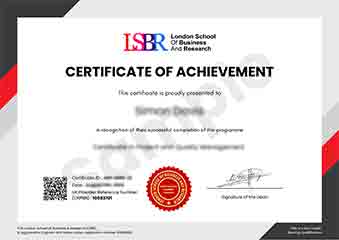
Sample Certificate
Preview the certificate you'll receive upon successful completion of this program.
Get Free Course Info
Enter your details and we'll send you a comprehensive course information pack straight to your inbox.
Employer Sponsored Training
Let your employer invest in your professional development. Request a corporate invoice and get your training funded.
Request Corporate InvoiceWhat People Say About Us
Hear from our students about their experience with the Certificate in Implementing Machine Learning in Supernova Analysis at LSBRX - Executive Education.
Charlotte Williams
United Kingdom"The course content is incredibly thorough and well-structured, providing a solid foundation in applying machine learning techniques to supernova analysis. Gaining hands-on experience with real datasets has been invaluable, significantly enhancing my ability to tackle complex astronomical data problems."
Oliver Davies
United Kingdom"This certificate course has been instrumental in bridging the gap between theoretical knowledge and practical applications in machine learning for supernova analysis. It has not only enhanced my technical skills but also provided me with a competitive edge in the job market, opening up new opportunities in astrophysics research."
Muhammad Hassan
Malaysia"The course structure is well-organized, providing a clear path from basic concepts to advanced techniques in machine learning for supernova analysis, which has significantly enhanced my understanding and practical skills in the field. The comprehensive content and real-world applications have been particularly beneficial for my professional growth."