
Certificate in Quantum Machine Learning for Predictive Analytics
Elevate predictive analytics with a Certificate in Quantum Machine Learning, enhancing data processing and model accuracy through quantum computing principles.
Certificate in Quantum Machine Learning for Predictive Analytics
Programme Overview
The Certificate in Quantum Machine Learning for Predictive Analytics is designed for professionals in data science, information technology, and related fields who wish to enhance their capabilities in predictive analytics through the integration of quantum computing principles. The programme equips learners with a robust understanding of quantum mechanics, quantum computing fundamentals, and their application in machine learning algorithms. It covers essential topics such as quantum circuits for machine learning, quantum algorithms for optimization and classification, and the integration of quantum computing with classical machine learning techniques.
Learners will develop key skills in designing and implementing quantum machine learning models, analyzing complex data sets, and leveraging quantum computing to solve real-world predictive analytics problems. By the end of the programme, participants will be proficient in using quantum computing tools and frameworks to enhance predictive models, understand the principles of quantum entanglement and superposition, and apply these principles to improve the efficiency and accuracy of predictive analytics tasks.
The certificate will significantly impact participants' career trajectories by positioning them as leaders in the emerging field of quantum-enhanced data science. Graduates will be well-prepared to lead projects that integrate quantum computing into existing data science methodologies, innovate in the development of new predictive models, and contribute to the growth of organizations through advanced predictive analytics capabilities.
What You'll Learn
The Certificate in Quantum Machine Learning for Predictive Analytics is designed to equip professionals with cutting-edge skills in leveraging quantum computing for advanced predictive analytics. This program is invaluable for those seeking to innovate in data science, artificial intelligence, and computational physics. Key topics include quantum computing fundamentals, quantum algorithms, machine learning principles, and their intersection. Students will explore how to apply quantum machine learning techniques to solve complex predictive analytics problems, from financial forecasting to healthcare diagnostics.
Upon completion, graduates will be able to develop and implement quantum machine learning models, enhance predictive accuracy, and optimize computational efficiency. This program not only provides theoretical knowledge but also offers practical experience through hands-on projects and case studies, preparing students to tackle real-world challenges. Career opportunities span across industries such as finance, healthcare, technology, and research, where predictive analytics and quantum computing are revolutionizing data-driven decision-making. Graduates can pursue roles as quantum data scientists, predictive analytics specialists, or quantum algorithm developers, contributing to the forefront of technological advancement.
Programme Highlights
Industry-Aligned Curriculum
Developed with industry leaders for job-ready skills valued by employers worldwide.
Globally Recognised Certificate
Recognised by employers across 180+ countries as a mark of professional excellence.
Flexible Online Learning
Study at your own pace with lifetime access to all course materials and updates.
Instant Access
Start learning immediately — no application process or waiting period required.
Constantly Updated Content
Stay ahead with the latest industry trends, best practices, and emerging insights.
Career Advancement
87% of graduates report measurable career progression within 6 months of completion.
Topics Covered
- 1. Introduction to Quantum Computing: Learners will study the basic principles of quantum computing, including qubits, superposition, and entanglement. They will gain foundational knowledge that is essential for understanding how quantum computing can be applied to machine learning and predictive analytics.
- 2. Quantum Algorithms for Machine Learning: This module covers various quantum algorithms that can be used in machine learning, such as Quantum Support Vector Machines and Quantum Principal Component Analysis. Learners will learn how these algorithms work and how they can be used to improve predictive models.
- 3. Quantum Machine Learning Frameworks: Learners will explore popular quantum machine learning frameworks and libraries, such as Qiskit and TensorQuant. They will gain hands-on experience with these tools and learn how to implement quantum machine learning models in practice.
- 4. Quantum Data Representation: This module focuses on techniques for representing data in a quantum computing context. Learners will study how to encode classical data into quantum states and understand the implications for quantum machine learning algorithms.
- 5. Quantum Optimization Techniques: Learners will delve into quantum optimization algorithms, such as Quantum Annealing and Variational Quantum Eigensolvers. They will learn how these techniques can be applied to solve complex optimization problems in predictive analytics.
- 6. Quantum Machine Learning Case Studies: Through real-world case studies, learners will apply quantum machine learning techniques to solve practical predictive analytics problems. This module emphasizes the practical application of quantum algorithms and frameworks.
- 7. Advanced Quantum Algorithms: This module covers more advanced quantum algorithms, such as Quantum Random Access Memory (QRAM) and Quantum Neural Networks. Learners will gain a deeper understanding of the capabilities and limitations of these algorithms.
- 8. Quantum Machine Learning Benchmarks: Learners will learn how to benchmark quantum machine learning algorithms against classical counterparts. They will understand how to measure and compare the performance of quantum and classical models.
- 9. Quantum Machine Learning in Industry: This module explores the current and potential applications of quantum machine learning in various industries. Learners will learn about real-world implementations and the challenges and opportunities in deploying quantum algorithms.
- 10. Future Directions in Quantum Machine Learning: The final module provides an overview of the current state of research in quantum machine learning and discusses potential future developments. Learners will gain insights into emerging trends and the evolving landscape of quantum computing and machine learning.
What You Get When You Enroll
Secure checkout • Instant access • Certificate included
Key Facts
Audience: Data scientists, engineers, researchers
Prerequisites: Basic quantum computing, linear algebra
Outcomes: Quantum algorithms for ML, predictive modeling skills
Ready to get started?
Join thousands of professionals who already took the next step. Enroll now and get instant access.
Enroll Now — $79Why This Course
Enhance Predictive Capabilities: The Certificate in Quantum Machine Learning for Predictive Analytics equips professionals with advanced skills in quantum algorithms and machine learning techniques. This knowledge is crucial for developing predictive models that outperform classical methods, especially in complex, high-dimensional data spaces. For instance, in finance, quantum machine learning can lead to more accurate market trend predictions, giving professionals a competitive edge.
Stay Ahead in the Job Market: As organizations increasingly adopt quantum technologies, there is a growing demand for professionals skilled in quantum machine learning. Obtaining this certificate can differentiate job candidates, making them highly sought after in industries such as cybersecurity, pharmaceuticals, and automotive. For example, roles in quantum data analysis and quantum algorithm development are emerging, offering higher salaries and more significant responsibilities.
Foster Innovation and Research: The program provides a solid foundation in quantum computing principles and their application to machine learning. This blend of expertise is essential for pushing the boundaries of predictive analytics. Professionals can contribute to cutting-edge research and development projects, potentially leading to breakthroughs in fields like genomics, where quantum algorithms could accelerate the discovery of new treatments.
Your Path to Certification
Trusted by Professionals Worldwide
Course Brochure
Download our comprehensive course brochure with all details
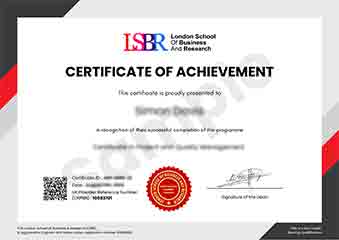
Sample Certificate
Preview the certificate you'll receive upon successful completion of this program.
Get Free Course Info
Enter your details and we'll send you a comprehensive course information pack straight to your inbox.
Employer Sponsored Training
Let your employer invest in your professional development. Request a corporate invoice and get your training funded.
Request Corporate InvoiceWhat People Say About Us
Hear from our students about their experience with the Certificate in Quantum Machine Learning for Predictive Analytics at LSBRX - Executive Education.
James Thompson
United Kingdom"The course content is incredibly thorough and well-structured, providing a solid foundation in quantum machine learning that has significantly enhanced my ability to apply these techniques in predictive analytics. I've gained practical skills that are directly applicable to real-world problems, which I believe will be invaluable in my career."
Emma Tremblay
Canada"This certificate program has been instrumental in enhancing my understanding of quantum machine learning, making me more competitive in the tech industry. It has provided me with practical tools and insights that I am already applying to real-world predictive analytics problems, opening up new career opportunities in cutting-edge research and development."
Oliver Davies
United Kingdom"The course's well-structured modules provided a comprehensive understanding of quantum machine learning, making complex concepts accessible and relevant to real-world predictive analytics challenges, which significantly enhanced my professional growth in this field."