
Certificate in Robust Design Optimization Techniques
This certificate equips professionals with advanced techniques for optimizing robust designs, enhancing product reliability and performance.
Certificate in Robust Design Optimization Techniques
Programme Overview
The Certificate in Robust Design Optimization Techniques is a comprehensive professional program designed for engineers, data scientists, and researchers seeking to enhance their ability to design and optimize products and systems under varying conditions. This program equips participants with advanced methodologies and tools that enable them to create robust designs that perform consistently across a range of operating conditions and uncertainties. Through a blend of theoretical instruction and practical application, learners will delve into key topics such as stochastic optimization, design of experiments, and response surface methodology.
Participants will develop essential skills in stochastic modeling, parameter estimation, and reliability analysis. They will learn how to apply optimization algorithms to real-world problems, integrate simulation tools for complex systems, and utilize statistical techniques to evaluate design robustness. By the end of the program, learners will be proficient in using various software packages and programming languages, such as Python, MATLAB, and R, to perform robust design optimization.
The career impact of this program is significant. Graduates will be well-prepared to lead projects that require advanced optimization techniques in various industries, including automotive, aerospace, electronics, and biotechnology. They will be able to contribute to the development of more reliable and efficient products, enhance product lifecycle management, and drive innovation through data-driven design processes. The skills acquired will also enable them to take on more complex roles in research and development, quality assurance, and process engineering.
What You'll Learn
The Certificate in Robust Design Optimization Techniques is a comprehensive program designed for engineers and professionals seeking to enhance their skills in optimizing design processes to achieve superior performance under varying conditions. This program equips participants with advanced methodologies and tools to handle complex design challenges, ensuring robustness and reliability in their work.
Key topics include statistical analysis, optimization algorithms, design of experiments, and simulation techniques. Participants learn to apply these concepts to real-world scenarios, improving product performance and reducing development cycles. By mastering these techniques, graduates can significantly enhance the quality and efficiency of their designs, making them invaluable in industries ranging from automotive and aerospace to electronics and manufacturing.
Upon completion, graduates can pursue roles such as design engineers, product development specialists, or quality assurance analysts. They can also contribute to research and development teams, drive innovation, and lead projects focused on optimizing design processes. This program not only provides a strong foundation in robust design optimization but also offers practical skills that are in high demand across various sectors, positioning graduates for successful careers and leadership roles.
Programme Highlights
Industry-Aligned Curriculum
Developed with industry leaders for job-ready skills valued by employers worldwide.
Globally Recognised Certificate
Recognised by employers across 180+ countries as a mark of professional excellence.
Flexible Online Learning
Study at your own pace with lifetime access to all course materials and updates.
Instant Access
Start learning immediately — no application process or waiting period required.
Constantly Updated Content
Stay ahead with the latest industry trends, best practices, and emerging insights.
Career Advancement
87% of graduates report measurable career progression within 6 months of completion.
Topics Covered
- 1. Introduction to Robust Design Optimization: Learners will explore foundational concepts of robust design optimization, including its importance in engineering design and the basics of statistical methods used in the field. They will gain an understanding of how to formulate robust design problems and apply basic optimization techniques.
- 2. Statistical Methods for Robust Design: This module will introduce learners to various statistical methods used in robust design optimization, such as Monte Carlo simulation, response surface methodology, and design of experiments. They will learn how to use these methods to analyze and optimize design parameters effectively.
- 3. Fundamentals of Optimization Techniques: Learners will study essential optimization techniques including gradient-based methods and metaheuristic algorithms. They will understand the strengths and limitations of different optimization algorithms and how to select appropriate methods for specific design problems.
- 4. Robust Design Optimization Methods: This module focuses on advanced robust design optimization methods, such as robust design of experiments (RDOE) and robust optimization. Learners will learn how to apply these techniques to improve the robustness of engineering designs against uncertainties.
- 5. Uncertainty Modeling and Analysis: Learners will delve into methods for modeling and analyzing uncertainties in design parameters and system behavior. They will learn how to quantify and manage uncertainties to ensure robustness in the design process.
- 6. Case Studies in Robust Design Optimization: Through real-world case studies, learners will apply robust design optimization techniques to solve practical engineering problems. They will gain hands-on experience in formulating, solving, and interpreting robust design optimization problems.
- 7. Advanced Optimization Algorithms: This module covers advanced optimization algorithms, including evolutionary algorithms, particle swarm optimization, and simulated annealing. Learners will learn how to implement and tune these algorithms for robust design optimization.
- 8. Integration of Robust Design with CAD/CAE Systems: Learners will explore how to integrate robust design optimization techniques with computer-aided design (CAD) and computer-aided engineering (CAE) systems. They will learn how to automate the design optimization process and work seamlessly with existing engineering tools.
- 9. Robust Design Optimization in Multidisciplinary Systems: This module focuses on robust design optimization in multidisciplinary systems, where multiple disciplines interact. Learners will learn how to handle dependencies and interactions between different system components in the optimization process.
- 10. Final Project: Robust Design Optimization Case Study: In this module, learners will work on a comprehensive final project where they will apply all the knowledge and skills gained throughout the course to solve a real-world robust design optimization problem. They will present their findings and solutions, demonstrating their proficiency in the subject.
What You Get When You Enroll
Secure checkout • Instant access • Certificate included
Key Facts
Audience: Engineers, researchers, data analysts
Prerequisites: Basic calculus, statistics knowledge
Outcomes: Understand robust optimization, apply techniques, solve complex problems
Ready to get started?
Join thousands of professionals who already took the next step. Enroll now and get instant access.
Enroll Now — $79Why This Course
Professionals pursuing a Certificate in Robust Design Optimization Techniques gain a competitive edge by mastering advanced methodologies. These techniques enable them to design products that perform consistently across various conditions, reducing the risk of failure and enhancing customer satisfaction. For instance, automotive engineers who apply robust design principles can create components that withstand a wider range of temperatures and pressures, improving vehicle reliability.
This certification significantly enhances career prospects by making candidates more versatile and valuable to employers. The ability to optimize designs under uncertainty is a rare skill that bridges the gap between theoretical models and practical applications. Engineers with this certificate can address complex, real-world challenges more effectively, leading to faster project completion and higher quality outcomes.
Professionals who earn this certificate develop specialized skills in statistical analysis and simulation, which are crucial for modern engineering and manufacturing processes. They learn to use sophisticated tools and software, such as Design of Experiments (DOE) and Response Surface Methodology (RSM), to optimize product performance and reduce variability. These skills not only improve individual productivity but also foster innovation and efficiency in their teams and organizations.
Your Path to Certification
Trusted by Professionals Worldwide
Course Brochure
Download our comprehensive course brochure with all details
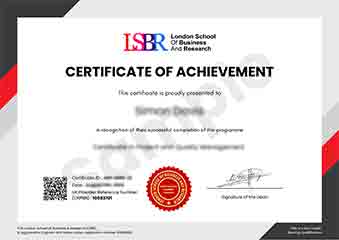
Sample Certificate
Preview the certificate you'll receive upon successful completion of this program.
Get Free Course Info
Enter your details and we'll send you a comprehensive course information pack straight to your inbox.
Employer Sponsored Training
Let your employer invest in your professional development. Request a corporate invoice and get your training funded.
Request Corporate InvoiceWhat People Say About Us
Hear from our students about their experience with the Certificate in Robust Design Optimization Techniques at LSBRX - Executive Education.
Oliver Davies
United Kingdom"The course provided an in-depth understanding of robust design optimization techniques, which significantly enhanced my ability to solve complex engineering problems. Gaining these practical skills has been incredibly beneficial for my career, as I can now apply them directly in my work to improve product reliability and performance."
Jack Thompson
Australia"This course has been incredibly valuable, equipping me with advanced optimization techniques that are directly applicable in my field. It has not only enhanced my analytical skills but also opened up new career opportunities in areas that require robust design optimization."
Tyler Johnson
United States"The course structure is well-organized, providing a clear path from foundational concepts to advanced techniques in robust design optimization, which has significantly enhanced my understanding and ability to apply these methods in practical scenarios."