
Certificate in Statistical Analysis for Extensive Data Sets
This certificate equips learners with advanced statistical analysis skills for managing and interpreting extensive data sets, enhancing data-driven decision-making capabilities.
Certificate in Statistical Analysis for Extensive Data Sets
Programme Overview
The 'Certificate in Statistical Analysis for Extensive Data Sets' is a comprehensive programme designed for professionals in fields such as data science, business analytics, research, and academia who require advanced skills in handling and analyzing large, complex datasets. The curriculum covers essential topics including data management, statistical inference, regression analysis, machine learning techniques, and data visualization, equipping learners with the ability to effectively manage and extract actionable insights from extensive data.
Participants will develop a robust set of skills, including proficiency in using statistical software like R and Python for data manipulation and analysis, understanding of statistical models and their applications, and practical experience with big data technologies such as Hadoop and Spark. Through hands-on projects and case studies, learners will gain expertise in predictive modeling, time series analysis, and the ethical considerations of data analysis, ensuring they can confidently apply these skills in real-world scenarios.
The programme significantly enhances career prospects by preparing graduates to lead data-driven projects, make informed business decisions, and contribute to cutting-edge research. It positions professionals to excel in roles such as data analyst, data scientist, or research analyst, where they can leverage their statistical acumen to solve complex problems and drive innovation in their organizations.
What You'll Learn
The Certificate in Statistical Analysis for Extensive Data Sets is designed to equip professionals with the advanced skills needed to navigate and extract meaningful insights from large, complex datasets. This comprehensive program covers essential topics such as data cleaning, exploratory data analysis, statistical modeling, and predictive analytics, using both theoretical frameworks and practical applications. Participants will gain proficiency in using Python and R, two leading languages in data science, and will learn to leverage big data tools and techniques to handle massive datasets efficiently.
Upon completion, graduates will be well-prepared to apply these skills in real-world scenarios, such as business intelligence, healthcare research, and financial modeling. They will be able to design and execute statistical analyses, interpret results, and communicate findings to stakeholders effectively. This certificate is a stepping stone for careers in data science, analytics, and business intelligence, providing a solid foundation for those aiming to make data-driven decisions in various industries.
Graduates will be eligible for roles such as data analyst, business analyst, data scientist, and quantitative analyst. The program is ideal for professionals in fields like finance, healthcare, marketing, and tech, as well as for those transitioning into data-driven roles or seeking to enhance their analytical capabilities in their current positions. By mastering the techniques and tools covered, participants will be well-equipped to tackle the challenges of extensive data sets and drive informed decision-making in their organizations.
Programme Highlights
Industry-Aligned Curriculum
Developed with industry leaders for job-ready skills valued by employers worldwide.
Globally Recognised Certificate
Recognised by employers across 180+ countries as a mark of professional excellence.
Flexible Online Learning
Study at your own pace with lifetime access to all course materials and updates.
Instant Access
Start learning immediately — no application process or waiting period required.
Constantly Updated Content
Stay ahead with the latest industry trends, best practices, and emerging insights.
Career Advancement
87% of graduates report measurable career progression within 6 months of completion.
Topics Covered
- 1. Introduction to Statistical Analysis: Learners will be introduced to basic statistical concepts, including data types, measures of central tendency, and variability. They will gain foundational skills in using statistical software to organize and summarize data.
- 2. Probability Theory and Distributions: Students will explore probability theory and its application in statistical analysis, focusing on common distributions such as normal, binomial, and Poisson. They will learn to calculate probabilities and understand their significance in data analysis.
- 3. Descriptive Statistics and Data Visualization: This module covers techniques for summarizing and presenting data through graphs and tables. Learners will develop skills in using software tools to create effective visualizations and interpret descriptive statistics.
- 4. Inferential Statistics: Confidence Intervals: Students will learn how to construct confidence intervals to estimate population parameters based on sample data. Practical skills include using statistical software to perform calculations and interpret results.
- 5. Hypothesis Testing: This module introduces hypothesis testing procedures, including t-tests, chi-square tests, and ANOVA. Learners will practice formulating hypotheses, conducting tests, and drawing conclusions based on statistical evidence.
- 6. Regression Analysis: Students will delve into regression analysis, covering simple and multiple linear regression. They will learn to model relationships between variables, interpret regression coefficients, and assess model fit.
- 7. Advanced Regression Techniques: This module covers advanced regression methods such as logistic regression, polynomial regression, and interaction terms. Learners will gain the ability to handle more complex data structures and relationships.
- 8. Multivariate Analysis: Students will study multivariate techniques, including principal component analysis and factor analysis. They will learn to reduce data dimensionality and uncover underlying patterns in extensive datasets.
- 9. Time Series Analysis: This module focuses on analyzing data collected over time, covering methods such as moving averages, ARIMA models, and seasonal adjustments. Learners will develop skills in forecasting and analyzing time-dependent data.
- 10. Big Data and Data Management: Learners will explore strategies for managing and analyzing large datasets efficiently. Topics include data cleaning, preprocessing, and the use of big data tools and technologies.
What You Get When You Enroll
Secure checkout • Instant access • Certificate included
Key Facts
For professionals and students
No prior stats knowledge required
Understands data analysis techniques
Analyzes extensive data sets
Uses statistical software tools
Communicates findings effectively
Ready to get started?
Join thousands of professionals who already took the next step. Enroll now and get instant access.
Enroll Now — $79Why This Course
Enhance Analytical Skills: The Certificate in Statistical Analysis for Extensive Data Sets equips professionals with advanced statistical tools and techniques, such as regression analysis, predictive modeling, and machine learning, which are crucial for making data-driven decisions. This skill set is in high demand across industries, from finance and healthcare to technology and marketing.
Boost Career Opportunities: With the increasing reliance on data for strategic planning, this certificate can help professionals transition into specialized roles such as data analysts, data scientists, or business intelligence specialists. Employers often seek candidates with advanced statistical expertise for roles that require in-depth data analysis and interpretation.
Improve Decision-Making: By understanding complex data sets and applying statistical methods, professionals can uncover hidden insights and patterns. This capability is invaluable in fields like healthcare, where statistical analysis can improve patient outcomes, or in finance, where it can enhance risk management strategies.
Stay Competitive in the Job Market: As data analytics becomes more integral to business success, having a formal certification in advanced statistical analysis can set professionals apart from their peers. This credential demonstrates a commitment to continuous learning and expertise in a rapidly evolving field, making candidates more attractive to potential employers.
Your Path to Certification
Trusted by Professionals Worldwide
Course Brochure
Download our comprehensive course brochure with all details
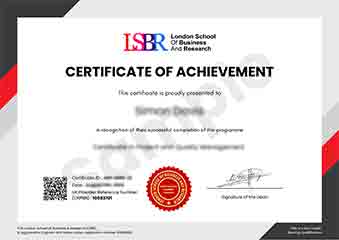
Sample Certificate
Preview the certificate you'll receive upon successful completion of this program.
Get Free Course Info
Enter your details and we'll send you a comprehensive course information pack straight to your inbox.
Employer Sponsored Training
Let your employer invest in your professional development. Request a corporate invoice and get your training funded.
Request Corporate InvoiceWhat People Say About Us
Hear from our students about their experience with the Certificate in Statistical Analysis for Extensive Data Sets at LSBRX - Executive Education.
Sophie Brown
United Kingdom"The course provided comprehensive and well-structured content that significantly enhanced my ability to analyze large data sets, equipping me with practical skills in statistical methods and software tools that are highly valuable for my career in data analysis."
Sophie Brown
United Kingdom"The certificate in Statistical Analysis for Extensive Data Sets has been incredibly valuable, equipping me with the tools to analyze large datasets effectively and make data-driven decisions that have a direct impact on my projects. This skill set has opened up new opportunities in my career, allowing me to contribute more meaningfully to my team's goals."
Ahmad Rahman
Malaysia"The course structure is well-organized, providing a comprehensive understanding of statistical analysis techniques that are directly applicable to real-world data sets, significantly enhancing my professional skills in data interpretation and analysis."