
Executive Development Programme in Analyzing Economic Time Series Data
This programme equips executives with advanced skills in analyzing economic time series data, enhancing strategic decision-making and predictive analytics capabilities.
Executive Development Programme in Analyzing Economic Time Series Data
Programme Overview
The Executive Development Programme in Analyzing Economic Time Series Data is designed for senior executives, data analysts, and financial professionals who require advanced skills in interpreting and utilizing time series data for strategic decision-making. This comprehensive programme equips participants with the latest methodologies and tools for analyzing economic trends, forecasting future market conditions, and making informed business decisions.
Participants will develop a robust set of skills in statistical analysis, econometric modeling, and data visualization, enabling them to effectively manage and interpret complex economic data. Key knowledge areas include understanding time series decomposition, applying ARIMA models, conducting seasonal adjustments, and leveraging machine learning techniques for predictive analytics. Participants will also learn to use specialized software and programming languages such as Python and R, enhancing their ability to process large datasets and generate actionable insights.
The programme has a significant impact on career progression, equipping participants with advanced analytical skills that are highly valued in the business world. Graduates will be better positioned to lead data-driven initiatives, optimize business strategies, and navigate economic uncertainties. This program not only enhances individual expertise but also contributes to the strategic direction of their organizations by providing them with the tools to interpret economic trends and make data-informed decisions.
What You'll Learn
Delve into the dynamic world of economic analysis with our Executive Development Programme in Analyzing Economic Time Series Data. This comprehensive program equips you with advanced skills in handling and interpreting complex economic data, enabling you to make informed decisions and drive strategic initiatives. Key topics include time series analysis, econometrics, forecasting models, and data visualization techniques, all underpinned by real-world case studies and industry insights.
Participants will learn to analyze historical data, identify trends, and predict future economic scenarios using cutting-edge statistical tools and software. You will gain proficiency in using R or Python for data manipulation and analysis, and master the art of communicating complex economic insights to non-technical stakeholders. The program also emphasizes ethical considerations in data analysis and the responsible use of data in decision-making processes.
By the end of the program, you will be well-prepared to lead projects that require rigorous economic analysis, whether in financial consulting, policy-making, or corporate strategy roles. Graduates can expect to enhance their analytical capabilities, improve forecasting accuracy, and contribute significantly to strategic planning in various sectors, including finance, economics, and business strategy. Join us to transform raw data into actionable intelligence and propel your career to new heights.
Programme Highlights
Industry-Aligned Curriculum
Developed with industry leaders for job-ready skills valued by employers worldwide.
Globally Recognised Certificate
Recognised by employers across 180+ countries as a mark of professional excellence.
Flexible Online Learning
Study at your own pace with lifetime access to all course materials and updates.
Instant Access
Start learning immediately — no application process or waiting period required.
Constantly Updated Content
Stay ahead with the latest industry trends, best practices, and emerging insights.
Career Advancement
87% of graduates report measurable career progression within 6 months of completion.
Topics Covered
- 1. Introduction to Economic Time Series Data: Learners will study the basics of economic time series data, including definitions and types, and gain foundational knowledge on data collection methods. They will learn to use basic software tools to import and manage time series data.
- 2. Descriptive Statistics for Time Series: This module covers the application of descriptive statistics to time series data, enabling learners to summarize and visualize data trends effectively. Practical skills include computing mean, variance, and autocorrelation functions using statistical software.
- 3. Stationarity and Differencing: Learners will understand the concept of stationarity in time series data and its importance in analysis. They will learn techniques to make non-stationary data stationary through differencing and other transformations, using software tools.
- 4. Decomposition of Time Series: This module focuses on decomposing time series data into trend, seasonal, and irregular components. Learners will gain skills in applying decomposition techniques and interpreting the results.
- 5. Autoregressive Integrated Moving Average (ARIMA) Models: Learners will study ARIMA models, including their components and fitting procedures. Practical exercises will cover model identification, estimation, and forecasting using statistical software.
- 6. Vector Autoregression (VAR) Models: This module introduces VAR models for analyzing multiple time series data. Learners will learn how to specify, estimate, and interpret VAR models, and perform impulse response analysis.
- 7. Seasonal Adjustment Techniques: Learners will explore various seasonal adjustment techniques, including X-13ARIMA-SEATS. They will learn to apply these techniques to real-world data and interpret the adjusted series.
- 8. Forecasting Models: This module covers different forecasting models and techniques, such as exponential smoothing and state space models. Practical skills include model selection, parameter tuning, and evaluating forecast accuracy.
- 9. Cointegration and Error Correction Models: Learners will study cointegration and its application in modeling long-term relationships between non-stationary time series. They will learn to estimate and interpret error correction models.
- 10. Advanced Topics in Time Series Analysis: This module delves into advanced topics like volatility modeling (GARCH models), machine learning techniques for time series, and big data challenges in time series analysis. Learners will engage in case studies and projects to apply advanced techniques.
What You Get When You Enroll
Secure checkout • Instant access • Certificate included
Key Facts
Audience: Professionals in economics, finance, and related fields
Prerequisites: Basic knowledge of statistics and economics
Outcomes: Proficient in analyzing economic time series data
Ready to get started?
Join thousands of professionals who already took the next step. Enroll now and get instant access.
Enroll Now — $199Why This Course
Enhanced Analytical Skills: Participating in an Executive Development Programme in Analyzing Economic Time Series Data equips professionals with advanced analytical techniques, enabling them to interpret complex economic data more effectively. This skill is crucial for making informed strategic decisions and staying ahead in competitive markets.
Improved Forecasting Capabilities: The programme focuses on predictive modeling, which helps professionals develop robust forecasting models. This capability is essential for anticipating market trends, planning financial strategies, and mitigating risks. For instance, accurate forecasts can significantly enhance the performance of investment portfolios or inform strategic business planning.
Decision-Making Excellence: By mastering the analysis of economic time series data, professionals can make data-driven decisions based on empirical evidence. This approach reduces the reliance on intuition and enhances decision-making processes. For example, a business leader using these skills can more confidently decide on expansion, contraction, or investment in new markets, leading to better strategic outcomes.
Competitive Edge in Job Market: Acquiring specialized skills in analyzing economic time series data can set professionals apart in the job market. Companies increasingly seek individuals who can leverage data to drive business performance. This programme not only provides a solid foundation in the necessary techniques but also offers real-world case studies and industry insights, making graduates highly sought after in both private and public sectors.
Your Path to Certification
Trusted by Professionals Worldwide
Course Brochure
Download our comprehensive course brochure with all details
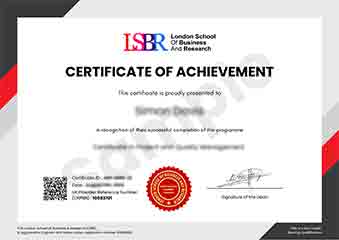
Sample Certificate
Preview the certificate you'll receive upon successful completion of this program.
Get Free Course Info
Enter your details and we'll send you a comprehensive course information pack straight to your inbox.
Employer Sponsored Training
Let your employer invest in your professional development. Request a corporate invoice and get your training funded.
Request Corporate InvoiceWhat People Say About Us
Hear from our students about their experience with the Executive Development Programme in Analyzing Economic Time Series Data at LSBRX - Executive Education.
Charlotte Williams
United Kingdom"The course provided high-quality material that significantly enhanced my ability to analyze economic time series data, equipping me with practical skills that are directly applicable in my career. I gained a deeper understanding of economic trends and forecasting methods, which has been invaluable in my professional development."
Tyler Johnson
United States"The Executive Development Programme in Analyzing Economic Time Series Data has significantly enhanced my ability to analyze market trends and make informed strategic decisions, directly contributing to my recent promotion to a senior analyst role. This course provided me with practical tools and insights that are highly relevant in the current business environment, setting me apart in my field."
Jack Thompson
Australia"The course structure was meticulously organized, providing a seamless transition from theoretical concepts to practical applications in economic time series analysis, which significantly enhanced my understanding and prepared me for real-world challenges."