
Executive Development Programme in Automating Grading with Machine Learning
This program equips executives with the knowledge and skills to automate grading using machine learning, enhancing efficiency and accuracy in educational institutions.
Executive Development Programme in Automating Grading with Machine Learning
Programme Overview
The Executive Development Programme in Automating Grading with Machine Learning is designed for educational leaders, academic administrators, and professionals in the education sector who seek to enhance their institution's assessment capabilities through the integration of advanced machine learning techniques. This program is tailored to equip participants with the skills necessary to analyze, implement, and oversee the automation of grading processes, thereby improving efficiency and fairness in educational assessments.
Participants will develop a comprehensive understanding of machine learning algorithms and their applications in grading, including data preprocessing, model selection, and evaluation metrics. They will also learn to use relevant software tools and programming languages such as Python and TensorFlow to develop and deploy automated grading systems. Additionally, the program emphasizes ethical considerations in algorithmic grading and the importance of continuous model refinement to ensure accurate and unbiased assessments.
This programme will have a significant impact on participants' careers, enabling them to lead or support initiatives that transform traditional grading practices. Graduates will be well-prepared to foster a data-driven educational environment, enhance student learning outcomes, and demonstrate the value of technology in modern education. The ability to automate grading processes will not only streamline administrative tasks but also allow educators to focus on more personalized and meaningful interactions with students, ultimately contributing to a more efficient and effective educational system.
What You'll Learn
The Executive Development Programme in Automating Grading with Machine Learning is designed for educators, administrators, and industry professionals aiming to harness the power of machine learning to revolutionize grading processes. This cutting-edge program equips participants with the skills to develop, implement, and optimize machine learning models for automated grading, ensuring accuracy, consistency, and efficiency in educational assessments.
Key topics include the foundational concepts of machine learning, data preprocessing techniques, model selection, and evaluation metrics. Participants delve into specific algorithms and tools, such as Python and TensorFlow, through hands-on workshops and real-world case studies. The program also covers ethical considerations in education technology and strategies for fostering student engagement and equity.
Graduates of this program are well-prepared to lead the automation of grading systems in educational institutions, enhancing the learning experience and freeing educators for more impactful work. They can also explore roles in educational technology companies, where they can develop innovative solutions to improve assessment tools and policies. By the end of the program, participants will have a comprehensive understanding of how machine learning can transform educational assessment practices, opening doors to a wide range of career opportunities in both education and technology sectors.
Programme Highlights
Industry-Aligned Curriculum
Developed with industry leaders for job-ready skills valued by employers worldwide.
Globally Recognised Certificate
Recognised by employers across 180+ countries as a mark of professional excellence.
Flexible Online Learning
Study at your own pace with lifetime access to all course materials and updates.
Instant Access
Start learning immediately — no application process or waiting period required.
Constantly Updated Content
Stay ahead with the latest industry trends, best practices, and emerging insights.
Career Advancement
87% of graduates report measurable career progression within 6 months of completion.
Topics Covered
- 1. Introduction to Machine Learning: Learners will understand the basics of machine learning, including supervised and unsupervised learning, and gain foundational knowledge to apply ML in grading systems. They will learn how to prepare data and evaluate model performance.
- 2. Data Preprocessing for Grading Systems: This module covers the essential steps in data cleaning, normalization, and feature selection, specifically tailored for educational grading data. Learners will practice preprocessing techniques using real-world datasets.
- 3. Building a Basic Grading Model: Here, learners will create a simple machine learning model for grading based on predefined criteria. They will learn to implement a model using Python and libraries such as scikit-learn.
- 4. Advanced Model Selection and Validation: This module delves into various model selection techniques and validation methods, including cross-validation and hyperparameter tuning. Learners will apply these techniques to optimize their grading models.
- 5. Natural Language Processing for Text-Based Assessments: Focusing on text data, learners will explore NLP techniques to analyze and grade written responses. They will work on projects involving text classification and sentiment analysis.
- 6. Implementing Automated Grading Systems: This module covers the practical aspects of deploying machine learning models in real-world grading systems. Learners will learn about APIs, integration with existing systems, and user interfaces.
- 7. Ethical Considerations in Grading with Machine Learning: A critical discussion on the ethical implications of using machine learning in grading, including bias detection and mitigation. Learners will analyze case studies and develop strategies to ensure fair and unbiased grading.
- 8. Enhancing Grading Models with Deep Learning: Introducing deep learning concepts and architectures, learners will build and train neural networks for grading. They will explore convolutional neural networks and recurrent neural networks tailored to grading tasks.
- 9. Case Studies in Automating Grading: Through case studies, learners will see how machine learning is applied in various educational settings. They will analyze successful implementations and discuss challenges faced during the process.
- 10. Future Trends in Automated Grading: This final module explores emerging trends and technologies in automated grading. Learners will discuss the impact of advancements in AI and machine learning on the future of education and assessment.
What You Get When You Enroll
Secure checkout • Instant access • Certificate included
Key Facts
Audience: Mid-level to senior educators, tech enthusiasts
Prerequisites: Basic knowledge of grading processes, machine learning concepts
Outcomes: Enhanced skills in automating assessments, improved grading efficiency
Ready to get started?
Join thousands of professionals who already took the next step. Enroll now and get instant access.
Enroll Now — $199Why This Course
Enhance Career Versatility: By participating in an Executive Development Programme in Automating Grading with Machine Learning, professionals can expand their skill set to include advanced analytics and data-driven decision-making capabilities. This knowledge is highly valuable in a variety of industries, from education to corporate training, enabling them to automate and streamline grading processes, thereby increasing efficiency and accuracy.
Boost Leadership Competence: This program equips participants with the technical understanding necessary to lead teams that manage and implement machine learning solutions. Graduates can take on more complex roles requiring both technical expertise and leadership, such as overseeing large-scale automation projects or guiding data science initiatives.
Drive Innovation and Efficiency: Professionals who acquire skills in automating grading with machine learning can innovate within their organization by developing custom automation tools. These tools can significantly reduce the time and effort required for manual grading, freeing up resources for more strategic initiatives. Additionally, the program provides insights into how to effectively integrate machine learning models into existing workflows, ensuring smooth and effective transitions.
Your Path to Certification
Trusted by Professionals Worldwide
Course Brochure
Download our comprehensive course brochure with all details
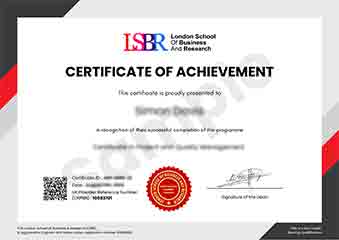
Sample Certificate
Preview the certificate you'll receive upon successful completion of this program.
Get Free Course Info
Enter your details and we'll send you a comprehensive course information pack straight to your inbox.
Employer Sponsored Training
Let your employer invest in your professional development. Request a corporate invoice and get your training funded.
Request Corporate InvoiceWhat People Say About Us
Hear from our students about their experience with the Executive Development Programme in Automating Grading with Machine Learning at LSBRX - Executive Education.
James Thompson
United Kingdom"The course content was incredibly well-researched and up-to-date, providing a solid foundation in automating grading with machine learning. I gained practical skills that I can immediately apply to improve our grading processes at work, which has already enhanced my job performance and opened up new opportunities for automation in my field."
Rahul Singh
India"This course has been incredibly valuable in enhancing my ability to implement machine learning solutions in automating grading processes, making my work more efficient and accurate. It has directly contributed to my career advancement by equipping me with industry-relevant skills that are in high demand."
Rahul Singh
India"The course structure was meticulously organized, providing a seamless transition from foundational concepts to advanced applications in automating grading with machine learning, which significantly enhanced my understanding and practical skills in the field. The comprehensive content and real-world examples were particularly beneficial for applying theoretical knowledge to solve complex problems in a professional setting."