
Executive Development Programme in Data Mining and Quantitative Research Methods
This program equips executives with advanced data mining and quantitative research skills for informed decision-making and strategic advantage.
Executive Development Programme in Data Mining and Quantitative Research Methods
Programme Overview
The Executive Development Programme in Data Mining and Quantitative Research Methods is designed for senior executives and professionals seeking to deepen their understanding and expertise in leveraging data to drive strategic decisions. This program is ideal for those in leadership roles who wish to enhance their analytical capabilities and stay at the forefront of data-driven decision-making in their industries. Participants will engage in a comprehensive curriculum that includes advanced data mining techniques, statistical analysis, machine learning algorithms, and predictive modeling.
Through hands-on workshops, case studies, and real-world applications, learners will develop a robust set of skills in data mining and quantitative research methods. The program emphasizes practical skills such as data cleaning, feature selection, model validation, and the interpretation of complex data outputs. Additionally, participants will gain proficiency in using advanced statistical software and programming languages like Python and R, enabling them to effectively analyze large datasets and derive actionable insights.
The career impact of this program is significant, as participants will be better equipped to lead data-driven initiatives, optimize business operations, and make informed strategic decisions. They will be able to transform complex data into valuable business intelligence, enhancing their leadership and decision-making capabilities. Graduates of this program are well-prepared to take on more complex roles, such as data science leadership positions or consulting roles that require a deep understanding of data analytics.
What You'll Learn
The Executive Development Programme in Data Mining and Quantitative Research Methods is designed for professionals seeking to enhance their analytical capabilities in data-driven decision-making. This comprehensive program equips participants with advanced skills in data mining, statistical analysis, and machine learning, providing a robust framework for analyzing complex datasets and uncovering actionable insights. Key topics include predictive modeling, data visualization, big data technologies, and ethical considerations in data science.
Participants learn through hands-on workshops, real-world case studies, and guest lectures from industry leaders. By the end of the program, graduates are proficient in leveraging quantitative research methods to inform strategy, optimize operations, and drive innovation in their organizations. They acquire the expertise to lead data projects, interpret data-driven insights, and communicate findings effectively to stakeholders.
This program opens doors to diverse career opportunities in data science, business analytics, market research, and beyond. Graduates are well-prepared for roles such as data scientist, quantitative analyst, research manager, or business intelligence analyst. The program also facilitates networking with industry professionals and alumni, providing a support network for career advancement and collaboration.
Programme Highlights
Industry-Aligned Curriculum
Developed with industry leaders for job-ready skills valued by employers worldwide.
Globally Recognised Certificate
Recognised by employers across 180+ countries as a mark of professional excellence.
Flexible Online Learning
Study at your own pace with lifetime access to all course materials and updates.
Instant Access
Start learning immediately — no application process or waiting period required.
Constantly Updated Content
Stay ahead with the latest industry trends, best practices, and emerging insights.
Career Advancement
87% of graduates report measurable career progression within 6 months of completion.
Topics Covered
- 1. Introduction to Data Mining and Quantitative Research: Learners will explore fundamental concepts of data mining and quantitative research, including types of data, research design, and basic statistical methods. They will gain foundational skills in data collection, data cleaning, and basic data analysis.
- 2. Data Visualization and Exploratory Data Analysis: This module covers techniques for visualizing data and performing exploratory data analysis. Learners will study various visualization tools and methods to uncover patterns and insights in data, enhancing their ability to communicate findings effectively.
- 3. Statistical Inference and Hypothesis Testing: Learners will delve into statistical inference, including hypothesis testing, confidence intervals, and p-values. Practical skills in using statistical software to conduct hypothesis tests and interpret results will be developed.
- 4. Regression Analysis: This module focuses on linear and multiple regression analysis, including model building, diagnostics, and interpretation. Learners will gain proficiency in using regression models to predict outcomes and understand relationships between variables.
- 5. Advanced Regression Techniques: Building on basic regression analysis, learners will explore advanced techniques such as logistic regression, ordinal regression, and generalized linear models. Practical skills in selecting appropriate models and interpreting complex results will be emphasized.
- 6. Machine Learning Fundamentals: Learners will be introduced to machine learning concepts, including supervised and unsupervised learning. They will gain hands-on experience with common machine learning algorithms and techniques for data classification and clustering.
- 7. Predictive Modeling: This module covers the development of predictive models using various machine learning algorithms. Learners will learn how to build, evaluate, and validate predictive models, focusing on model selection and performance optimization.
- 8. Time Series Analysis: Learners will study time series data and the methods used for forecasting future values. Practical skills in analyzing and predicting trends, seasonality, and other temporal patterns in data will be developed.
- 9. Big Data Technologies: This module introduces learners to big data technologies and frameworks such as Hadoop and Spark. They will gain practical experience in handling large datasets and performing big data analysis.
- 10. Research Project: In this final module, learners will apply the skills and knowledge gained throughout the programme to a comprehensive research project. They will design, implement, and present a data mining and quantitative research project, showcasing their ability to solve real-world problems.
What You Get When You Enroll
Secure checkout • Instant access • Certificate included
Key Facts
Audience: Mid-level to senior executives
Prerequisites: Basic statistics knowledge
Outcomes: Expertise in data mining techniques
Outcomes: Advanced quantitative research skills
Outcomes: Data-driven decision-making ability
Ready to get started?
Join thousands of professionals who already took the next step. Enroll now and get instant access.
Enroll Now — $199Why This Course
Enhanced Analytical Skills: Participating in an Executive Development Programme in Data Mining and Quantitative Research Methods equips professionals with advanced analytical tools and techniques. These skills enable them to derive meaningful insights from complex data sets, making them invaluable to decision-making processes in their organizations. For instance, a marketing manager might use these skills to predict consumer behavior trends, thus optimizing marketing strategies.
Competitive Edge in Hiring: As the digital transformation continues, organizations increasingly value employees who can handle big data and apply quantitative research methods. This program not only teaches the technical aspects of data mining but also enhances one's ability to communicate findings effectively. This combination makes professionals more attractive to potential employers and more marketable in their current roles.
Leadership and Strategic Impact: The program integrates advanced data analysis with leadership and strategic planning to help professionals make data-driven decisions at a higher level. Leaders who can leverage data effectively can drive significant improvements in efficiency, innovation, and overall organizational performance. For example, a director of operations could use these skills to streamline supply chain processes, reducing costs and improving customer satisfaction.
Your Path to Certification
Trusted by Professionals Worldwide
Course Brochure
Download our comprehensive course brochure with all details
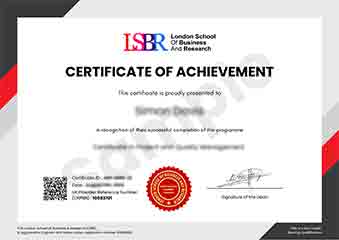
Sample Certificate
Preview the certificate you'll receive upon successful completion of this program.
Get Free Course Info
Enter your details and we'll send you a comprehensive course information pack straight to your inbox.
Employer Sponsored Training
Let your employer invest in your professional development. Request a corporate invoice and get your training funded.
Request Corporate InvoiceWhat People Say About Us
Hear from our students about their experience with the Executive Development Programme in Data Mining and Quantitative Research Methods at LSBRX - Executive Education.
Sophie Brown
United Kingdom"The course provided high-quality, up-to-date material that significantly enhanced my analytical skills, particularly in data mining and quantitative research. It has already proven invaluable in my current role, allowing me to approach complex problems with more confidence and precision."
Rahul Singh
India"The Executive Development Programme in Data Mining and Quantitative Research Methods has been incredibly transformative, equipping me with advanced analytical skills that are directly applicable in my role. This course has not only enhanced my ability to interpret complex data but also opened up new career opportunities in data-driven decision-making roles."
Liam O'Connor
Australia"The course structure was meticulously organized, providing a seamless transition from theoretical concepts to practical applications, which significantly enhanced my understanding and prepared me for real-world challenges in data mining and research."