
Executive Development Programme in Developing and Evaluating Test Items
This programme equips executives with skills to develop and evaluate test items, enhancing assessment validity and effectiveness.
Executive Development Programme in Developing and Evaluating Test Items
Programme Overview
The Executive Development Programme in Developing and Evaluating Test Items is designed for senior education professionals, test developers, and researchers aiming to enhance their expertise in crafting and assessing high-quality educational assessments. Participants will gain a deep understanding of the theoretical foundations and practical applications of item development, ensuring that test items are reliable, valid, and culturally fair. The programme covers advanced statistical analyses, psychometric theories, and the latest methodologies in item analysis and test construction, equipping participants with the skills to design, implement, and evaluate sophisticated testing instruments.
Key skills and knowledge developed through this programme include the ability to create test items that align with educational objectives, apply item response theory to improve test reliability and validity, and use advanced statistical software for analysis. Participants will also learn to conduct thorough item analyses, manage test equating and scaling, and ensure compliance with ethical standards in testing. These skills are essential for professionals in educational assessment, psychometrics, and related fields.
The programme significantly impacts careers by providing participants with the tools to lead in the development of robust and equitable assessment tools, enhancing their ability to influence educational policy and improve educational outcomes. Graduates of this programme are well-equipped to take on leadership roles in educational measurement, contributing to the advancement of educational research and practice.
What You'll Learn
The Executive Development Programme in Developing and Evaluating Test Items is a comprehensive, six-month curriculum designed for executives and professionals seeking to enhance their skills in creating and assessing high-quality, effective test items. This program equips participants with the knowledge and tools necessary to develop valid and reliable assessments that meet the needs of diverse stakeholders, including students, educators, and policymakers.
Key topics include the theoretical foundations of test development, item writing techniques, statistical analysis of test data, and best practices in test security and fairness. Participants engage in hands-on workshops, case studies, and project-based learning, allowing them to apply their understanding through real-world scenarios and collaborative problem-solving.
Upon completion, graduates will be adept at designing, implementing, and evaluating assessments that drive educational outcomes and inform decision-making. They can leverage these skills to improve educational programs, refine testing protocols, and contribute to broader policy discussions. Graduates are well-positioned for roles such as test development managers, assessment directors, and evaluators in educational institutions, government agencies, and non-profit organizations. The program’s focus on ethical considerations and equitable assessment practices ensures that graduates are prepared to make a positive impact in the field of educational measurement and evaluation.
Programme Highlights
Industry-Aligned Curriculum
Developed with industry leaders for job-ready skills valued by employers worldwide.
Globally Recognised Certificate
Recognised by employers across 180+ countries as a mark of professional excellence.
Flexible Online Learning
Study at your own pace with lifetime access to all course materials and updates.
Instant Access
Start learning immediately — no application process or waiting period required.
Constantly Updated Content
Stay ahead with the latest industry trends, best practices, and emerging insights.
Career Advancement
87% of graduates report measurable career progression within 6 months of completion.
Topics Covered
- 1. Introduction to Item Development: Learners will study the basic principles and foundational concepts of item development, including item types and functions. They will gain the practical skill of creating simple test items suitable for various assessment purposes.
- 2. Item Analysis Techniques: This module covers statistical methods for analyzing test items to ensure reliability and validity. Learners will develop skills in using statistical software to conduct item analysis and interpret the results.
- 3. Test Construction and Design: Focusing on the systematic process of test construction, learners will learn to design tests that align with specific learning objectives. They will gain the skill to create coherent and balanced test structures.
- 4. Developing Objective Test Items: Learners will study the principles of developing objective test items such as multiple-choice and true/false questions. Practical skills include crafting clear and unbiased questions and writing effective distractors.
- 5. Constructing Essay and Short-Answer Items: This module covers the development of essay and short-answer questions, emphasizing the importance of clear rubrics and scoring criteria. Learners will gain the skill to create well-structured and fair assessment items.
- 6. Advanced Item Writing Techniques: Building on foundational knowledge, this module delves into advanced techniques for writing test items, including the use of higher-order thinking skills and the creation of complex items.
- 7. Test Validation and Reliability: Learners will study various methods for validating test items and ensuring reliability, such as criterion-related, construct, and content validity. Practical skills include conducting reliability analyses.
- 8. Test Fairness and Bias: This module focuses on ensuring that test items are fair and unbiased. Learners will learn to identify and mitigate potential sources of bias in test items and develop strategies for creating equitable assessments.
- 9. Computer-Adaptive Testing: Covering the principles and practical applications of computer-adaptive testing, learners will gain the skill to develop and implement adaptive testing algorithms.
- 10. Evaluating and Improving Test Items: In this final module, learners will learn how to evaluate the effectiveness of test items and make improvements based on feedback and analysis. Practical skills include revising and refining test items to enhance their quality and utility.
What You Get When You Enroll
Secure checkout • Instant access • Certificate included
Key Facts
Audience: Testing professionals, HR managers
Prerequisites: Basic understanding of testing
Outcomes: Develop test items, evaluate validity, enhance skills
Ready to get started?
Join thousands of professionals who already took the next step. Enroll now and get instant access.
Enroll Now — $199Why This Course
Enhanced Career Prospects: Participating in an Executive Development Programme in Developing and Evaluating Test Items equips professionals with advanced skills in psychometrics and assessment design. This is particularly valuable for roles in human resources, education, and research, where the ability to create reliable and valid tests can significantly influence hiring decisions and educational outcomes.
Improved Test Validity and Reliability: The programme provides a deep understanding of statistical methods and psychometric principles, enabling professionals to develop more accurate and unbiased tests. This not only enhances the credibility of the assessments but also ensures that the results are meaningful and actionable for stakeholders, thus improving decision-making processes.
Strategic Thinking and Decision-Making: The curriculum focuses on the strategic use of test items in organizational and educational contexts. By learning how to design, implement, and evaluate tests, professionals can contribute to more effective talent management strategies and educational programs. This knowledge helps in identifying gaps in current practices and developing innovative solutions to address them.
Interdisciplinary Collaboration: The programme fosters collaboration among professionals from various disciplines, including psychology, statistics, and education. This interdisciplinary approach enhances cross-functional communication and problem-solving skills, making participants better equipped to work in diverse teams and lead projects that require a multi-faceted approach to assessment and development.
Your Path to Certification
Trusted by Professionals Worldwide
Course Brochure
Download our comprehensive course brochure with all details
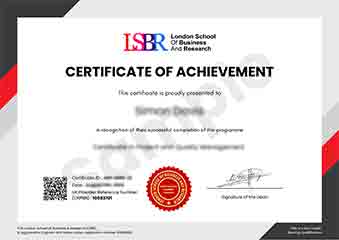
Sample Certificate
Preview the certificate you'll receive upon successful completion of this program.
Get Free Course Info
Enter your details and we'll send you a comprehensive course information pack straight to your inbox.
Employer Sponsored Training
Let your employer invest in your professional development. Request a corporate invoice and get your training funded.
Request Corporate InvoiceWhat People Say About Us
Hear from our students about their experience with the Executive Development Programme in Developing and Evaluating Test Items at LSBRX - Executive Education.
James Thompson
United Kingdom"The course provided high-quality materials that significantly enhanced my ability to develop and evaluate test items effectively. I gained practical skills that have already proven beneficial in my current role, making the content both relevant and highly applicable."
Jia Li Lim
Singapore"The Executive Development Programme in Developing and Evaluating Test Items has significantly enhanced my ability to create effective assessments, making my work more relevant to the industry. This skill has opened new opportunities for career advancement and has made my contributions in the field much more impactful."
Jia Li Lim
Singapore"The course structure was meticulously organized, providing a clear pathway for understanding the complexities of test item development and evaluation. The knowledge gained has been incredibly beneficial, offering practical insights that enhance my ability to design effective assessments in a professional setting."