
Executive Development Programme in Environmental Policy Modeling and Simulation
Unlock career potential with comprehensive environmental policy modeling and simulation training. Prepare for advancement and new challenges.
Executive Development Programme in Environmental Policy Modeling and Simulation
Programme Overview
The Executive Development Programme in Environmental Policy Modeling and Simulation is designed for professionals seeking to enhance their expertise in developing and applying advanced models to inform environmental policy decisions. Targeted at environmental scientists, policymakers, and industry leaders, this program equips participants with the strategic and technical skills needed to navigate complex environmental challenges and contribute effectively to sustainable development initiatives.
Participants will develop a robust understanding of quantitative and qualitative methodologies in environmental policy modeling, including systems dynamics, agent-based modeling, and machine learning techniques. They will learn to design, implement, and analyze models to predict environmental impacts, assess policy scenarios, and evaluate sustainability outcomes. Key competencies include data analysis, scenario planning, stakeholder engagement, and policy formulation, all of which are crucial for effective environmental stewardship and policy development.
This program significantly impacts careers by preparing participants to lead in the development and implementation of evidence-based environmental policies. Graduates will be well-equipped to drive innovation, manage environmental risks, and contribute to global sustainability efforts. The program’s rigorous curriculum and practical applications ensure that learners are not only academically proficient but also operationally effective, positioning them as leaders in their fields.
What You'll Learn
The Executive Development Programme in Environmental Policy Modeling and Simulation is designed for professionals aiming to navigate the complex landscape of environmental policy and sustainability. This comprehensive program equips participants with advanced skills in environmental modeling, policy analysis, and simulation techniques. It provides a deep understanding of the global environmental challenges, from climate change to biodiversity loss, and how they intersect with economic and social factors.
Key topics include advanced statistical methods, environmental impact assessment, policy design and evaluation, and the use of sophisticated software tools for modeling. Participants engage in hands-on projects that simulate real-world scenarios, enabling them to apply theoretical knowledge to practical policy-making. The program also emphasizes ethical considerations in environmental policy and the integration of diverse stakeholder perspectives.
Graduates are well-prepared to lead environmental policy initiatives, design sustainable business strategies, and contribute to international environmental negotiations. They gain the ability to analyze complex data, develop evidence-based policy recommendations, and communicate effectively with policymakers, industry leaders, and the public. Career opportunities span government agencies, non-profit organizations, consulting firms, and academic institutions, offering roles such as environmental policy analysts, sustainability managers, and environmental consultants.
Programme Highlights
Industry-Aligned Curriculum
Developed with industry leaders for job-ready skills valued by employers worldwide.
Globally Recognised Certificate
Recognised by employers across 180+ countries as a mark of professional excellence.
Flexible Online Learning
Study at your own pace with lifetime access to all course materials and updates.
Instant Access
Start learning immediately — no application process or waiting period required.
Constantly Updated Content
Stay ahead with the latest industry trends, best practices, and emerging insights.
Career Advancement
87% of graduates report measurable career progression within 6 months of completion.
Topics Covered
- 1. Introduction to Environmental Policy Modeling: Learners will study the basics of environmental policy modeling, including key concepts and terminologies. They will gain foundational skills in understanding how models are used to predict the impacts of various policies.
- 2. Data Collection and Management for Policy Modeling: This module covers the techniques and tools used for collecting and managing data relevant to environmental policy modeling. Learners will gain practical skills in handling and processing large datasets.
- 3. Statistical Methods in Environmental Modeling: An introduction to statistical methods used in environmental modeling, including regression analysis and time series analysis. Learners will learn to apply these methods to real-world environmental data.
- 4. Systems Dynamics Modeling: Learners will explore systems dynamics modeling techniques and their applications in environmental policy. They will gain skills in constructing and analyzing system dynamics models to understand complex environmental systems.
- 5. Agent-Based Modeling: This module focuses on agent-based modeling approaches in environmental policy. Learners will learn how to develop and simulate models with multiple interacting agents to study environmental policy impacts.
- 6. Optimization Techniques for Policy Simulation: An in-depth look at optimization techniques used in environmental policy simulation. Learners will gain skills in using optimization algorithms to find the best policy solutions.
- 7. Machine Learning for Environmental Policy Modeling: This module covers the application of machine learning techniques in environmental policy modeling. Learners will learn to use machine learning models to predict environmental outcomes and optimize policy decisions.
- 8. Policy Impact Assessment and Evaluation: An exploration of methods for assessing and evaluating the impact of environmental policies using simulation models. Learners will gain skills in conducting thorough policy impact assessments.
- 9. Real-World Case Studies in Environmental Policy Modeling: A series of case studies examining real-world applications of environmental policy modeling. Learners will apply their skills to analyze and propose solutions for real environmental policy challenges.
- 10. Advanced Topics in Environmental Policy Modeling: This module delves into advanced topics such as uncertainty analysis, scenario planning, and integration of social and economic factors in environmental policy modeling. Learners will gain expertise in handling complex and multi-faceted policy issues.
What You Get When You Enroll
Secure checkout • Instant access • Certificate included
Key Facts
Target audience: Professionals in environmental policy
Prerequisites: Basic understanding of environmental science
Outcomes: Advanced modeling skills, policy analysis expertise
Ready to get started?
Join thousands of professionals who already took the next step. Enroll now and get instant access.
Enroll Now — $199Why This Course
Enhance Expertise: Professionals can significantly enhance their expertise in environmental policy modeling and simulation through this program. It provides in-depth knowledge and hands-on experience with advanced modeling techniques and software tools, equipping them to make informed, data-driven decisions that are crucial for environmental policy formulation.
Career Advancement: By participating in this program, individuals can advance their careers in various sectors, including government agencies, non-profit organizations, and consulting firms. The program’s focus on practical applications and real-world scenarios prepares participants for leadership roles where they can influence environmental policies and sustainability strategies.
Interdisciplinary Skills: The program fosters interdisciplinary skills by integrating environmental science, policy analysis, and computational modeling. This holistic approach allows professionals to bridge the gap between scientific research and policy implementation, making them valuable assets in developing and evaluating environmental policies.
Networking Opportunities: The program offers extensive networking opportunities with professionals, academics, and industry leaders in the field. These connections can lead to collaborations, job opportunities, and mentorship, which are essential for career growth and staying updated with the latest trends and challenges in environmental policy modeling and simulation.
Your Path to Certification
Trusted by Professionals Worldwide
Course Brochure
Download our comprehensive course brochure with all details
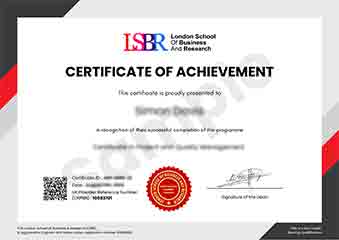
Sample Certificate
Preview the certificate you'll receive upon successful completion of this program.
Get Free Course Info
Enter your details and we'll send you a comprehensive course information pack straight to your inbox.
Employer Sponsored Training
Let your employer invest in your professional development. Request a corporate invoice and get your training funded.
Request Corporate InvoiceWhat People Say About Us
Hear from our students about their experience with the Executive Development Programme in Environmental Policy Modeling and Simulation at LSBRX - Executive Education.
James Thompson
United Kingdom"The course provided an in-depth look at environmental policy modeling and simulation, equipping me with valuable analytical tools that I can apply directly in my work. Gaining hands-on experience with the latest software and models has significantly enhanced my ability to contribute to sustainable policy development."
Tyler Johnson
United States"The Executive Development Programme in Environmental Policy Modeling and Simulation has significantly enhanced my ability to apply complex models in real-world scenarios, making my insights more valuable to stakeholders and clients. This course has not only deepened my technical skills but also opened up new career opportunities in environmental consulting firms and government agencies."
Mei Ling Wong
Singapore"The course structure is well-organized, providing a comprehensive overview of environmental policy modeling and simulation that seamlessly bridges theoretical knowledge with practical applications, significantly enhancing my understanding and professional growth in the field."