
Executive Development Programme in Financial Modeling and Data Analysis
This program enhances leadership skills in financial modeling and data analysis, equipping executives with strategic insights for informed decision-making.
Executive Development Programme in Financial Modeling and Data Analysis
Programme Overview
The Executive Development Programme in Financial Modeling and Data Analysis is designed for mid-to-senior level executives, finance professionals, and consultants seeking to enhance their analytical capabilities in complex financial environments. This comprehensive program equips participants with advanced skills in financial modeling, data analysis, and strategic decision-making, leveraging cutting-edge tools and methodologies. Through a blend of theoretical instruction and practical application, learners will master techniques for building and interpreting financial models, performing data-driven analysis, and applying statistical methods to inform business strategies.
Participants will develop key skills in creating and refining financial models for investment analysis, forecasting, and performance evaluation; conducting sophisticated data analysis using statistical software and programming languages such as Python and R; and integrating data visualization techniques to communicate insights effectively. The program also emphasizes the importance of ethical considerations in data analysis and the strategic use of financial data to drive business growth and innovation.
Upon completion, participants will be better equipped to lead data-informed decision-making processes, enhance financial planning and analysis, and drive strategic initiatives within their organizations. This program not only boosts individual career prospects but also contributes to the organization's ability to make data-driven strategic decisions, leading to improved financial performance and competitive advantage.
What You'll Learn
The Executive Development Programme in Financial Modeling and Data Analysis is designed for professionals seeking to elevate their expertise in financial modeling, data analysis, and strategic decision-making. This cutting-edge program equips participants with advanced skills in quantitative finance, predictive analytics, and financial forecasting, enhancing their ability to drive informed business strategies. Key topics include advanced Excel techniques, machine learning algorithms, financial statement analysis, and risk management, all delivered through a practical, project-based curriculum.
Participants engage in real-world case studies and collaborate on projects that simulate complex business scenarios, ensuring they can apply their knowledge effectively in professional settings. Upon completion, graduates are well-prepared to lead complex financial analyses, develop robust financial models, and leverage data-driven insights to inform business decisions. The program also provides networking opportunities with industry leaders and access to an exclusive alumni network, facilitating career advancement and collaborative opportunities.
Graduates of this programme are ideally positioned for roles such as financial analyst, data scientist, investment banker, or management consultant. They can contribute to organizations by optimizing business operations, enhancing profitability, and making strategic investments based on thorough financial and data analysis. With a focus on hands-on learning and industry-relevant skills, this program is a transformative step towards a successful career in finance and data analysis.
Programme Highlights
Industry-Aligned Curriculum
Developed with industry leaders for job-ready skills valued by employers worldwide.
Globally Recognised Certificate
Recognised by employers across 180+ countries as a mark of professional excellence.
Flexible Online Learning
Study at your own pace with lifetime access to all course materials and updates.
Instant Access
Start learning immediately — no application process or waiting period required.
Constantly Updated Content
Stay ahead with the latest industry trends, best practices, and emerging insights.
Career Advancement
87% of graduates report measurable career progression within 6 months of completion.
Topics Covered
- 1. Introduction to Financial Modeling: Learners will study the basics of financial modeling, including cash flow analysis, financial statement analysis, and valuation techniques. They will gain foundational skills in building simple financial models using spreadsheet software.
- 2. Data Collection and Management: This module covers the process of collecting, cleaning, and managing data for financial modeling. Learners will learn to use various data sources and tools to ensure data accuracy and integrity.
- 3. Advanced Financial Statement Analysis: Focusing on in-depth analysis of financial statements, learners will study ratios, trends, and other metrics to evaluate a company's financial health. Practical skills include using financial modeling to forecast future financial performance.
- 4. Valuation Techniques: Learners will explore different valuation methods such as discounted cash flow (DCF), relative valuation, and option pricing models. They will practice applying these techniques to real-world scenarios and learn how to interpret the results.
- 5. Econometrics and Economic Forecasting: This module introduces econometric methods for analyzing economic data. Learners will learn to use regression analysis and time-series models to forecast economic indicators and their impact on financial markets.
- 6. Portfolio Analysis and Risk Management: Focusing on portfolio theory, learners will study asset allocation, diversification strategies, and risk management techniques. Practical skills include constructing and optimizing portfolios using modern portfolio theory frameworks.
- 7. Advanced Spreadsheet Techniques: This module covers advanced features of spreadsheet software, including pivot tables, macros, and advanced formulas. Learners will enhance their ability to create complex financial models and automate repetitive tasks.
- 8. Data Visualization and Reporting: Learners will learn to create effective visual representations of financial data using charts, graphs, and dashboards. They will practice preparing comprehensive financial reports and presentations for stakeholders.
- 9. Machine Learning in Financial Modeling: This module introduces machine learning techniques and their applications in financial modeling. Learners will explore algorithms such as regression, decision trees, and neural networks, and learn how to apply them to financial data.
- 10. Ethical and Regulatory Considerations: Focusing on ethical and regulatory issues in financial modeling and data analysis, learners will study the importance of compliance, data privacy, and ethical decision-making in the financial industry.
What You Get When You Enroll
Secure checkout • Instant access • Certificate included
Key Facts
Audience: Executives seeking financial acumen
Prerequisites: Basic finance knowledge, Excel proficiency
Outcomes: Advanced modeling skills, data analysis expertise
Ready to get started?
Join thousands of professionals who already took the next step. Enroll now and get instant access.
Enroll Now — $199Why This Course
Enhance Decision-Making Capabilities: An Executive Development Programme in Financial Modeling and Data Analysis equips professionals with advanced tools and techniques to analyze complex financial data. This enhances their ability to make informed, data-driven decisions, which is crucial in today's competitive business environment. For instance, professionals can better assess investment opportunities, manage risks, and optimize financial strategies, leading to more robust business performance.
Strengthen Analytical Skills: The programme focuses on developing strong analytical skills, enabling professionals to interpret large datasets efficiently. These skills are essential for identifying trends, forecasting outcomes, and uncovering insights that drive strategic business decisions. For example, by learning to use Excel for financial modeling, professionals can create detailed financial projections, which are vital for budgeting, financial planning, and investment analysis.
Bridge the Gap Between Finance and Technology: The programme bridges the gap between traditional financial analysis and modern data analysis techniques. It teaches professionals to utilize advanced tools such as Python, SQL, and Tableau, which are increasingly important in the finance industry. This allows professionals to handle complex data more effectively, collaborate with data scientists, and contribute to data-driven initiatives, thereby enhancing their value to the organization.
Your Path to Certification
Trusted by Professionals Worldwide
Course Brochure
Download our comprehensive course brochure with all details
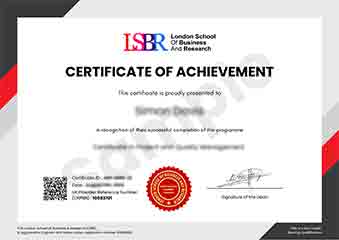
Sample Certificate
Preview the certificate you'll receive upon successful completion of this program.
Get Free Course Info
Enter your details and we'll send you a comprehensive course information pack straight to your inbox.
Employer Sponsored Training
Let your employer invest in your professional development. Request a corporate invoice and get your training funded.
Request Corporate InvoiceWhat People Say About Us
Hear from our students about their experience with the Executive Development Programme in Financial Modeling and Data Analysis at LSBRX - Executive Education.
James Thompson
United Kingdom"The course content was incredibly detailed and well-structured, providing a solid foundation in financial modeling and data analysis that has significantly enhanced my analytical skills. I've gained practical tools and techniques that are directly applicable in my role, making me more efficient and valuable to my team."
Liam O'Connor
Australia"The Executive Development Programme in Financial Modeling and Data Analysis has been incredibly practical and industry-relevant, equipping me with advanced skills in financial modeling and data analysis that I immediately applied to real-world projects, leading to significant career advancement opportunities."
Wei Ming Tan
Singapore"The course structure is meticulously organized, providing a seamless transition from foundational concepts to advanced financial modeling techniques, which has significantly enhanced my ability to apply these skills in real-world scenarios. It has been incredibly beneficial for my professional growth, offering a comprehensive understanding of data analysis in finance that I can immediately implement in my work."