
Executive Development Programme in Geospatial Big Data Processing and Analytics
This programme equips executives with advanced skills in geospatial big data processing and analytics, enhancing strategic decision-making and innovation.
Executive Development Programme in Geospatial Big Data Processing and Analytics
Programme Overview
The Executive Development Programme in Geospatial Big Data Processing and Analytics is tailored for senior-level professionals and executives in the geospatial industry, information technology, and related sectors seeking to enhance their expertise in leveraging big data technologies for strategic decision-making. This program covers advanced techniques in geospatial data acquisition, storage, processing, and analysis, including the use of machine learning and artificial intelligence to extract meaningful insights. Participants will also gain proficiency in big data technologies such as Hadoop and Spark, and learn how to integrate these tools with geospatial systems to improve operational efficiency and business outcomes.
Key skills and knowledge developed through this program include the ability to design and implement geospatial data workflows, manage large-scale geospatial datasets, and apply advanced analytics to solve complex problems. Learners will also acquire expertise in spatial data visualization and storytelling, enabling them to communicate insights effectively to stakeholders. The curriculum is designed to bridge the gap between technical expertise and business acumen, equipping participants with the skills necessary to lead data-driven initiatives and drive innovation in their organizations.
The career impact of this program is substantial, as participants will be better positioned to lead and manage geospatial big data projects, driving strategic initiatives that leverage data to gain a competitive edge. Graduates of this program are well-prepared to assume leadership roles in organizations that require a strong foundation in both geospatial technology and big data analytics. The program’s comprehensive approach ensures that participants not only enhance their technical capabilities but also develop the
What You'll Learn
The Executive Development Programme in Geospatial Big Data Processing and Analytics is designed for professionals seeking to harness the power of spatial data to drive strategic business decisions. This program equips participants with advanced skills in data processing, analysis, and visualization using cutting-edge tools and technologies. Key topics include spatial data infrastructure, big data technologies, spatial statistics, and predictive analytics, all tailored to real-world applications in sectors like urban planning, environmental management, and retail analytics.
Graduates of this program are well-prepared to lead initiatives that leverage geospatial big data to enhance operational efficiency and create competitive advantages. They gain the ability to design and implement robust data solutions, manage large datasets, and interpret complex geospatial information to inform decision-making processes. The program also emphasizes ethical considerations in data usage and privacy, ensuring graduates are prepared for the responsible application of their skills.
Career opportunities span a wide range of industries, including government agencies, consulting firms, technology companies, and non-profits. Graduates can pursue roles such as geospatial data scientists, data analysts, urban planners, and GIS managers. This program not only provides the technical expertise needed to excel in these positions but also fosters leadership skills, enabling professionals to make meaningful contributions to their organizations and society at large.
Programme Highlights
Industry-Aligned Curriculum
Developed with industry leaders for job-ready skills valued by employers worldwide.
Globally Recognised Certificate
Recognised by employers across 180+ countries as a mark of professional excellence.
Flexible Online Learning
Study at your own pace with lifetime access to all course materials and updates.
Instant Access
Start learning immediately — no application process or waiting period required.
Constantly Updated Content
Stay ahead with the latest industry trends, best practices, and emerging insights.
Career Advancement
87% of graduates report measurable career progression within 6 months of completion.
Topics Covered
- 1. Introduction to Geospatial Data: Learners will study the basics of geospatial data types and structures, including coordinate systems, vector and raster data, and will gain skills in understanding and interpreting geospatial datasets.
- 2. Geospatial Data Acquisition and Management: This module covers methods for acquiring geospatial data from various sources and introduces tools for managing and organizing these data. Learners will develop skills in data acquisition, storage, and basic data management practices.
- 3. Geospatial Data Processing: Learners will delve into techniques for processing and manipulating geospatial data using software tools. They will gain skills in data cleaning, transformation, and preparation for analysis.
- 4. Introduction to Big Data Technologies: This module introduces learners to key concepts and technologies in big data processing, including Hadoop and Spark. Learners will understand how these technologies can be applied to geospatial big data.
- 5. Geospatial Big Data Analytics: Learners will explore advanced analytics techniques for geospatial big data, including spatial statistics, machine learning, and data mining. They will gain skills in using these techniques to derive meaningful insights from large geospatial datasets.
- 6. Geospatial Visualization and Communication: This module covers the creation of effective visualizations of geospatial data and the communication of findings to stakeholders. Learners will develop skills in using GIS software for visualization and in presenting geospatial analysis results.
- 7. Geospatial Big Data Case Studies: Through real-world case studies, learners will apply their knowledge to complex geospatial big data problems. They will gain experience in project management and team collaboration in geospatial big data projects.
- 8. Ethical and Legal Considerations in Geospatial Data: This module explores the ethical and legal issues surrounding geospatial data, including privacy, consent, and data ownership. Learners will understand the importance of ethical practices in geospatial data processing and analytics.
- 9. Geospatial Big Data Security: Learners will study the security challenges associated with geospatial big data, including data encryption, access controls, and protection against cyber threats. They will gain skills in implementing secure data handling practices.
- 10. Future Trends in Geospatial Big Data: This final module looks at emerging trends and technologies in geospatial big data processing and analytics, such as IoT, AI, and cloud computing. Learners will gain insights into the future of the field and how to stay current with new developments.
What You Get When You Enroll
Secure checkout • Instant access • Certificate included
Key Facts
Target audience: Industry professionals, data scientists
Prerequisites: Basic programming knowledge, familiarity with GIS
Outcomes: Expertise in geospatial big data, advanced analytics skills
Ready to get started?
Join thousands of professionals who already took the next step. Enroll now and get instant access.
Enroll Now — $199Why This Course
Enhanced Analytical Skills: The Executive Development Programme in Geospatial Big Data Processing and Analytics equips professionals with advanced analytical tools and techniques. This not only enhances their ability to interpret complex data but also prepares them to make data-driven decisions. For instance, the program includes modules on GIS software, machine learning algorithms, and big data analytics, which are crucial for analyzing vast amounts of geospatial data.
Increased Career Opportunities: As the demand for geospatial data analysis grows across industries including urban planning, environmental management, and defense, professionals with specialized training in this area are highly sought after. The program can significantly boost career prospects by providing the necessary skills to work in roles that require advanced geospatial data processing and analytics, such as geospatial data scientist or geospatial analyst.
Practical Application of Knowledge: The programme includes hands-on training and case studies that simulate real-world scenarios. This practical approach ensures that participants can apply their learning to solve complex problems. For example, students might work on projects involving satellite imagery analysis for disaster management or traffic flow optimization, thereby gaining valuable experience that can be directly applied in their professional roles.
Your Path to Certification
Trusted by Professionals Worldwide
Course Brochure
Download our comprehensive course brochure with all details
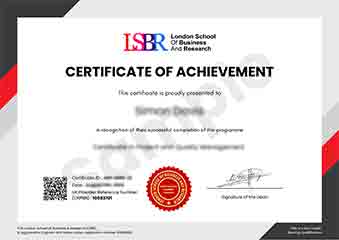
Sample Certificate
Preview the certificate you'll receive upon successful completion of this program.
Get Free Course Info
Enter your details and we'll send you a comprehensive course information pack straight to your inbox.
Employer Sponsored Training
Let your employer invest in your professional development. Request a corporate invoice and get your training funded.
Request Corporate InvoiceWhat People Say About Us
Hear from our students about their experience with the Executive Development Programme in Geospatial Big Data Processing and Analytics at LSBRX - Executive Education.
James Thompson
United Kingdom"The course content was incredibly comprehensive, providing deep insights into geospatial big data processing and analytics that significantly enhanced my technical skills. I gained practical knowledge that has already proven invaluable in my work, making me more effective in handling complex spatial data analysis tasks."
Ryan MacLeod
Canada"The Executive Development Programme in Geospatial Big Data Processing and Analytics has significantly enhanced my ability to handle large datasets and apply geospatial analysis in real-world scenarios, making my skills highly relevant in the current job market. This program has not only deepened my technical expertise but also opened up new career opportunities in sectors like urban planning and environmental management."
Ashley Rodriguez
United States"The course structure was well-organized, providing a comprehensive overview of geospatial big data processing and analytics that seamlessly bridged theoretical knowledge with practical applications, significantly enhancing my ability to tackle real-world challenges in the field."