
Executive Development Programme in Implementing Statistical Methods in Research
This program equips executives with statistical methods to enhance research effectiveness, drive data-informed decisions, and boost organizational performance.
Executive Development Programme in Implementing Statistical Methods in Research
Programme Overview
The Executive Development Programme in Implementing Statistical Methods in Research is designed for senior-level executives, researchers, and data analysts seeking to enhance their skills in leveraging statistical techniques to drive evidence-based decision-making. This program equips participants with advanced statistical knowledge and practical application skills, enabling them to analyze complex data sets and derive actionable insights for strategic planning and innovation.
Participants will develop a robust understanding of statistical methods, including regression analysis, hypothesis testing, and predictive modeling. They will also learn to use statistical software tools such as R and Python for data analysis and visual representation. The curriculum emphasizes real-world application, focusing on how to integrate statistical methodologies into research and organizational practices to improve outcomes and foster innovation.
By completing this program, participants will be better positioned to lead data-driven initiatives, optimize research methodologies, and drive evidence-based decision-making within their organizations. This will not only enhance their personal professional capabilities but also contribute to significant improvements in organizational performance, strategic alignment, and competitive advantage. The program’s outcomes are directly tied to the ability to interpret and utilize data effectively, which is crucial for maintaining a competitive edge in today’s data-centric business environment.
What You'll Learn
The Executive Development Programme in Implementing Statistical Methods in Research is designed to empower seasoned professionals and emerging leaders with the skills necessary to effectively leverage statistical methods in their research endeavors. This program is ideal for individuals looking to enhance their analytical capabilities, drive evidence-based decision-making, and stay at the forefront of their field.
Key topics include data analysis techniques, statistical modeling, machine learning, and advanced research methodologies. Participants will engage in hands-on workshops, interactive sessions, and case studies that simulate real-world research challenges. The program emphasizes practical application through projects that utilize cutting-edge software tools and datasets.
Upon completion, graduates will be equipped to design and implement robust statistical analyses, interpret complex data, and communicate findings to diverse audiences. This skill set is invaluable in a range of sectors, including healthcare, finance, technology, and academia. Graduates can anticipate career advancements in roles such as data scientist, research analyst, or quantitative analyst. The program also prepares participants for further academic pursuits, such as advanced degrees in statistics or data science.
Programme Highlights
Industry-Aligned Curriculum
Developed with industry leaders for job-ready skills valued by employers worldwide.
Globally Recognised Certificate
Recognised by employers across 180+ countries as a mark of professional excellence.
Flexible Online Learning
Study at your own pace with lifetime access to all course materials and updates.
Instant Access
Start learning immediately — no application process or waiting period required.
Constantly Updated Content
Stay ahead with the latest industry trends, best practices, and emerging insights.
Career Advancement
87% of graduates report measurable career progression within 6 months of completion.
Topics Covered
- 1. Introduction to Research Methodology: Learners will study the fundamental principles and terminology of research methodology, including research design, data collection, and ethical considerations. They will gain the foundational knowledge necessary to design and implement statistical studies effectively.
- 2. Descriptive Statistics: This module covers basic statistical concepts such as measures of central tendency, dispersion, and graphical representation of data. Learners will develop skills in summarizing and presenting data sets in a meaningful way.
- 3. Inferential Statistics: Learners will explore techniques for making inferences about populations based on sample data, including hypothesis testing, confidence intervals, and type I/II errors. Practical skills in conducting and interpreting inferential statistics will be developed.
- 4. Regression Analysis: This module introduces simple and multiple linear regression, focusing on model fitting, interpretation, and diagnostics. Learners will learn to use regression analysis to predict outcomes and understand relationships between variables.
- 5. Advanced Regression Techniques: Building on Module 4, this module covers advanced regression techniques such as logistic regression, polynomial regression, and interaction terms. Learners will gain expertise in applying these methods to complex research questions.
- 6. Analysis of Variance (ANOVA): Learners will study the theory and application of ANOVA, including one-way, two-way, and repeated measures designs. Practical skills in analyzing and interpreting ANOVA results will be developed.
- 7. Nonparametric Statistics: This module covers statistical methods that do not rely on assumptions about the distribution of the data. Learners will learn when and how to use nonparametric tests, such as the Wilcoxon rank-sum test and the Kruskal-Wallis test.
- 8. Data Management and Software Skills: Learners will learn best practices for data management, including data cleaning, validation, and storage. They will also gain proficiency in using statistical software such as R or Python for data analysis.
- 9. Advanced Data Visualization: This module focuses on creating effective visual representations of data, including interactive visualizations and advanced plotting techniques. Learners will develop skills in communicating research findings through visual means.
- 10. Project Management and Presentation: In this final module, learners will work on a comprehensive research project, applying all the statistical methods learned throughout the programme. They will also learn how to present their findings effectively in written and oral formats.
What You Get When You Enroll
Secure checkout • Instant access • Certificate included
Key Facts
Audience: Researchers, data analysts, managers
Prerequisites: Basic statistics knowledge, research experience
Outcomes: Expertise in statistical methods, enhanced analytical skills, improved research quality
Ready to get started?
Join thousands of professionals who already took the next step. Enroll now and get instant access.
Enroll Now — $199Why This Course
Enhance Decision-Making Skills: Participating in an Executive Development Programme in Implementing Statistical Methods in Research equips professionals with advanced statistical tools and techniques. This enables them to analyze data more effectively, leading to more informed and data-driven decisions that can significantly impact business strategies and outcomes.
Boost Research Competence: The programme provides comprehensive training in various statistical methods, from basic to advanced levels. This deepens understanding and proficiency in data analysis, which is crucial for conducting robust research. Professionals can then apply these skills to improve the quality and reliability of their work, leading to more credible and impactful research findings.
Strengthen Leadership Capabilities: By mastering statistical methods, professionals can better communicate complex data insights to non-technical team members and stakeholders. This enhances their ability to lead cross-functional teams and collaborate effectively, fostering a data-savvy organizational culture. The programme also includes leadership components that help participants develop skills like strategic thinking and problem-solving, which are essential for executive roles.
Your Path to Certification
Trusted by Professionals Worldwide
Course Brochure
Download our comprehensive course brochure with all details
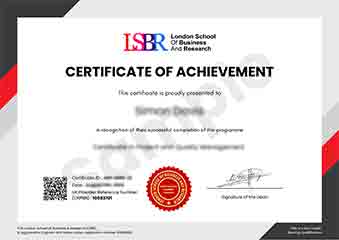
Sample Certificate
Preview the certificate you'll receive upon successful completion of this program.
Get Free Course Info
Enter your details and we'll send you a comprehensive course information pack straight to your inbox.
Employer Sponsored Training
Let your employer invest in your professional development. Request a corporate invoice and get your training funded.
Request Corporate InvoiceWhat People Say About Us
Hear from our students about their experience with the Executive Development Programme in Implementing Statistical Methods in Research at LSBRX - Executive Education.
Sophie Brown
United Kingdom"The course provided high-quality, practical content that significantly enhanced my ability to apply statistical methods in real-world research scenarios, making me more confident in my analytical skills and better prepared for advanced projects in my field."
Madison Davis
United States"The Executive Development Programme in Implementing Statistical Methods in Research has significantly enhanced my ability to analyze data effectively, making my insights more credible and impactful in the industry. This program has not only deepened my technical skills but also provided me with practical tools that I can directly apply to drive better business outcomes and advance my career."
Priya Sharma
India"The course structure is meticulously organized, making it easy to navigate through complex statistical methods, which has significantly enhanced my ability to apply these techniques in real-world research scenarios, leading to substantial professional growth."