
Executive Development Programme in Machine Learning for Logistics Operations
This program equips logistics executives with advanced machine learning skills to optimize operations, enhance decision-making, and drive operational excellence.
Executive Development Programme in Machine Learning for Logistics Operations
Programme Overview
The Executive Development Programme in Machine Learning for Logistics Operations is tailored for logistics executives, managers, and professionals seeking to enhance their strategic and operational decision-making capabilities through advanced machine learning techniques. This program equips participants with the necessary skills to integrate machine learning into their organization's operations, thereby optimizing processes, improving efficiency, and driving innovation. Participants will learn to leverage predictive analytics, optimize supply chain management, and enhance customer service through data-driven insights.
Key skills and knowledge developed in the program include understanding machine learning algorithms, data preprocessing and cleaning, model training and validation, and deploying machine learning models in real-world logistics scenarios. Participants will gain proficiency in using Python and popular machine learning libraries, as well as familiarity with tools and platforms such as TensorFlow and Scikit-learn. The curriculum also focuses on ethical considerations in data use and the practical application of machine learning in logistics, ensuring that learners are well-prepared to address complex challenges in the industry.
The career impact of this program is substantial, as participants will be better positioned to lead data-driven initiatives, make informed strategic decisions, and drive organizational transformation. Graduates of the program will be capable of spearheading the adoption of machine learning technologies, improving operational efficiency, and enhancing customer satisfaction. This program not only aligns with the evolving needs of the logistics sector but also prepares participants to take on more strategic roles within their organizations, contributing to their professional growth and the overall competitiveness of their companies.
What You'll Learn
Transform your career with the 'Executive Development Programme in Machine Learning for Logistics Operations,' designed for logistics executives aiming to harness the power of data and automation. This comprehensive programme equips you with advanced machine learning techniques tailored to optimize logistics operations, enhance supply chain efficiency, and drive innovation. Key topics include predictive analytics, optimization algorithms, and data-driven decision-making, providing a solid foundation in machine learning principles and their practical applications.
Throughout the programme, you'll apply these skills to real-world case studies, collaborate with industry leaders, and participate in hands-on workshops. You'll learn to implement machine learning models to forecast demand, streamline inventory management, and improve route optimization, thereby reducing costs and increasing operational efficiency.
Graduates of this programme are well-prepared to lead transformative initiatives in their organizations, drive digital transformation, and stay ahead of industry trends. Career opportunities include roles as Machine Learning Lead in Logistics, Data Science Director, and Chief Data Officer. The programme not only accelerates your professional growth but also enhances your ability to make data-informed decisions, making you a key influencer in the logistics industry.
Programme Highlights
Industry-Aligned Curriculum
Developed with industry leaders for job-ready skills valued by employers worldwide.
Globally Recognised Certificate
Recognised by employers across 180+ countries as a mark of professional excellence.
Flexible Online Learning
Study at your own pace with lifetime access to all course materials and updates.
Instant Access
Start learning immediately — no application process or waiting period required.
Constantly Updated Content
Stay ahead with the latest industry trends, best practices, and emerging insights.
Career Advancement
87% of graduates report measurable career progression within 6 months of completion.
Topics Covered
- 1. Introduction to Machine Learning: Learners will be introduced to fundamental concepts of machine learning, including supervised and unsupervised learning, and gain an understanding of how these techniques can be applied to logistics operations.
- 2. Data Preprocessing for Logistics: This module covers data cleaning, transformation, and feature engineering, enabling learners to prepare datasets for machine learning models, specifically tailored to logistics data.
- 3. Regression Techniques in Logistics: Learners will explore linear and non-linear regression models, learning to predict continuous outcomes such as delivery times and costs, and gain hands-on experience with model evaluation and selection.
- 4. Classification Algorithms for Logistics: This module focuses on classification techniques, including decision trees, random forests, and support vector machines, teaching learners to categorize logistics data and make informed decisions.
- 5. Clustering and Market Segmentation: Learners will study clustering algorithms, such as K-means and hierarchical clustering, to segment customers or products, optimizing logistics strategies and supply chain management.
- 6. Time Series Forecasting in Logistics: This module introduces time series analysis, covering ARIMA models and exponential smoothing, enabling learners to forecast demand and optimize inventory levels.
- 7. Optimization Techniques for Logistics: Learners will delve into linear and integer programming, learning to solve complex logistical optimization problems, such as routing and scheduling.
- 8. Reinforcement Learning for Logistics: This advanced module covers reinforcement learning, teaching learners to develop intelligent agents that can learn from feedback in dynamic logistics environments.
- 9. Machine Learning Ethics and Compliance: The focus of this module is on ethical considerations and compliance issues in machine learning applications in logistics, ensuring learners are aware of legal and ethical standards.
- 10. Implementing Machine Learning Solutions in Logistics: Learners will complete a capstone project, applying machine learning techniques to real-world logistics challenges, from data collection and model development to deployment and monitoring.
What You Get When You Enroll
Secure checkout • Instant access • Certificate included
Key Facts
Audience: Logistics managers, IT professionals
Prerequisites: Basic IT skills, familiarity with logistics operations
Outcomes: Enhanced ML knowledge, improved data analysis skills, optimized logistics processes
Ready to get started?
Join thousands of professionals who already took the next step. Enroll now and get instant access.
Enroll Now — $199Why This Course
Enhanced Analytical Skills: The programme equips professionals with advanced analytical tools and techniques, enabling them to make data-driven decisions that optimize logistics operations. For instance, participants learn to use predictive analytics to forecast demand more accurately, reducing inventory costs and improving supply chain efficiency.
Strategic Decision-Making: By integrating machine learning into strategic planning, logistics managers can better anticipate operational challenges and opportunities. This capability is crucial for developing long-term strategies that enhance customer satisfaction and operational resilience. For example, mastering machine learning algorithms allows for the identification of underperforming supply chain segments, guiding targeted improvements.
Competitive Advantage: Organizations that embrace machine learning in logistics operations gain a competitive edge. The programme prepares professionals to leverage these technologies effectively, leading to more efficient processes and better resource allocation. This not only boosts operational performance but also attracts and retains customers who value streamlined, reliable services.
Interdisciplinary Knowledge: The programme bridges the gap between technical expertise and business acumen, fostering a holistic understanding of how machine learning applications can transform logistics operations. This interdisciplinary approach is essential for professionals who wish to lead innovation and drive change within their organizations. By blending technical skills with business strategy, participants are better positioned to navigate the complexities of modern logistics environments.
Your Path to Certification
Trusted by Professionals Worldwide
Course Brochure
Download our comprehensive course brochure with all details
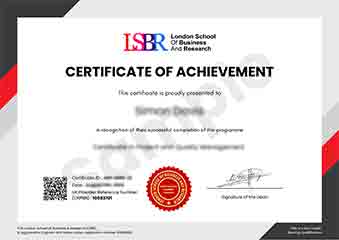
Sample Certificate
Preview the certificate you'll receive upon successful completion of this program.
Get Free Course Info
Enter your details and we'll send you a comprehensive course information pack straight to your inbox.
Employer Sponsored Training
Let your employer invest in your professional development. Request a corporate invoice and get your training funded.
Request Corporate InvoiceWhat People Say About Us
Hear from our students about their experience with the Executive Development Programme in Machine Learning for Logistics Operations at LSBRX - Executive Education.
Oliver Davies
United Kingdom"The course content was highly relevant and comprehensive, providing a solid foundation in machine learning techniques specifically applicable to logistics operations. I gained valuable practical skills that I can directly apply to optimize supply chain processes, which I believe will significantly enhance my career prospects in the field."
Jack Thompson
Australia"The Executive Development Programme in Machine Learning for Logistics Operations has significantly enhanced my ability to leverage data-driven solutions in my role, making my supply chain operations more efficient and cost-effective. This course not only provided me with advanced machine learning techniques but also showed me how to apply them in real-world logistics scenarios, which has opened up new career opportunities in my field."
Ashley Rodriguez
United States"The course structure was well-organized, providing a clear path from foundational concepts to advanced topics in machine learning, which greatly enhanced my understanding of how these techniques can be applied to optimize logistics operations. The comprehensive content and real-world case studies were particularly beneficial for my professional growth, offering practical insights that I can immediately apply in my role."