
Executive Development Programme in Predictive Analytics Using Bayesian Methods
This program equips executives with predictive analytics skills using Bayesian methods, enhancing decision-making and strategic planning.
Executive Development Programme in Predictive Analytics Using Bayesian Methods
Programme Overview
The Executive Development Programme in Predictive Analytics Using Bayesian Methods is designed for senior executives and data professionals seeking to integrate advanced predictive analytics techniques into their strategic decision-making processes. This program equips participants with the skills necessary to leverage Bayesian methods for forecasting, risk assessment, and data-driven strategy formulation. Participants will gain expertise in Bayesian inference, model building, and the application of Bayesian techniques to real-world business challenges.
Throughout the program, learners will develop key skills such as understanding the principles of Bayesian statistics, applying Bayesian models to predictive analytics, and interpreting complex data to inform strategic business decisions. They will also learn to use software tools and platforms for Bayesian analysis, enabling them to implement these methods effectively within their organizations. The program includes hands-on workshops and case studies to solidify learning and provide practical, actionable insights.
This program will significantly enhance the career trajectory of participants by enabling them to drive innovation through data-driven strategies and improve organizational performance. Graduates will be well-prepared to lead initiatives that leverage predictive analytics to address complex business challenges, making them invaluable assets in their organizations' data strategy teams. The knowledge and skills gained will position them to lead and influence the strategic use of predictive analytics in their companies, contributing to sustainable growth and competitive advantage.
What You'll Learn
The Executive Development Programme in Predictive Analytics Using Bayesian Methods is a comprehensive, month curriculum designed to equip experienced professionals with advanced skills in predictive analytics, specifically focusing on Bayesian methods. This program is ideal for executives and leaders in data-driven industries who seek to enhance their decision-making capabilities through sophisticated statistical techniques.
Key topics include foundational Bayesian statistics, model building and validation, and real-world applications of Bayesian methods in predictive analytics. Participants will learn to integrate Bayesian approaches with modern data science tools, enabling them to craft predictive models that yield more accurate and reliable insights. The program offers hands-on experience through case studies and practical projects, allowing participants to apply their knowledge to solve complex business challenges.
Graduates of this program will be well-prepared to lead data-driven initiatives that drive innovation and competitive advantage. They will be equipped to communicate complex analytical results to stakeholders, drive strategic decisions, and develop predictive models that inform business strategies. Career opportunities include roles as executive data scientists, predictive model managers, and data-driven business leaders. This program not only enhances technical skills but also bridges the gap between technical expertise and business acumen, positioning graduates as leaders in the field of predictive analytics.
Programme Highlights
Industry-Aligned Curriculum
Developed with industry leaders for job-ready skills valued by employers worldwide.
Globally Recognised Certificate
Recognised by employers across 180+ countries as a mark of professional excellence.
Flexible Online Learning
Study at your own pace with lifetime access to all course materials and updates.
Instant Access
Start learning immediately — no application process or waiting period required.
Constantly Updated Content
Stay ahead with the latest industry trends, best practices, and emerging insights.
Career Advancement
87% of graduates report measurable career progression within 6 months of completion.
Topics Covered
- 1. Introduction to Predictive Analytics: Learners will understand the fundamentals of predictive analytics and its importance in decision-making processes. They will gain foundational knowledge in data collection, statistical concepts, and basic predictive modeling techniques.
- 2. Bayesian Statistics Basics: This module covers the core principles of Bayesian statistics, including Bayes' Theorem, prior and posterior distributions. Learners will develop a solid understanding of how Bayesian methods differ from traditional frequentist approaches.
- 3. Prior Distributions and Model Specification: Learners will explore how to specify prior distributions, understand their role in Bayesian analysis, and learn how to choose appropriate priors for different types of data and models.
- 4. Bayesian Inference Techniques: This module delves into various Bayesian inference techniques such as Markov Chain Monte Carlo (MCMC) methods and Gibbs sampling. Learners will gain hands-on experience with implementing these techniques using software tools.
- 5. Bayesian Linear Regression: Learners will study how to apply Bayesian methods to linear regression models, including model formulation, parameter estimation, and model comparison. Practical skills in Bayesian linear regression will be developed.
- 6. Advanced Bayesian Regression Models: This module covers more advanced regression models such as hierarchical models, mixed-effects models, and non-linear regression models. Learners will learn how to implement these models using Bayesian techniques.
- 7. Bayesian Model Selection and Validation: Learners will understand how to select among competing models using Bayesian criteria such as the Bayes factor and the Deviance Information Criterion (DIC). They will also learn methods for validating and assessing the quality of Bayesian models.
- 8. Bayesian Time Series Analysis: This module focuses on applying Bayesian methods to time series data. Learners will learn about autoregressive models, moving average models, and how to incorporate Bayesian priors in time series analysis.
- 9. Bayesian Machine Learning: Learners will explore the application of Bayesian methods in machine learning, including Bayesian networks, Gaussian processes, and Bayesian neural networks. Practical skills in using Bayesian methods for machine learning will be developed.
- 10. Advanced Topics in Bayesian Analysis: This module covers advanced topics such as Bayesian deep learning, Bayesian variable selection, and Bayesian non-parametric methods. Learners will gain a deeper understanding of cutting-edge Bayesian techniques and their applications.
What You Get When You Enroll
Secure checkout • Instant access • Certificate included
Key Facts
Audience: Mid-to-senior level executives
Prerequisites: Basic statistics knowledge
Outcomes: Enhanced predictive analytics skills
Outcomes: Improved decision-making processes
Outcomes: Understanding Bayesian methods
Ready to get started?
Join thousands of professionals who already took the next step. Enroll now and get instant access.
Enroll Now — $199Why This Course
Enhanced Predictive Capabilities: Professionals who undertake this programme will gain advanced skills in predictive analytics using Bayesian methods. This includes understanding and applying Bayesian statistical techniques to build more accurate predictive models. These capabilities are highly sought after in industries ranging from finance to healthcare, where data-driven decision-making is crucial.
Competitive Edge in Data-Driven Roles: With the increasing importance of data analytics in business strategy, professionals with expertise in Bayesian methods will stand out. The programme equips learners with the ability to analyze complex data and derive actionable insights, making them more competitive in the job market. Employers value these skills, leading to potential career advancements and higher job satisfaction.
Versatile Skill Set for Diverse Industries: The programme offers a comprehensive curriculum that covers various applications of Bayesian methods, from financial forecasting to risk assessment. This versatility prepares professionals for a wide range of industries and roles, enhancing their adaptability and marketability. Whether transitioning to a new field or aiming for a leadership position, the skills learned are transferable and valuable.
Your Path to Certification
Trusted by Professionals Worldwide
Course Brochure
Download our comprehensive course brochure with all details
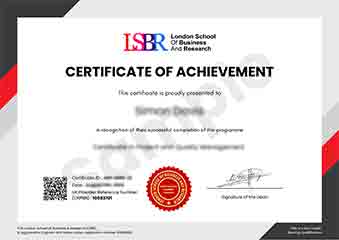
Sample Certificate
Preview the certificate you'll receive upon successful completion of this program.
Get Free Course Info
Enter your details and we'll send you a comprehensive course information pack straight to your inbox.
Employer Sponsored Training
Let your employer invest in your professional development. Request a corporate invoice and get your training funded.
Request Corporate InvoiceWhat People Say About Us
Hear from our students about their experience with the Executive Development Programme in Predictive Analytics Using Bayesian Methods at LSBRX - Executive Education.
Oliver Davies
United Kingdom"The course provided a deep dive into predictive analytics using Bayesian methods, equipping me with robust tools to analyze complex data and make informed decisions. I gained practical skills that have already enhanced my ability to solve real-world problems, opening up new opportunities in my career."
Fatimah Ibrahim
Malaysia"The Executive Development Programme in Predictive Analytics Using Bayesian Methods has significantly enhanced my ability to apply advanced analytics in real-world business scenarios, making my insights more actionable and driving better decision-making processes within my organization. This program has not only deepened my technical skills but also provided me with a competitive edge, opening up new opportunities for career advancement in data-driven roles."
Sophie Brown
United Kingdom"The course structure was meticulously organized, providing a seamless transition from theoretical concepts to practical applications, which significantly enhanced my understanding and prepared me for real-world challenges in predictive analytics."