
Executive Development Programme in Remote Sensing for Ocean Pollution Detection
This programme equips executives with advanced remote sensing techniques for detecting and mitigating ocean pollution, enhancing strategic decision-making.
Executive Development Programme in Remote Sensing for Ocean Pollution Detection
Programme Overview
The Executive Development Programme in Remote Sensing for Ocean Pollution Detection is designed for mid-to-senior level professionals in the environmental, maritime, and governmental sectors who seek to enhance their capabilities in using remote sensing technologies for monitoring and mitigating ocean pollution. The programme focuses on advanced methodologies for data acquisition, analysis, and interpretation, leveraging satellite imagery, drones, and other remote sensing tools to detect and track pollution sources, assess environmental impacts, and develop effective management strategies.
Participants will develop a comprehensive understanding of remote sensing principles, including the selection and application of appropriate remote sensing techniques, the use of geospatial analysis software, and the integration of remote sensing data with other environmental monitoring systems. They will also learn to interpret complex data sets, analyze trends, and make informed decisions based on remote sensing findings. Additionally, the programme will cover the legal and regulatory frameworks governing ocean pollution management, as well as best practices for stakeholder engagement and project implementation.
This programme significantly impacts career progression by equipping participants with the technical and strategic expertise needed to lead remote sensing initiatives in pollution detection and mitigation. Graduates will be well-prepared to assume leadership roles in environmental monitoring, policy development, and sustainable resource management, contributing to global efforts to protect marine ecosystems and promote environmental sustainability.
What You'll Learn
The Executive Development Programme in Remote Sensing for Ocean Pollution Detection is a cutting-edge initiative designed to equip professionals with advanced skills in analyzing and mitigating ocean pollution through remote sensing technology. This program emphasizes the application of satellite imagery and other remote sensing data to monitor and manage environmental challenges, providing a unique blend of theoretical knowledge and practical skills.
Key topics include the principles of remote sensing, the use of satellite data for environmental monitoring, advanced data analysis techniques, and the integration of remote sensing with Geographic Information Systems (GIS). Participants will also explore case studies and real-world applications, such as oil spill detection, plastic waste tracking, and marine ecosystem health assessment.
Graduates of this program will be well-prepared to apply their skills in various sectors, including environmental agencies, research institutions, and consulting firms. They will be able to contribute to policy development, environmental impact assessments, and sustainable management practices. Career opportunities abound in roles such as environmental data analysts, remote sensing specialists, and environmental consultants.
By the end of the programme, participants will have a comprehensive understanding of how remote sensing can be leveraged to protect our oceans, driving impactful change and sustainable practices in environmental conservation.
Programme Highlights
Industry-Aligned Curriculum
Developed with industry leaders for job-ready skills valued by employers worldwide.
Globally Recognised Certificate
Recognised by employers across 180+ countries as a mark of professional excellence.
Flexible Online Learning
Study at your own pace with lifetime access to all course materials and updates.
Instant Access
Start learning immediately — no application process or waiting period required.
Constantly Updated Content
Stay ahead with the latest industry trends, best practices, and emerging insights.
Career Advancement
87% of graduates report measurable career progression within 6 months of completion.
Topics Covered
- 1. Introduction to Remote Sensing for Ocean Monitoring: Learners will study the principles of remote sensing technology and its application in ocean monitoring. They will gain foundational knowledge on different types of sensors and satellite systems used for ocean observation.
- 2. Fundamentals of Oceanography: Learners will explore basic oceanographic concepts including water properties, currents, and ecosystems. They will develop an understanding of how these factors influence ocean pollution detection.
- 3. Remote Sensing Data Acquisition and Preprocessing: Learners will learn about data acquisition methods and preprocessing techniques for remote sensing data. They will gain practical skills in using software tools to manage and preprocess ocean-related data.
- 4. Image Processing for Ocean Monitoring: Learners will study various image processing techniques specifically tailored for analyzing oceanic data. They will practice image enhancement, feature extraction, and classification using remote sensing imagery.
- 5. Detection of Oil Spills and Pollution Plumes: Learners will focus on identifying and quantifying oil spills and pollution plumes using remote sensing data. They will learn about specific spectral and spatial characteristics of pollutants.
- 6. Monitoring Algal Blooms and Hypoxia: Learners will study the detection and monitoring of harmful algal blooms and hypoxic zones in the ocean. They will develop skills in analyzing chlorophyll-a concentrations and dissolved oxygen levels.
- 7. Advanced Topics in Remote Sensing for Marine Pollution: Learners will delve into advanced topics such as ocean color modeling, ocean currents analysis, and the integration of multiple sensor data. They will apply these techniques to enhance pollution detection capabilities.
- 8. Case Studies and Best Practices: Learners will analyze real-world case studies of ocean pollution detection using remote sensing. They will learn about successful strategies and best practices employed by environmental agencies and organizations.
- 9. Data Interpretation and Reporting: Learners will learn how to interpret remote sensing data and prepare comprehensive reports on ocean pollution incidents. They will practice writing clear and concise reports for stakeholders.
- 10. Legal and Ethical Considerations in Remote Sensing: Learners will explore the legal and ethical implications of using remote sensing technology for ocean pollution detection. They will understand the importance of compliance with international regulations and ethical standards.
What You Get When You Enroll
Secure checkout • Instant access • Certificate included
Key Facts
Audience: Professionals in remote sensing, environmental science
Prerequisites: Basic knowledge of remote sensing, GIS experience
Outcomes: Expertise in ocean pollution detection, practical skills, network expansion
Ready to get started?
Join thousands of professionals who already took the next step. Enroll now and get instant access.
Enroll Now — $199Why This Course
Enhanced Expertise and Specialization: Participating in an Executive Development Programme in Remote Sensing for Ocean Pollution Detection can significantly enhance professionals' expertise in using advanced remote sensing technologies. This program equips them with the latest knowledge and tools to monitor and detect ocean pollution, making them valuable assets in environmental and maritime industries.
Career Advancement Opportunities: With the increasing global focus on environmental sustainability and pollution control, professionals in this field can advance their careers by taking on leadership roles in environmental agencies, research institutions, or private sector organizations. The program's curriculum, which includes practical applications and case studies, prepares participants to tackle complex environmental challenges.
Interdisciplinary Skill Development: The programme fosters interdisciplinary skills by integrating knowledge from remote sensing, environmental science, and data analytics. This holistic approach not only enhances technical capabilities but also promotes effective collaboration across different domains. Such skills are highly sought after in multidisciplinary projects, offering professionals a broader range of career paths and increased marketability.
Your Path to Certification
Trusted by Professionals Worldwide
Course Brochure
Download our comprehensive course brochure with all details
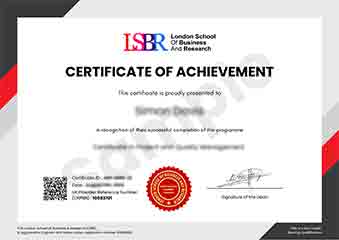
Sample Certificate
Preview the certificate you'll receive upon successful completion of this program.
Get Free Course Info
Enter your details and we'll send you a comprehensive course information pack straight to your inbox.
Employer Sponsored Training
Let your employer invest in your professional development. Request a corporate invoice and get your training funded.
Request Corporate InvoiceWhat People Say About Us
Hear from our students about their experience with the Executive Development Programme in Remote Sensing for Ocean Pollution Detection at LSBRX - Executive Education.
Oliver Davies
United Kingdom"The course content was incredibly thorough, providing a deep understanding of remote sensing techniques specifically tailored for detecting ocean pollution. Gaining hands-on experience with the software and tools used in the industry has significantly enhanced my practical skills and opened up new career opportunities in environmental monitoring."
Ruby McKenzie
Australia"This course has been instrumental in enhancing my ability to analyze and interpret remote sensing data, which is crucial for monitoring ocean pollution. It has not only deepened my technical skills but also provided me with practical tools that I can directly apply in my role, leading to significant career advancement."
Fatimah Ibrahim
Malaysia"The course structure was meticulously organized, providing a seamless transition from theoretical concepts to practical applications in ocean pollution detection, which significantly enhanced my understanding and prepared me for real-world challenges."