
Executive Development Programme in Symbolic Logic for Data Analysis
Strengthen your symbolic logic for data analysis capabilities with expert guidance. Develop proficiency in critical areas.
Executive Development Programme in Symbolic Logic for Data Analysis
Programme Overview
The Executive Development Programme in Symbolic Logic for Data Analysis is an advanced educational initiative designed for executives, data scientists, and professionals in the technology and business sectors who seek to harness the power of symbolic logic to enhance data analysis and decision-making processes. This program is tailored to equip participants with the skills necessary to integrate symbolic logic into their data-driven strategies, ensuring that they can leverage the precision and automation of logical reasoning to address complex business challenges.
Participants will develop a deep understanding of symbolic logic, including its principles, applications, and integration with data analysis techniques. They will learn to construct and evaluate logical arguments, perform automated reasoning, and apply symbolic logic to predictive modeling, anomaly detection, and decision support systems. The program also emphasizes the use of symbolic logic in natural language processing, machine learning, and artificial intelligence, providing learners with a comprehensive toolkit to optimize data-driven strategies and improve organizational performance.
The programme will significantly impact participants' careers by enabling them to lead more data-informed decision-making processes, enhance their ability to innovate and solve complex problems, and drive strategic initiatives that leverage the latest advancements in symbolic logic and data science. Graduates of this program will be better positioned to lead cross-functional teams, develop cutting-edge data solutions, and contribute to the strategic direction of their organizations by integrating logical reasoning into their data analysis practices.
What You'll Learn
The Executive Development Programme in Symbolic Logic for Data Analysis is designed to empower business leaders with advanced skills in logical reasoning and data interpretation. This transformative programme integrates symbolic logic principles with practical data analysis techniques, equipping participants with the ability to make informed decisions based on structured reasoning and data-driven insights.
Key topics include foundational logic, symbolic representation of data, deductive and inductive reasoning, and the application of logical operators in data analysis. Participants will learn to construct and evaluate logical arguments, identify fallacies, and apply these skills to real-world business scenarios.
Upon completion, graduates can leverage their newfound expertise to enhance strategic planning, optimize decision-making processes, and improve operational efficiency. The programme prepares professionals for leadership roles that require a deep understanding of complex data sets and the ability to derive actionable insights.
Career opportunities expand significantly with this programme. Graduates are well-suited for roles in data science, business analytics, strategic planning, and research and development. They can lead initiatives in areas such as predictive analytics, risk assessment, and market analysis, driving innovation and competitive advantage in their organizations.
Programme Highlights
Industry-Aligned Curriculum
Developed with industry leaders for job-ready skills valued by employers worldwide.
Globally Recognised Certificate
Recognised by employers across 180+ countries as a mark of professional excellence.
Flexible Online Learning
Study at your own pace with lifetime access to all course materials and updates.
Instant Access
Start learning immediately — no application process or waiting period required.
Constantly Updated Content
Stay ahead with the latest industry trends, best practices, and emerging insights.
Career Advancement
87% of graduates report measurable career progression within 6 months of completion.
Topics Covered
- 1. Introduction to Symbolic Logic: Learners will study the basics of symbolic logic, including propositions, logical connectives, and truth tables. They will gain skills in constructing and evaluating logical arguments.
- 2. Predicate Logic and Quantifiers: This module covers predicate logic, including quantifiers and their applications. Learners will develop the ability to analyze and construct formal arguments using predicates and quantifiers.
- 3. Logical Reasoning and Problem Solving: Focusing on real-world problem-solving, learners will apply logical reasoning techniques to various scenarios. They will enhance their critical thinking and problem-solving skills through practical exercises.
- 4. Formal Systems and Deductive Reasoning: Students will explore formal systems and learn about deductive reasoning. They will gain the ability to construct rigorous proofs and understand the structure of logical arguments.
- 5. Advanced Logical Connectives: This module delves into advanced logical connectives, such as material implication and equivalence. Learners will enhance their ability to analyze complex logical expressions and construct sophisticated arguments.
- 6. Symbolic Logic in Data Analysis: Learners will apply symbolic logic to data analysis tasks, including hypothesis testing and data interpretation. They will gain practical skills in using logic to make informed decisions based on data.
- 7. Fuzzy Logic and Its Applications: This module introduces fuzzy logic and its applications in data analysis. Learners will understand how to handle uncertainty and imprecision in data using fuzzy logic techniques.
- 8. Automated Reasoning and Logic Programming: Students will learn about automated reasoning systems and logic programming languages. They will gain the ability to implement and use automated reasoning tools for data analysis.
- 9. Advanced Topics in Symbolic Logic: Covering cutting-edge topics in symbolic logic, this module explores areas such as modal logic and non-classical logics. Learners will expand their knowledge of logical systems and their applications.
- 10. Capstone Project: Applying Symbolic Logic to Real-World Data Analysis Problems: In this final module, learners will work on a capstone project where they apply symbolic logic techniques to real-world data analysis problems. They will demonstrate their ability to solve complex problems using the skills acquired throughout the programme.
What You Get When You Enroll
Secure checkout • Instant access • Certificate included
Key Facts
Audience: Data analysts, business consultants
Prerequisites: Basic statistics knowledge
Outcomes: Master symbolic logic, enhance analytical skills
Ready to get started?
Join thousands of professionals who already took the next step. Enroll now and get instant access.
Enroll Now — $199Why This Course
Enhance Analytical Skills: Participating in an Executive Development Programme in Symbolic Logic for Data Analysis equips professionals with advanced analytical techniques. Symbolic logic enhances the ability to reason and deduce information from complex datasets, which is crucial for making informed decisions in data-driven industries. This skill set can significantly improve problem-solving capabilities and strategic thinking.
Improve Data Interpretation: The programme focuses on how to interpret data through symbolic logic, enabling professionals to uncover deeper insights and patterns that are not immediately evident. This proficiency is invaluable in fields such as finance, healthcare, and technology, where data interpretation is key to success.
Boost Career Advancement: Proficiency in symbolic logic can open up new career opportunities and accelerate professional growth. Companies increasingly seek individuals who can integrate symbolic logic with data analysis to develop predictive models, optimize processes, and innovate solutions. This skill set can position professionals as leaders in their field, capable of driving strategic initiatives.
Strengthen Competitive Edge: In a rapidly evolving technological landscape, professionals who master symbolic logic are better positioned to stay competitive. The programme not only enhances technical skills but also fosters a deeper understanding of logical reasoning, which is essential for adapting to new tools and methodologies in data analysis. This knowledge can provide a significant advantage in the job market and in leadership roles.
Your Path to Certification
Trusted by Professionals Worldwide
Course Brochure
Download our comprehensive course brochure with all details
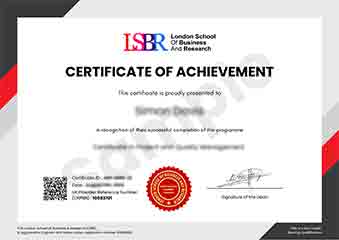
Sample Certificate
Preview the certificate you'll receive upon successful completion of this program.
Get Free Course Info
Enter your details and we'll send you a comprehensive course information pack straight to your inbox.
Employer Sponsored Training
Let your employer invest in your professional development. Request a corporate invoice and get your training funded.
Request Corporate InvoiceWhat People Say About Us
Hear from our students about their experience with the Executive Development Programme in Symbolic Logic for Data Analysis at LSBRX - Executive Education.
James Thompson
United Kingdom"The course provided a robust foundation in symbolic logic, which significantly enhanced my ability to analyze complex data sets. I gained practical skills that have already proven invaluable in my current role, allowing me to approach problems with a more structured and logical mindset."
Jack Thompson
Australia"The Executive Development Programme in Symbolic Logic for Data Analysis has significantly enhanced my ability to analyze complex data sets efficiently, making me more competitive in my field. This course has not only deepened my understanding of symbolic logic but also provided practical tools that I immediately applied to improve project outcomes at work."
Zoe Williams
Australia"The course structure was meticulously organized, providing a clear path from foundational concepts to advanced applications in data analysis, which significantly enhanced my understanding and practical skills in symbolic logic. The comprehensive content not only deepened my knowledge but also opened up new avenues for applying symbolic logic in real-world scenarios, fostering my professional growth."