
Global Certificate in Dynamic Systems Stability Optimization
This certificate equips professionals with advanced tools and techniques to optimize and ensure the stability of dynamic systems globally.
Global Certificate in Dynamic Systems Stability Optimization
Programme Overview
The Global Certificate in Dynamic Systems Stability Optimization is tailored for professionals in the fields of engineering, mathematics, and data science who seek to enhance their expertise in managing and optimizing complex dynamic systems. This program delves into advanced analytical techniques and computational methods necessary for understanding the behavior and stability of systems across various industries, including aerospace, automotive, and telecommunications. Participants will explore topics such as stability analysis, control theory, and optimization algorithms, all of which are critical for ensuring the reliable performance of dynamic systems.
Learners will develop a robust set of skills in mathematical modeling, system identification, and advanced computational modeling. This includes proficiency in using software tools for dynamic system simulation and optimization, as well as the ability to apply these tools to real-world problems. Through hands-on projects and case studies, participants will gain practical experience in analyzing and optimizing dynamic systems, preparing them to address complex challenges in their respective fields.
The program has a significant impact on career advancement, particularly for those in research and development, system design, and operational management roles. Graduates will be well-equipped to lead projects that require advanced stability optimization techniques, enhancing the reliability and efficiency of dynamic systems. This certification also opens doors to specialized roles such as systems analyst, dynamic systems engineer, and stability optimization specialist, where they can apply their skills to improve system performance and contribute to innovation in their industries.
What You'll Learn
The Global Certificate in Dynamic Systems Stability Optimization is a comprehensive, cutting-edge program designed for professionals seeking to enhance their skills in managing and optimizing the stability of complex systems. This program is ideal for engineers, data scientists, and analysts who work with dynamic systems in fields such as aerospace, automotive, finance, and renewable energy.
The curriculum covers essential topics including system dynamics, stability analysis, control theory, and optimization techniques. Students will learn to apply advanced mathematical models and computational tools to predict and mitigate system instabilities. Practical case studies and real-world projects will help participants understand how to implement these concepts in diverse industries.
Graduates of this program will be equipped to design, analyze, and optimize dynamic systems, ensuring their stability and reliability. They can also innovate in areas such as predictive maintenance, risk management, and real-time system monitoring. Career opportunities abound in roles such as system dynamics analyst, stability engineer, and optimization specialist, with potential for advancement in research and development, project management, and leadership positions.
This program is a gateway to a future where stability and efficiency are paramount in the design and operation of dynamic systems. It empowers professionals to drive innovation and contribute to the advancement of technology and industry.
Programme Highlights
Industry-Aligned Curriculum
Developed with industry leaders for job-ready skills valued by employers worldwide.
Globally Recognised Certificate
Recognised by employers across 180+ countries as a mark of professional excellence.
Flexible Online Learning
Study at your own pace with lifetime access to all course materials and updates.
Instant Access
Start learning immediately — no application process or waiting period required.
Constantly Updated Content
Stay ahead with the latest industry trends, best practices, and emerging insights.
Career Advancement
87% of graduates report measurable career progression within 6 months of completion.
Topics Covered
- 1. Introduction to Dynamic Systems: Learners will explore the basic concepts of dynamic systems, including state variables, system inputs, and outputs. They will gain foundational skills in analyzing and representing linear time-invariant systems.
- 2. Linear System Analysis: Learners will study mathematical models of linear dynamic systems, stability criteria, and frequency response methods. Practical skills include using MATLAB for system analysis and stability assessment.
- 3. Nonlinear Systems Fundamentals: This module covers the introduction to nonlinear dynamics, phase plane analysis, and stability analysis of nonlinear systems. Learners will develop skills in identifying and classifying equilibrium points and understanding the behavior of nonlinear systems.
- 4. Control System Design: Learners will learn various control design methods for linear and nonlinear systems, including PID control, state feedback, and observer design. Practical skills include designing controllers and observers for real-world systems.
- 5. Advanced Control Techniques: This module delves into advanced control strategies such as model predictive control, adaptive control, and robust control. Learners will gain expertise in implementing these techniques and analyzing their performance.
- 6. Optimization Methods for Dynamic Systems: Learners will study optimization techniques tailored for dynamic systems, including linear and nonlinear programming, and optimal control. Practical skills include formulating and solving optimization problems for system stability and performance improvement.
- 7. Stability Analysis of Complex Systems: This module focuses on stability analysis of interconnected and complex dynamic systems, including methods for stability verification and validation. Learners will develop skills in analyzing large-scale systems and understanding their stability properties.
- 8. Case Studies in Dynamic Systems Stability: Through real-world case studies, learners will apply stability optimization techniques to complex engineering problems. Practical skills include analyzing and solving practical stability issues in various industry sectors.
- 9. Advanced Topics in Dynamic Systems: This module covers cutting-edge topics such as stochastic systems, time-delay systems, and complex network dynamics. Learners will gain in-depth knowledge and skills in these advanced areas.
- 10. Final Project and Presentation: Learners will complete a comprehensive project on a topic of their choice, applying the skills and knowledge acquired throughout the programme. They will present their project findings and demonstrate their understanding of dynamic systems stability optimization.
What You Get When You Enroll
Secure checkout • Instant access • Certificate included
Key Facts
For professionals in control systems, engineering, and applied mathematics
Basic knowledge of linear algebra and differential equations
Understand stability analysis techniques for nonlinear systems
Apply advanced optimization methods to system design
Utilize simulation tools for stability assessment
Develop skills in mathematical modeling of dynamic systems
Ready to get started?
Join thousands of professionals who already took the next step. Enroll now and get instant access.
Enroll Now — $99Why This Course
Enhanced Expertise in System Optimization: Professions in engineering, finance, and data science can greatly benefit from a Global Certificate in Dynamic Systems Stability Optimization. This certification equips professionals with advanced tools and techniques for analyzing and optimizing complex systems, which can lead to more efficient operations and better decision-making processes.
Competitive Edge in the Job Market: As systems become more complex, the ability to optimize them for stability is becoming increasingly valuable. Holding this certificate can set professionals apart in the job market, particularly for roles that require a deep understanding of system dynamics and stability, such as data analysts, financial engineers, and system architects.
Career Advancement Opportunities: The skills gained from this certification can accelerate career progression. Employers are often looking for professionals who can not only maintain system stability but also innovate and adapt to new challenges. This certificate can open doors to senior-level positions where leadership and strategic oversight are key, such as Chief Technology Officers or System Stability Advisors.
Networking and Community Engagement: Participating in this program often involves interactions with experts and peers from diverse industries. This network can be invaluable for learning, collaboration, and career development. Engaging with a community of professionals dedicated to system optimization can provide insights and opportunities that are hard to find elsewhere.
Your Path to Certification
Trusted by Professionals Worldwide
Course Brochure
Download our comprehensive course brochure with all details
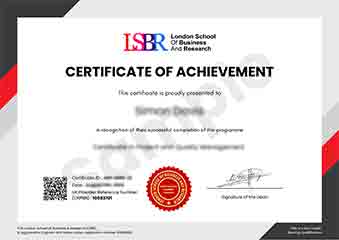
Sample Certificate
Preview the certificate you'll receive upon successful completion of this program.
Get Free Course Info
Enter your details and we'll send you a comprehensive course information pack straight to your inbox.
Employer Sponsored Training
Let your employer invest in your professional development. Request a corporate invoice and get your training funded.
Request Corporate InvoiceWhat People Say About Us
Hear from our students about their experience with the Global Certificate in Dynamic Systems Stability Optimization at LSBRX - Executive Education.
Charlotte Williams
United Kingdom"The course content is incredibly thorough, covering a wide range of topics that are directly applicable to real-world problems in system optimization. Gaining a solid foundation in these areas has significantly enhanced my ability to analyze and improve the stability of complex systems, which is invaluable for my career in engineering."
Kai Wen Ng
Singapore"This course has been incredibly valuable in enhancing my ability to analyze complex systems and optimize their stability, making me more competitive in the job market. The practical applications have directly translated into more effective solutions at work, leading to faster project completion and better outcomes."
Hans Weber
Germany"The course structure is well-organized, providing a comprehensive overview of dynamic systems stability optimization that seamlessly bridges theoretical concepts with real-world applications, significantly enhancing my understanding and professional growth in the field."