
Global Certificate in Optimizing Test Reliability Through Statistics
Strengthen your optimizing test reliability through statistics foundation with best practices and proven frameworks. Excel in complex business environments.
Global Certificate in Optimizing Test Reliability Through Statistics
Programme Overview
The Global Certificate in Optimizing Test Reliability Through Statistics is a comprehensive programme designed for professionals in the fields of psychology, education, market research, and social sciences who are looking to enhance their expertise in statistical methods for improving the reliability of assessments and tests. The programme delves into advanced statistical techniques, including classical test theory and item response theory, to provide participants with a robust framework for evaluating and refining test reliability.
Participants will develop key skills in analyzing test data using statistical software, interpreting reliability coefficients, and applying methods to optimize test items for reliability. They will also learn how to conduct validity studies, understand the implications of different types of reliability coefficients, and implement strategies for improving the consistency and accuracy of assessments. By the end of the programme, learners will be proficient in using statistical tools to enhance the reliability of their research and testing methodologies, ensuring more accurate and reliable outcomes.
The programme has a significant impact on careers by equipping professionals with the skills necessary to design, implement, and evaluate high-reliability assessments. Graduates can apply these skills in various roles, including psychometrician, research analyst, and testing specialist. They will be better prepared to contribute to the development of robust and reliable measurement tools, leading to enhanced credibility and effectiveness in their professional domains.
What You'll Learn
The Global Certificate in Optimizing Test Reliability Through Statistics is a comprehensive online program designed to empower professionals and researchers with advanced statistical techniques for enhancing the reliability of tests and assessments. This program equips participants with a robust understanding of statistical methods, including item analysis, test-retest reliability, and factor analysis, tailored to various fields such as education, psychology, and market research.
By delving into practical applications of statistical software like SPSS and R, participants learn to conduct rigorous analyses and interpret results to optimize test reliability. The curriculum includes case studies and real-world projects, enabling learners to apply statistical concepts to improve the validity and reliability of their own assessments.
Graduates of this program are well-prepared to advance in their careers by designing more effective tests, contributing to research that relies on reliable data, and improving educational and psychological evaluations. Career opportunities span from educational testing firms and research institutions to market research companies and consulting firms, where the skills learned can significantly enhance the quality and impact of assessments and evaluations.
Programme Highlights
Industry-Aligned Curriculum
Developed with industry leaders for job-ready skills valued by employers worldwide.
Globally Recognised Certificate
Recognised by employers across 180+ countries as a mark of professional excellence.
Flexible Online Learning
Study at your own pace with lifetime access to all course materials and updates.
Instant Access
Start learning immediately — no application process or waiting period required.
Constantly Updated Content
Stay ahead with the latest industry trends, best practices, and emerging insights.
Career Advancement
87% of graduates report measurable career progression within 6 months of completion.
Topics Covered
- 1. Introduction to Test Reliability and Statistical Concepts: Learners will understand the importance of reliability in testing and explore foundational statistical concepts necessary for optimizing test reliability. They will gain skills in defining reliability, types of reliability, and basic statistical measures.
- 2. Measurement Theory and Its Application in Testing: This module covers key measurement theory concepts such as validity, reliability, and error analysis. Learners will learn how to apply these theories in the context of test design and evaluation, enhancing their ability to create more reliable tests.
- 3. Classical Test Theory (CTT) and Item Analysis: Focusing on CTT, learners will study how to analyze test items using statistical methods. They will learn to calculate item difficulty, discrimination, and reliability estimates, preparing them to improve individual test items and overall test reliability.
- 4. Item Response Theory (IRT) Basics: Introducing IRT, learners will explore how item characteristics influence test performance and how IRT models can be used to refine test items and construct more effective tests. They will gain skills in understanding and applying IRT concepts.
- 5. Statistical Methods for Test Equating: This module covers various statistical techniques for equating tests, ensuring that scores are comparable across different test versions. Learners will learn to apply these methods to ensure fairness and consistency in test administration.
- 6. Advanced Reliability Analysis Techniques: Building on foundational concepts, learners will delve into advanced reliability analysis techniques, including internal consistency, parallel-forms reliability, and inter-rater reliability. They will gain practical skills in using these techniques to enhance test reliability.
- 7. Analyzing Test Bias and Fairness: This module focuses on identifying and mitigating test bias to ensure fairness and equity. Learners will study statistical methods for detecting and addressing issues related to test bias.
- 8. Technology-Enhanced Assessment Tools: Exploring the use of technology in assessment, learners will learn about modern tools and methods for enhancing test reliability. They will gain hands-on experience with software and platforms designed for creating and administering reliable tests.
- 9. Advanced Item Response Theory Models: Focusing on advanced IRT models, learners will explore how to apply these models to complex test designs and large-scale testing scenarios. They will learn to use IRT for test development and analysis in diverse educational settings.
- 10. Practical Applications and Case Studies: In this final module, learners will apply the knowledge and skills gained throughout the programme to real-world scenarios. Through case studies and practical exercises, they will gain experience in optimizing test reliability in various testing environments.
What You Get When You Enroll
Secure checkout • Instant access • Certificate included
Key Facts
Audience: Professionals in testing, research analysts
Prerequisites: Basic statistics knowledge
Outcomes: Enhanced reliability in test designs, improved analytic skills
Ready to get started?
Join thousands of professionals who already took the next step. Enroll now and get instant access.
Enroll Now — $99Why This Course
Enhance Skill Set: Obtaining the Global Certificate in Optimizing Test Reliability Through Statistics equips professionals with advanced statistical methods and analytical tools, crucial for improving test reliability and validity. This knowledge is particularly valuable in fields like psychology, education, and market research, where accurate and reliable test results are essential.
Career Advancement: The certificate demonstrates a deep understanding of statistical techniques and their application in enhancing test reliability. This can significantly boost career prospects, making professionals more competitive for roles that require strong analytical skills and expertise in data analysis.
Improved Test Quality: By mastering the methods taught in the certificate program, professionals can develop and refine tests that yield more consistent and accurate results. This not only improves the quality of the tests but also enhances the credibility of the organizations they work for, leading to potential cost savings and better outcomes.
Competitive Edge: In an increasingly data-driven world, the ability to optimize test reliability through statistical methods is a distinct advantage. This certificate provides professionals with a unique skill set that can set them apart in their field, opening up opportunities for leadership roles and advanced positions in areas such as research, quality control, and data analysis.
Your Path to Certification
Trusted by Professionals Worldwide
Course Brochure
Download our comprehensive course brochure with all details
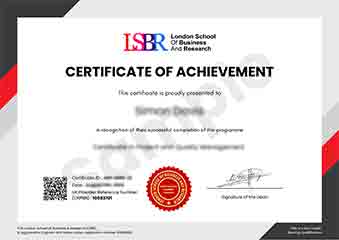
Sample Certificate
Preview the certificate you'll receive upon successful completion of this program.
Get Free Course Info
Enter your details and we'll send you a comprehensive course information pack straight to your inbox.
Employer Sponsored Training
Let your employer invest in your professional development. Request a corporate invoice and get your training funded.
Request Corporate InvoiceWhat People Say About Us
Hear from our students about their experience with the Global Certificate in Optimizing Test Reliability Through Statistics at LSBRX - Executive Education.
James Thompson
United Kingdom"The course provided deep insights into statistical methods for enhancing test reliability, equipping me with practical skills that are directly applicable in my field. Gaining a solid understanding of these techniques has significantly boosted my confidence in designing and analyzing assessments."
Kavya Reddy
India"This course has been incredibly valuable, equipping me with the statistical tools necessary to enhance the reliability of tests in my field. It has not only deepened my understanding of statistical methods but also provided me with practical insights that have directly contributed to my career advancement."
Kavya Reddy
India"The course structure is well-organized, providing a clear path from foundational statistical concepts to advanced techniques for enhancing test reliability, which has significantly broadened my understanding and practical skills in the field. The comprehensive content and real-world applications have been particularly beneficial for my professional growth, offering valuable insights that I can apply directly in my work."