
Postgraduate Certificate in Advanced Simulation Modeling with Python
Develop leadership capabilities in advanced simulation modeling with python management. Learn to guide teams and projects to success.
Postgraduate Certificate in Advanced Simulation Modeling with Python
Programme Overview
The Postgraduate Certificate in Advanced Simulation Modeling with Python is a specialized programme designed for professionals and advanced learners seeking to enhance their analytical and computational skills in the application of Python for complex simulation modeling. Ideal for individuals in fields such as engineering, data science, finance, and research, the programme equips participants with the ability to develop, implement, and optimize simulation models using Python, a powerful and versatile programming language.
Key among the skills and knowledge developed are proficiency in Python programming, understanding of advanced simulation techniques, and the ability to apply these models to real-world problems. Learners will master the use of Python libraries for numerical and scientific computing, as well as learn to integrate simulation models with databases and other software tools. The programme also emphasizes the importance of model validation, uncertainty analysis, and the ethical considerations in model application, ensuring that learners are well-prepared to tackle complex scenarios in their respective fields.
The programme has a profound impact on career trajectories, providing participants with the advanced competencies needed to lead in roles that require sophisticated modeling and data analysis. Graduates are well-positioned for advanced positions in research, development, and management, particularly in industries that rely on advanced simulation techniques for decision-making. The programme also facilitates further academic pursuits, such as enrolling in a master's or doctoral programme, or pursuing specialized certifications in related fields.
What You'll Learn
Explore the cutting-edge world of advanced simulation modeling with the Postgraduate Certificate in Advanced Simulation Modeling with Python. This intensive program equips you with the skills to harness Python for sophisticated modeling tasks, making it invaluable for professionals looking to enhance their analytical capabilities. Key topics include system dynamics, agent-based modeling, and optimization techniques, all tailored for real-world applications in fields such as finance, engineering, and environmental science.
Through hands-on projects and case studies, you will learn to develop and implement complex models using Python, a language known for its readability and extensive libraries. This program not only deepens your understanding of simulation techniques but also prepares you to analyze and predict outcomes in dynamic systems.
Graduates of this program are well-prepared for careers in data analysis, predictive modeling, and research. Potential roles include data scientist, simulation engineer, and modeler. Employers seek individuals who can leverage Python for innovative solutions, and this certificate positions you as a proficient practitioner in this domain. Join a community of professionals dedicated to advancing the application of simulation modeling in diverse industries.
Programme Highlights
Industry-Aligned Curriculum
Developed with industry leaders for job-ready skills valued by employers worldwide.
Globally Recognised Certificate
Recognised by employers across 180+ countries as a mark of professional excellence.
Flexible Online Learning
Study at your own pace with lifetime access to all course materials and updates.
Instant Access
Start learning immediately — no application process or waiting period required.
Constantly Updated Content
Stay ahead with the latest industry trends, best practices, and emerging insights.
Career Advancement
87% of graduates report measurable career progression within 6 months of completion.
Topics Covered
- 1. Introduction to Python for Scientific Computing: Learners will study the basics of Python programming and its libraries essential for scientific computing. They will gain practical skills in writing scripts, using data structures, and performing basic operations.
- 2. Fundamentals of Simulation Modeling: This module covers the core principles of simulation modeling, including types of simulations, model formulation, and validation techniques. Learners will develop a foundational understanding of how to design and implement simple simulation models.
- 3. Probability and Statistics for Simulation: Learners will delve into probability theory and statistical methods relevant to simulation modeling. They will gain skills in generating random variables, statistical analysis, and applying statistical tests to simulation outputs.
- 4. Discrete Event Simulation: This module explores discrete event simulation techniques and their applications. Learners will learn to model systems that change state at specific points in time, such as manufacturing lines, service centers, and traffic systems.
- 5. Agent-Based Modeling: Learners will study agent-based modeling approaches and their use in simulating complex systems. They will gain skills in creating and managing agent populations, defining agent behaviors, and analyzing emergent system dynamics.
- 6. Simulation Optimization Techniques: This module focuses on advanced optimization techniques for improving simulation models. Learners will learn methods such as genetic algorithms, Monte Carlo simulation, and sensitivity analysis to enhance model performance and decision-making.
- 7. Simulation Data Analysis and Visualization: This module covers techniques for analyzing and visualizing simulation data. Learners will develop skills in using Python libraries for data analysis and visualization, such as NumPy, Pandas, Matplotlib, and Seaborn, to interpret simulation results.
- 8. Parallel and Distributed Simulation: Learners will explore strategies for running large-scale simulations across multiple processors or distributed computing environments. They will gain skills in implementing parallel and distributed simulation models to handle complex and computationally intensive systems.
- 9. Real-World Case Studies and Applications: This module involves applying simulation modeling techniques to real-world problems in various industries. Learners will work on case studies, develop simulation models, and present their findings to demonstrate their understanding and practical skills.
- 10. Capstone Project: Learners will complete a comprehensive capstone project where they apply advanced simulation modeling techniques to solve a significant problem. This project will integrate knowledge and skills gained throughout the programme, culminating in a detailed simulation model and analysis.
What You Get When You Enroll
Secure checkout • Instant access • Certificate included
Key Facts
Audience: Professionals, researchers, data scientists
Prerequisites: Bachelor’s degree, basic Python knowledge
Outcomes: Advanced simulation, modeling skills, Python proficiency
Ready to get started?
Join thousands of professionals who already took the next step. Enroll now and get instant access.
Enroll Now — $149Why This Course
Enhanced Proficiency: This postgraduate certificate equips professionals with advanced skills in using Python for simulation and modeling. Python's robust libraries like NumPy, Pandas, and SciPy facilitate complex computations and data manipulation, significantly enhancing one's ability to handle sophisticated models.
Career Advancement: Acquiring this certification can elevate professionals to more specialized roles, such as data scientists, simulation engineers, or quantitative analysts. It opens doors to industries like finance, healthcare, and engineering, where advanced simulation and modeling are crucial.
Practical Application: The program emphasizes hands-on training with real-world applications, allowing professionals to apply theoretical knowledge to practical scenarios. This skill set is highly valued in the job market, where employers seek candidates capable of translating complex models into actionable insights.
Industry Relevance: The certificate aligns with current industry demands for professionals skilled in Python-based simulation and modeling. As businesses increasingly rely on data-driven decision-making, these skills become indispensable, providing professionals with a competitive edge in the job market.
Your Path to Certification
Trusted by Professionals Worldwide
Course Brochure
Download our comprehensive course brochure with all details
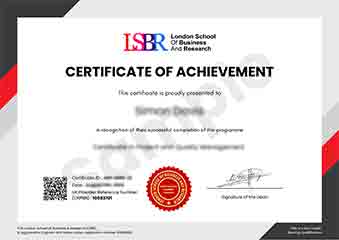
Sample Certificate
Preview the certificate you'll receive upon successful completion of this program.
Get Free Course Info
Enter your details and we'll send you a comprehensive course information pack straight to your inbox.
Employer Sponsored Training
Let your employer invest in your professional development. Request a corporate invoice and get your training funded.
Request Corporate InvoiceWhat People Say About Us
Hear from our students about their experience with the Postgraduate Certificate in Advanced Simulation Modeling with Python at LSBRX - Executive Education.
Oliver Davies
United Kingdom"The course content is exceptionally well-structured, providing a deep dive into advanced simulation techniques with Python, which has significantly enhanced my ability to model complex systems. I've gained practical skills that are directly applicable to real-world problems, making this certificate a valuable addition to my skill set."
Madison Davis
United States"This postgraduate certificate has significantly enhanced my ability to apply advanced simulation techniques in real-world scenarios, making my skills highly relevant in the industry. It has opened up new opportunities for career advancement, particularly in roles that require sophisticated data analysis and modeling capabilities."
Liam O'Connor
Australia"The course structure is well-organized, providing a comprehensive foundation in advanced simulation modeling with Python, which has significantly enhanced my ability to apply these techniques in real-world scenarios, fostering my professional growth in data analysis and modeling."