
Professional Certificate in Data Interpretation
Elevate your data analysis skills with this certificate, enhancing your ability to interpret data effectively and make informed decisions.
Professional Certificate in Data Interpretation
Programme Overview
The Professional Certificate in Data Interpretation is a comprehensive program designed for professionals in various industries who seek to enhance their analytical skills and gain a deeper understanding of data-driven decision-making. Targeted at individuals in roles such as data analysts, business intelligence specialists, and data scientists, the program equips learners with the necessary tools and knowledge to transform raw data into actionable insights.
Throughout the course, learners will develop a robust set of skills including statistical analysis, data visualization, predictive modeling, and critical thinking. They will learn to use advanced analytics software and tools, interpret complex data sets efficiently, and communicate findings effectively to stakeholders. The curriculum also emphasizes the ethical considerations in data interpretation and the importance of data privacy and security.
The certificate significantly impacts career progression by enabling professionals to take on more complex roles that require data-driven decision-making. Graduates are well-prepared to lead data projects, optimize business strategies, and drive innovation within their organizations. The program also enhances their ability to navigate the ever-evolving landscape of data technologies and methodologies, ensuring they remain competitive in the job market.
What You'll Learn
The Professional Certificate in Data Interpretation is a comprehensive program designed to equip professionals with the skills necessary to extract meaningful insights from complex data sets. Ideal for those in business, healthcare, technology, and social sciences, this program offers a blend of theoretical knowledge and practical applications, ensuring that participants can effectively communicate data-driven conclusions.
Key topics include statistical analysis, data visualization, predictive modeling, and data ethics. Participants learn to use advanced tools like Python, R, and SQL to manipulate and analyze large datasets. Through hands-on projects and case studies, learners gain experience in interpreting data to inform strategic decision-making in their respective fields.
Graduates of this program are well-prepared to transform raw data into actionable insights that drive innovation and efficiency. They can apply their skills in areas such as market research, financial analysis, healthcare analytics, and operations management. The program also emphasizes the importance of ethical considerations in data interpretation, ensuring that graduates are mindful of the implications of their work.
Upon completion, participants will have the credentials and practical experience needed to advance in their careers or transition into data analysis roles. Career opportunities include data analyst, business intelligence specialist, data scientist, and quantitative analyst. The program's focus on contemporary tools and methodologies ensures that graduates are well-positioned to succeed in today’s data-driven job market.
Programme Highlights
Industry-Aligned Curriculum
Developed with industry leaders for job-ready skills valued by employers worldwide.
Globally Recognised Certificate
Recognised by employers across 180+ countries as a mark of professional excellence.
Flexible Online Learning
Study at your own pace with lifetime access to all course materials and updates.
Instant Access
Start learning immediately — no application process or waiting period required.
Constantly Updated Content
Stay ahead with the latest industry trends, best practices, and emerging insights.
Career Advancement
87% of graduates report measurable career progression within 6 months of completion.
Topics Covered
- 1. Introduction to Data Interpretation: Learners will explore the basics of data interpretation, including types of data, data visualization techniques, and foundational statistical concepts. They will gain practical skills in understanding and interpreting basic data sets.
- 2. Descriptive Statistics: This module delves into measures of central tendency and dispersion, frequency distributions, and graphical representations of data. Learners will develop skills in summarizing and presenting data effectively.
- 3. Inferential Statistics: Here, learners will study hypothesis testing, confidence intervals, and various statistical tests like t-tests and ANOVA. They will learn how to make inferences about populations based on sample data.
- 4. Data Visualization Tools: This module focuses on using tools like Tableau, Power BI, and Python libraries (such as Matplotlib and Seaborn) for data visualization. Learners will gain hands-on experience creating effective visualizations.
- 5. Advanced Data Cleaning Techniques: Learners will cover advanced methods for data cleaning, including handling missing values, outliers, and inconsistent data. They will learn to use programming languages like Python and R for data cleaning tasks.
- 6. Predictive Analytics: This module introduces learners to predictive modeling techniques, including regression analysis, time series analysis, and machine learning algorithms. They will develop skills in building predictive models and interpreting model outputs.
- 7. Data Interpretation in Business Contexts: Here, learners will apply data interpretation skills to real-world business scenarios. They will learn how to interpret data to inform strategic business decisions and improve operational efficiency.
- 8. Advanced Statistical Methods: This advanced module covers topics such as multivariate analysis, Bayesian statistics, and advanced machine learning techniques. Learners will deepen their understanding of complex statistical methods and their applications.
- 9. Ethical Considerations in Data Interpretation: This module explores ethical issues related to data interpretation, including privacy concerns, bias in algorithms, and the responsible use of data. Learners will gain insights into ethical practices in data analysis.
- 10. Capstone Project: Learners will work on a comprehensive project that integrates all the skills and knowledge gained throughout the programme. They will analyze a real dataset, interpret the findings, and present their conclusions.
What You Get When You Enroll
Secure checkout • Instant access • Certificate included
Key Facts
Audience: Data analysts, business professionals
Prerequisites: Basic statistics knowledge
Outcomes: Proficient data analysis, interpretation skills
Ready to get started?
Join thousands of professionals who already took the next step. Enroll now and get instant access.
Enroll Now — $149Why This Course
Enhance Analytical Skills: Gaining a Professional Certificate in Data Interpretation helps professionals develop robust analytical skills. This certification teaches the techniques and tools necessary to extract meaningful insights from complex data sets, which are crucial in today's data-driven business environments. For instance, data analysts can use these skills to uncover trends, predict outcomes, and inform strategic business decisions.
Career Advancement: Acquiring this certification can open up advanced career opportunities. Many companies seek professionals with data interpretation skills to fill roles such as data analysts, business intelligence specialists, and data scientists. A certificate in this field can set individuals apart in the job market, leading to higher job security and potential for increased salaries.
Boost Decision-Making Abilities: The certificate equips professionals with the ability to make informed decisions based on data. This is particularly valuable in industries like finance, healthcare, and marketing, where data-driven decisions can significantly impact outcomes. For example, a healthcare professional who can interpret data effectively can improve patient care and treatment plans, leading to better health outcomes.
Competitive Edge in the Job Market: In a world where data is increasingly central to business operations, having a Professional Certificate in Data Interpretation provides a competitive edge. It demonstrates to employers that the candidate has the necessary skills to handle and analyze data efficiently. This can be especially advantageous in roles that require rigorous data analysis, such as market research, product development, and risk management.
Your Path to Certification
Trusted by Professionals Worldwide
Course Brochure
Download our comprehensive course brochure with all details
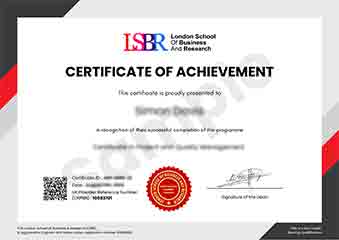
Sample Certificate
Preview the certificate you'll receive upon successful completion of this program.
Get Free Course Info
Enter your details and we'll send you a comprehensive course information pack straight to your inbox.
Employer Sponsored Training
Let your employer invest in your professional development. Request a corporate invoice and get your training funded.
Request Corporate InvoiceWhat People Say About Us
Hear from our students about their experience with the Professional Certificate in Data Interpretation at LSBRX - Executive Education.
Charlotte Williams
United Kingdom"The course content is incredibly thorough and well-structured, providing a solid foundation in data interpretation that has significantly enhanced my analytical skills. I've gained practical skills that are directly applicable in my role, making me more efficient and valuable in my current position."
Ahmad Rahman
Malaysia"This course has been incredibly valuable, equipping me with the skills to analyze complex data sets and derive actionable insights that are directly applicable in my role. It has not only enhanced my professional toolkit but also opened up new opportunities for career growth in data-driven industries."
Jia Li Lim
Singapore"The course structure is well-organized, providing a clear path from basic concepts to advanced data interpretation techniques, which has significantly enhanced my ability to analyze and apply data in real-world scenarios, fostering my professional growth."