
Professional Certificate in Reliability Engineering for Software Projects
Elevate your skills in ensuring software project reliability with this certificate, offering expertise in risk management, testing, and maintenance.
Professional Certificate in Reliability Engineering for Software Projects
Programme Overview
The Professional Certificate in Reliability Engineering for Software Projects is designed to equip professionals with the knowledge and skills required to ensure robust, reliable, and maintainable software systems. This programme caters to software engineers, project managers, quality assurance specialists, and anyone involved in the development and deployment of software products who seek to enhance their expertise in reliability engineering. The curriculum covers a wide range of topics, including fault tolerance, reliability modeling, testing methodologies, and continuous integration practices, providing a comprehensive understanding of the principles and techniques essential for achieving high reliability in software projects.
Participants will develop key skills such as analyzing system components for potential failure points, implementing reliability-centered design practices, conducting reliability testing and analysis, and integrating reliability measures into the software development lifecycle. They will also learn to leverage modern tools and technologies that support reliability engineering, such as reliability analysis software and cloud-based monitoring solutions. These competencies enable learners to design, develop, and maintain software systems that meet stringent reliability standards, thereby improving product quality and customer satisfaction.
The career impact of this programme is significant, as it opens up advanced roles in software reliability engineering, project management, and quality assurance. Graduates can contribute to the reliability and stability of complex software systems, ensuring that they are resilient to failures and can operate with minimal downtime. This programme also positions professionals to lead reliability initiatives, manage risk, and drive innovation in the software development process, ultimately contributing to the success and longevity of software projects in their organizations.
What You'll Learn
The Professional Certificate in Reliability Engineering for Software Projects is designed to equip professionals with the skills necessary to ensure the robustness, availability, and performance of software systems. This comprehensive program delves into key areas such as reliability assessment, failure analysis, and system design to enhance the quality and longevity of software applications. Participants will learn to implement reliability engineering principles using modern tools and techniques, enabling them to predict and mitigate potential issues before they impact users.
By completing this program, graduates will be able to apply their knowledge to improve software reliability in various industries, from fintech to healthcare, where software performance can directly affect user safety and business outcomes. They will gain hands-on experience in conducting reliability testing, integrating reliability metrics into development processes, and optimizing software to prevent failures.
This certificate opens doors to advanced roles such as Senior Software Engineer, Reliability Lead, or Quality Assurance Manager. Graduates will be well-prepared to lead teams in ensuring the reliability of complex software systems, contributing to safer, more effective digital solutions.
Programme Highlights
Industry-Aligned Curriculum
Developed with industry leaders for job-ready skills valued by employers worldwide.
Globally Recognised Certificate
Recognised by employers across 180+ countries as a mark of professional excellence.
Flexible Online Learning
Study at your own pace with lifetime access to all course materials and updates.
Instant Access
Start learning immediately — no application process or waiting period required.
Constantly Updated Content
Stay ahead with the latest industry trends, best practices, and emerging insights.
Career Advancement
87% of graduates report measurable career progression within 6 months of completion.
Topics Covered
- 1. Fundamentals of Reliability Engineering: Learners will study basic principles of reliability engineering and its importance in software projects, including failure modes and effects analysis (FMEA). They will gain an understanding of how to apply these principles to enhance software reliability.
- 2. Statistical Methods for Reliability Analysis: This module covers statistical techniques used in reliability analysis, such as probability distributions, confidence intervals, and hypothesis testing. Learners will acquire skills in using statistical methods to evaluate and improve software reliability.
- 3. Design for Reliability: Learners will explore strategies and techniques for designing software systems with reliability in mind. They will study how to identify and mitigate system vulnerabilities, and how to implement reliability-centered design practices.
- 4. Reliability Testing and Validation: This module focuses on methods for testing and validating software reliability, including test planning, test case development, and performance metrics. Learners will learn how to conduct comprehensive reliability testing and interpret test results.
- 5. Failure Modes and Effects Analysis (FMEA): An in-depth look at FMEA techniques, including single and multi-stage FMEA. Learners will practice identifying potential failure modes, their effects on system performance, and developing strategies to mitigate these risks.
- 6. Reliability-Centered Maintenance (RCM): This module introduces RCM principles and practices, including risk-based maintenance strategies and predictive maintenance techniques. Learners will understand how to integrate RCM into software development and maintenance processes.
- 7. Reliability Metrics and KPIs: Learners will study various reliability metrics and key performance indicators (KPIs) used in software projects. They will learn how to track and report reliability metrics effectively to stakeholders.
- 8. Case Studies in Reliability Engineering: Through real-world case studies, learners will analyze successful and unsuccessful reliability engineering implementations in software projects. They will gain insights into practical challenges and solutions in reliability engineering.
- 9. Advanced Reliability Techniques: This advanced module covers specialized reliability techniques, such as reliability growth testing and reliability prediction models. Learners will develop skills in applying these techniques to complex software systems.
- 10. Reliability Engineering Leadership: In this final module, learners will focus on leadership skills in the context of reliability engineering. They will learn how to lead teams, manage reliability projects, and influence organizational reliability practices.
What You Get When You Enroll
Secure checkout • Instant access • Certificate included
Key Facts
For professionals in tech and engineering
No prior certification required
Understand reliability engineering principles
Analyze and manage software risks
Implement reliability improvement strategies
Create reliability-centered maintenance plans
Ready to get started?
Join thousands of professionals who already took the next step. Enroll now and get instant access.
Enroll Now — $149Why This Course
Enhance Expertise and Competence: Obtaining a Professional Certificate in Reliability Engineering for Software Projects can significantly enhance an individual's expertise in software reliability, a critical aspect of modern software development. This certification demonstrates a deep understanding of the methodologies and tools essential for ensuring software reliability, which is crucial for maintaining system stability and preventing costly downtime.
Boost Career Opportunities: With the increasing demand for reliable software solutions, professionals holding this certificate are better positioned to advance in their careers. Employers often seek candidates who can prove their commitment to quality and reliability, making this certification a valuable asset in the job market. It can lead to higher job security and potential for leadership roles, especially in industries heavily reliant on software systems.
Improved Problem-Solving Skills: The course content covers various techniques for identifying and mitigating software risks, which helps professionals develop robust problem-solving skills. These skills are invaluable in real-world scenarios where software reliability issues can arise unpredictably. The hands-on experience and practical knowledge gained through the certification can translate into more effective and efficient solutions, contributing to better project outcomes.
Your Path to Certification
Trusted by Professionals Worldwide
Course Brochure
Download our comprehensive course brochure with all details
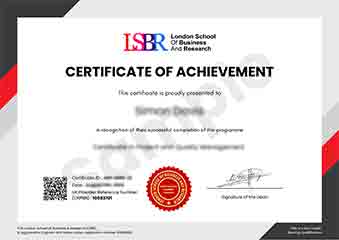
Sample Certificate
Preview the certificate you'll receive upon successful completion of this program.
Get Free Course Info
Enter your details and we'll send you a comprehensive course information pack straight to your inbox.
Employer Sponsored Training
Let your employer invest in your professional development. Request a corporate invoice and get your training funded.
Request Corporate InvoiceWhat People Say About Us
Hear from our students about their experience with the Professional Certificate in Reliability Engineering for Software Projects at LSBRX - Executive Education.
Sophie Brown
United Kingdom"The course provided in-depth material that significantly enhanced my understanding of reliability engineering principles, particularly in software projects. I gained practical skills that are directly applicable to improving software quality and reducing risks in development processes, which I believe will be invaluable in my career."
Anna Schmidt
Germany"This course has been instrumental in bridging the gap between theoretical concepts and practical applications in software reliability. It has not only enhanced my technical skills but also provided me with a competitive edge, opening up new opportunities for career advancement in the tech industry."
Ruby McKenzie
Australia"The course structure is well-organized, providing a clear path from foundational concepts to advanced topics in reliability engineering, which has significantly enhanced my understanding and ability to apply these principles in real-world software projects."