
Professional Certificate in Statistical Process Control Techniques
Elevate skills in Statistical Process Control Techniques, ensuring quality management excellence and process optimization.
Professional Certificate in Statistical Process Control Techniques
Programme Overview
The Professional Certificate in Statistical Process Control Techniques is designed to equip professionals with the essential skills needed to manage and improve the quality of processes in manufacturing, healthcare, finance, and other industries. This program is ideal for quality managers, production engineers, data analysts, and process improvement specialists who seek to enhance their ability to use statistical methods to monitor and control process performance effectively. The curriculum is structured to provide a comprehensive understanding of statistical process control (SPC) methodologies, including control charts, process capability analysis, and hypothesis testing, among others.
Participants will develop key skills such as the ability to apply SPC tools to identify process variability, assess process performance, and implement corrective actions to minimize defects and improve efficiency. The course also emphasizes the importance of data interpretation and analysis, enabling learners to make informed decisions that lead to process optimization and cost reduction. Furthermore, attendees will gain proficiency in using statistical software for data analysis and will learn to communicate SPC results effectively to stakeholders.
The career impact of this program is significant, as it prepares professionals to lead quality improvement initiatives, enhance process efficiency, and contribute to the continuous improvement of organizational performance. Graduates are well-equipped to take on roles that require advanced statistical process control knowledge, leading to opportunities for career advancement and higher job satisfaction in various sectors that rely on quality control and process optimization.
What You'll Learn
The Professional Certificate in Statistical Process Control Techniques equips professionals with the essential skills to enhance operational efficiency and quality in manufacturing, healthcare, software development, and more. This comprehensive program covers key topics such as process capability analysis, control charts, statistical process control (SPC) tools, and root cause analysis, providing a solid foundation in both theory and practical application. By integrating real-world case studies and hands-on exercises, participants learn to apply statistical methods to identify and mitigate process variations, leading to improved product quality and reduced waste.
Graduates of this program are well-prepared to implement SPC techniques in various industries, optimizing production processes, and streamlining workflows. They can also lead quality assurance teams, conduct data-driven improvement initiatives, and enhance customer satisfaction through consistent product quality. Career opportunities include roles such as Quality Control Analyst, Process Engineer, Six Sigma Black Belt, and Quality Assurance Manager. This certificate not only boosts employability but also enables professionals to drive significant improvements in their organizations, contributing to long-term success and innovation.
Programme Highlights
Industry-Aligned Curriculum
Developed with industry leaders for job-ready skills valued by employers worldwide.
Globally Recognised Certificate
Recognised by employers across 180+ countries as a mark of professional excellence.
Flexible Online Learning
Study at your own pace with lifetime access to all course materials and updates.
Instant Access
Start learning immediately — no application process or waiting period required.
Constantly Updated Content
Stay ahead with the latest industry trends, best practices, and emerging insights.
Career Advancement
87% of graduates report measurable career progression within 6 months of completion.
Topics Covered
- 1. Introduction to Statistical Process Control (SPC): Learners will study the basic principles of SPC, its importance in quality management, and the foundational concepts such as process variation, control charts, and statistical process capability. They will gain skills in recognizing and analyzing process data to identify variations and trends.
- 2. Control Charts for Variables: This module covers the use of X-bar and R charts, I-MR charts, and moving range charts to monitor and control variable data over time. Learners will learn how to plot and interpret these charts to detect process shifts and improvements.
- 3. Control Charts for Attributes: Focusing on p-charts, np-charts, c-charts, and u-charts, this module teaches learners to monitor and control attribute data. They will understand how to apply these tools to count data and assess the stability of processes.
- 4. Process Capability Analysis: In this module, learners will explore how to measure process performance using capability indices such as Cp, Cpk, Pp, and Ppk. They will learn to determine if a process is capable of meeting specification limits and how to improve process performance.
- 5. Advanced Control Chart Techniques: This module delves into more complex control chart methodologies, including multivariate control charts and adaptive control charts. Learners will gain the skills to handle multivariate data and adjust control limits dynamically based on process changes.
- 6. Process Control and Improvement Strategies: This module covers various strategies for process improvement, including the use of statistical tools like regression analysis and DOE (Design of Experiments). Learners will learn to identify root causes of process variations and implement corrective actions.
- 7. Total Productive Maintenance (TPM) and SPC: Focusing on the integration of TPM principles with SPC, this module teaches learners how to improve equipment reliability and reduce waste through proactive maintenance and process monitoring.
- 8. Statistical Process Control in Lean Six Sigma: This module explores the role of SPC in Lean Six Sigma projects, covering how to integrate SPC with process mapping, value stream mapping, and other Lean Six Sigma tools to achieve continuous improvement.
- 9. Software Tools for SPC: In this module, learners will become proficient in using SPC software tools and statistical analysis packages to collect, analyze, and present process data. They will learn to utilize these tools to automate SPC charting and reporting.
- 10. Leadership and Communication in SPC Implementation: This final module focuses on the leadership and communication skills necessary to implement and maintain SPC systems effectively. Learners will learn to lead cross-functional teams, communicate SPC findings, and drive process improvements throughout an organization.
What You Get When You Enroll
Secure checkout • Instant access • Certificate included
Key Facts
For quality assurance professionals
No prior certification required
Understands SPC methodologies
Implements statistical techniques
Analyzes process variations
Improves quality control processes
Ready to get started?
Join thousands of professionals who already took the next step. Enroll now and get instant access.
Enroll Now — $149Why This Course
Enhance Analytical Skills: Obtaining a Professional Certificate in Statistical Process Control (SPC) Techniques equips professionals with robust analytical skills. This includes understanding how to interpret data and apply statistical tools to identify variations in processes. For instance, proficiency in SPC techniques can help in minimizing defects and improving product quality, which is crucial in manufacturing and service industries.
Drive Continuous Improvement: SPC techniques focus on identifying areas for process improvement and monitoring these changes over time. By mastering these techniques, professionals can contribute to the continuous improvement of organizational processes. For example, a healthcare professional might use SPC to track patient wait times and implement strategies to reduce them, thereby enhancing patient satisfaction and operational efficiency.
Gain Competitive Edge: In a competitive job market, professionals with specialized certifications like SPC are in high demand. SPC skills are particularly valuable in industries like quality assurance, manufacturing, and healthcare. These skills can help in reducing costs, improving quality, and enhancing customer satisfaction, making certified individuals more attractive to employers.
Your Path to Certification
Trusted by Professionals Worldwide
Course Brochure
Download our comprehensive course brochure with all details
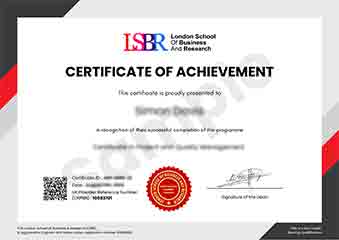
Sample Certificate
Preview the certificate you'll receive upon successful completion of this program.
Get Free Course Info
Enter your details and we'll send you a comprehensive course information pack straight to your inbox.
Employer Sponsored Training
Let your employer invest in your professional development. Request a corporate invoice and get your training funded.
Request Corporate InvoiceWhat People Say About Us
Hear from our students about their experience with the Professional Certificate in Statistical Process Control Techniques at LSBRX - Executive Education.
Charlotte Williams
United Kingdom"The course provided comprehensive and well-structured content that significantly enhanced my understanding of statistical process control techniques, equipping me with practical skills to analyze and improve manufacturing processes. Gaining this knowledge has been invaluable for my career in quality assurance, offering me a competitive edge in the job market."
Charlotte Williams
United Kingdom"The Professional Certificate in Statistical Process Control Techniques has significantly enhanced my ability to analyze and improve manufacturing processes, making me more valuable in my current role and opening up new career opportunities in quality control and management. This course has bridged the gap between theoretical knowledge and practical application, equipping me with tools that are directly applicable in the industry."
Tyler Johnson
United States"The course structure is well-organized, providing a clear path from basic statistical concepts to advanced process control techniques, which greatly enhances my understanding and application in real-world scenarios. It has been instrumental in my professional growth, offering a comprehensive toolkit for analyzing and improving processes in my industry."